
After the research in Shenzhen, Goldman Sachs outlined the main lines of AI infrastructure investment in China: high-power power supplies, ASIC liquid cooling, and 800V DC power
The Zhitong Finance App learned that just as the US AI computing power theme and semiconductor sector plummeted last week to a massive rebound during Monday's trading session, Goldman Sachs's latest data center research report shows that the Wall Street financial giant has seen a series of major AI infrastructure investment opportunities in China's AI data center industry chain.
Goldman Sachs stressed that huge on-hand orders and project reserves for electrical equipment in US data centers still strongly support AI computing power resource requirements from 2027 to 2028, and AI infrastructure-related equipment orders and projects will also be extended to 2027-2028. At the same time, the AI data center construction process of Chinese cloud vendors continues to accelerate. Coupled with the expansion of Southeast Asian data center parks, the expansion of data center parks in Southeast Asia has jointly broadened the customer base for core AI infrastructure participants and a wide range of hardware equipment suppliers related to AI data center construction in China.
Goldman Sachs's research report shows that the major opportunities the agency saw in China's AI data center industry chain came from two increments that were fulfilled at different times: high-power power supplies and liquid cooling orders for AI ASIC computing power clusters under the existing architecture, and new demand for data center-related equipment and components after the gradual popularization of 800V DC power supply.
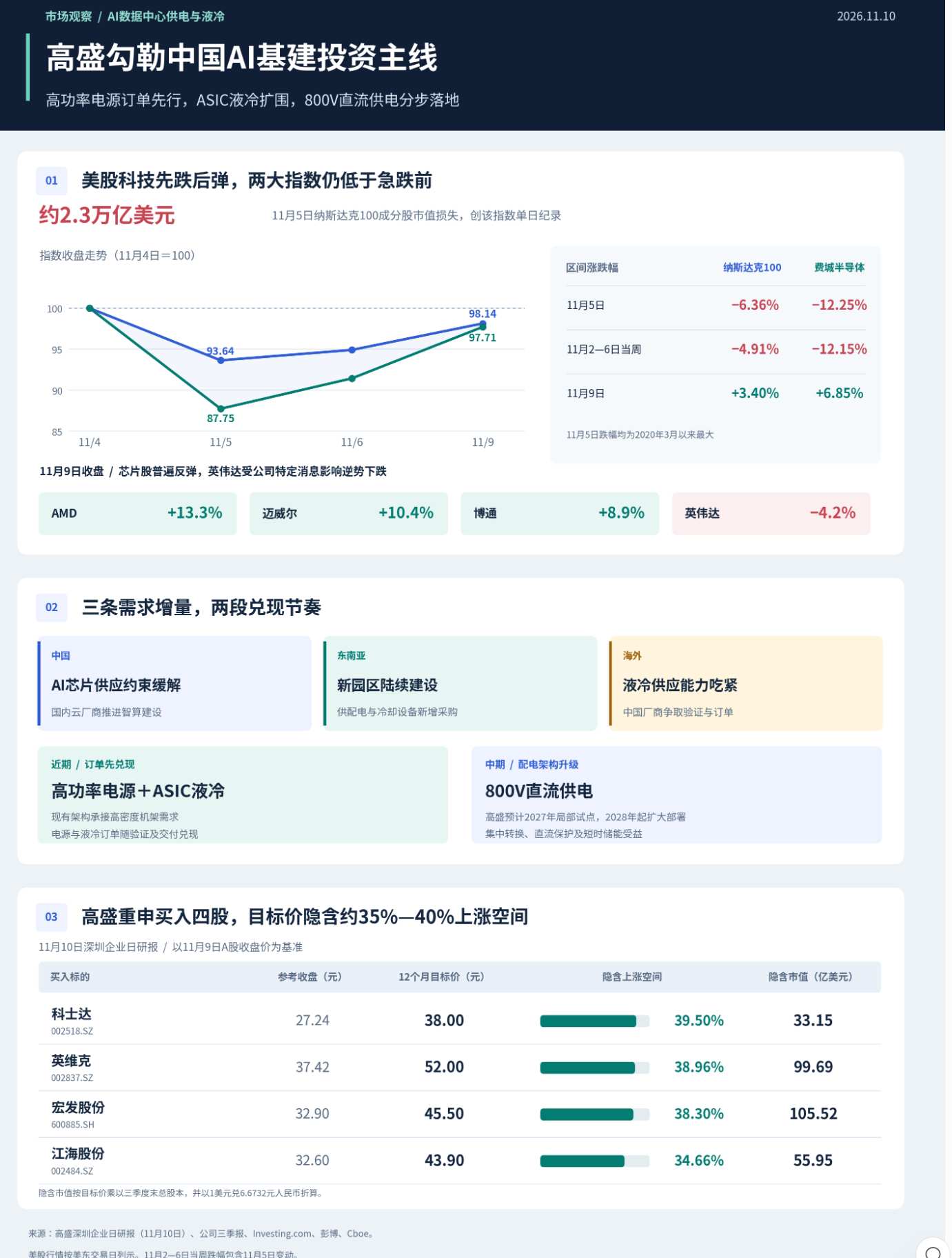
On November 5, EST, the NASDAQ 100 fell sharply by 6.36%, and the Philadelphia Semiconductor Index plummeted by 12.25%, all of which were the biggest one-day declines since March 2020. The total amount of NASDAQ's 100 constituent stocks evaporated about 2.3 trillion US dollars, setting a record for the index's loss in market value in a single day. The two major indices fell 4.91% and 12.15% respectively last week. They initially stabilized on Friday and rebounded by 3.40% and 6.85% respectively on November 9, still below the closing level on November 4. Technology stocks generally rebounded on Monday. AMD, Maywell, and Broadcom, the shares of the AI computing power industry chain leaders rose sharply by about 13.3%, 10.4%, and 8.9%, respectively, while Nvidia fell by about 4.2% due to company-specific news.
After the Democratic Party gained control of the Senate and House of Representatives, investors re-evaluated changes in AI safety supervision, data center electricity cost sharing, and project approval. For overvalued AI computing power topics and semiconductor stocks focusing on AI infrastructure, once construction and delivery are delayed, the fulfillment time for trillion-dollar AI chips, a wide range of AI infrastructure orders, and even the actual return on investment in data centers will be delayed, amplifying this change in expectations. Monday's rebound reflects that the market is beginning to distinguish some AI data center project delays and capital expenditure cycle reversals to some extent. Morgan Stanley believes that some projects may be postponed from 2028 to 2029. The extension does not necessarily mean the end of the AI capital expenditure cycle; UBS also believes that the market is too pessimistic about pricing the risks of politics, credit spreads, and return on expenditure.
For core AI infrastructure participants in China focusing on the AI data center construction process, Goldman Sachs analysts emphasized that the most noteworthy things are the massive expansion of the global customized AI ASIC chip supply chain, the acceleration of the construction process of major Chinese cloud computing cloud vendors, and new procurement brought about by Southeast Asian projects. Whether verification of overseas computing power and power chain demand can be converted into batch supply and on-hand orders into revenue and gross profit determines whether stock price adjustments provide an attractive buying point.
High power supply, ASIC liquid cooling, and 800V DC power supply
Goldman Sachs's November 10 research report is based on detailed internal exchanges with Costa, Megmeet, Eurocom, Shenghong Co., Ltd. and a liquid cooling industry expert on the Shenzhen Enterprise Day in early November. At the time of the interview, ongoing orders and project reserves in the US and North American markets were still strong. Some orders could be seen until 2027-2028. At the same time, domestic AI chip supply restrictions were eased, construction of a new Southeast Asia park, and overseas liquid cooling production capacity was tight, opening up three incremental paths for Chinese suppliers.
As a result, Goldman Sachs reiterated its “purchase” of Costa (002518.SZ), Invec (002837.SZ), Hongfa (600885.SH), and Jianghai (002484.SZ), which are respectively optimistic about the order and profit margins of the mature power supply business, the increase in ASIC liquid cooling volume, the share of relays and integrated modules, and the increase in the share of AI capacitor products. Megmeet (002851.SZ) and Kehua Data (002335.SZ) maintain a “neutral” investment rating, while the 12-month target prices are 102.90 yuan and 28.00 yuan, respectively.
Goldman Sachs said that recently, China's AI data center chain mainly depends on the fulfillment of orders for high-power power supplies and ASIC liquid cooling. In the medium term, 800V DC power supply changes the value distribution of equipment. The current power supply architecture can handle higher power racks. The 5 kilowatt power module developed by Continental Connect for Google's custom chip project has entered the early production stage. The target is to deliver about 10,000 modules to Google for testing in the fourth quarter of 2026. Mass production is expected to begin in the first half of 2027. Meanwhile, overseas liquid cooling production capacity is tight, creating opportunities for Chinese manufacturers to enter the coolant distribution unit (CDU) and cold plate supply chain.
Goldman Sachs said in the research report that experts interviewed estimated that the liquid cooling demand for ASIC platforms in 2027 is about 10.9 billion US dollars, which is close to the 11.6 billion US dollars of Nvidia platforms. In the longer term, 800V DC power supply can reduce transmission current at the same power, and shift the value of some equipment from in-cabinet rectification to centralized conversion, DC protection, and short-term energy storage. Goldman Sachs expects to focus on local pilots in 2027 and expand deployment in 2028 and beyond.
Goldman Sachs emphasized that as the power of a single cabinet continues to rise, 800V DC power supply can reduce transmission current at the same power, and shift the value of some equipment from in-cabinet rectification to centralized conversion, DC protection, and short-term energy storage. Goldman Sachs expects to focus on local pilots in 2027 and expand deployment in 2028 and beyond. This also explains the profit observation points of each of the four shares purchased: Costa looks at power supply orders and overseas gross profit; Invek looks at ASIC liquid cooling from verification to batch delivery; Hongfa Co., Ltd. and Jianghai Co., Ltd. look at the consumption of relays and integrated modules, capacitors, and short-term energy storage in a single cabinet, respectively.
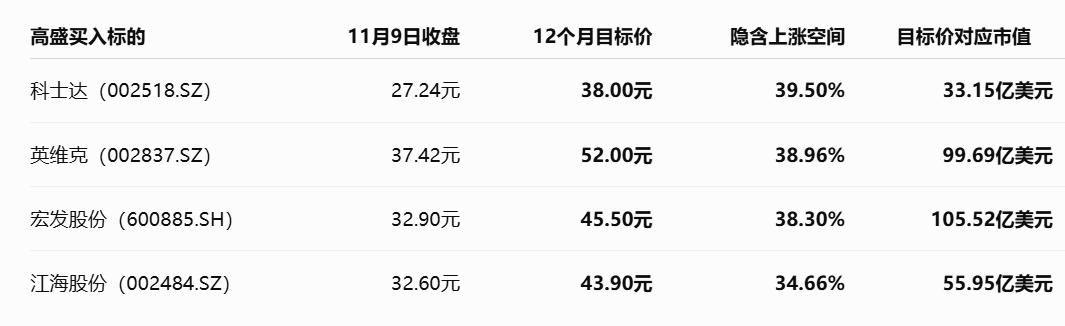
In the Shenzhen Enterprise Daily Research Report released on November 10, Goldman Sachs reiterated its optimistic “buy” rating for Costa, Invec, Hongfa Co., and Jianghai shares. The target prices for 12 months were 38.00 yuan, 52.00 yuan, 45.50 yuan, and 43.90 yuan, respectively. Based on the closing price on November 9, the target prices for the four shares implied potential growth of 39.50%, 38.96%, 38.30%, and 34.66%, respectively. Based on a static estimate of the total share capital at the end of the third quarter and the exchange rate of RMB against the US dollar on November 9, the corresponding market values were approximately $3.315 billion, $9,969 billion, $10.552 billion, and US$5.595 billion, respectively.
Orders are fulfilled before replacement, ASIC opens up new markets for power supply and liquid cooling
Goldman Sachs research reports that the current structure will still support shipments over the next two years. Market reports quoted by Goldman Sachs point to ByteDance's 2027-2028 AI data center construction plan of about 5-6 GW. Google, on the other hand, has announced an investment of 15 billion US dollars in Malaysia during the same period, covering data center parks, clean electricity, water, and talent projects. On the equipment side, Megmeet expects demand for Grace Blackwell power racks to continue, Vera Rubin power racks to gradually contribute revenue, and aim to obtain batch orders for AC side load fluctuation compensators (AC EDPP) from at least three global customers in 2027.
Eurocom's power rack for Google uses six 5kW modules, compatible with AC and ±400V DC inputs. It plans to deliver about 10,000 power modules for testing in the fourth quarter, with the goal of mass production in the first half of 2027. Shenghong's medium-voltage uninterruptible power supply (MV UPS) is also being piloted. It is expected that it will seek to sign projects totaling less than 100 MW in the fourth quarter, and about 2 GW will be its 2027 project reserve.
The increase in high-end liquid cooling equipment in data centers comes from both the number of racks and the value of a single cabinet. Industry experts estimate that from GB300 to Vera Rubin NVL72, the value of liquid cooling on the secondary side of a single cabinet rose from $73,000 to $95,000, an increase of about 30%. Higher power densities require stronger heat transfer and flow control, and cooling may further cover power racks and network equipment.
According to this expert's calculation data, in 2027, the total liquid cooling market for ASIC platforms such as Google TPU, AWS Trainium, Huawei Ascend, and Alibaba PPU was about 10.9 billion US dollars, close to the 11.6 billion US dollars of the Nvidia platform. According to its research, Google has purchased coolant distribution units (CDU) from Invict in the second half of 2026, and Amazon is also approaching Chinese suppliers. Tight overseas supply brings verification opportunities for Chinese manufacturers, and subsequent shares depend on control software, customer access, automated manufacturing, and engineering delivery capabilities.
800V went from partial listing to whole station power distribution, and overseas manufacturing first changed the profit structure
The value of 800V DC power supply is to send higher power closer to the rack with lower current. At the same DC power, increasing the voltage can reduce current and reduce the burden on conductors and heat dissipation. The existing computer room can retain upstream AC power supply and convert it to 800V DC through a side power cabinet between columns. Newly built parks can use medium voltage AC centralized rectifier or solid state transformers (SST), directly establish an 800V DC bus, and then reduce the voltage required to the board level and chip through DC conversion (DC/DC) within the rack. Architectural changes will shift some of the value from in-cabinet AC power to centralized conversion, DC protection, and short-term energy storage.
Since DC disconnection, safety certification, system reliability, and component supply all need to be verified, Goldman Sachs expects to focus on local pilots in 2027, expand deployment in 2028 and beyond, and the AC/DC architecture will coexist for a long time. Costa plans to conduct field tests in Europe and Southeast Asia. Megmeet has already entered customer testing and plans to launch a 35 kV solid state transformer prototype in the first quarter of 2027.
Prior to the large-scale deployment of 800V, the overseas shipping structure already had an opportunity to improve gross profit. According to Costa management, the year-on-year growth rate of data center orders accelerated from about 20% in the first quarter to 40% to 50% in June-July, and further strengthened in September-October. The company expects data center sales to grow by more than 30% in 2027, higher than Goldman Sachs's 26% forecast. Its Vietnamese factory is designed with an annual output value of about 2 billion yuan. It plans to expand direct supply to North America in the first quarter of 2027 and complete software burning locally. Overseas OEM UPS prices are about 0.5-0.6 yuan/watt, and domestic prices are about 0.3-0.4 yuan/watt. The company says the unit cost is close. This spread explains why Goldman Sachs values the share of overseas revenue. Actual gross profit also has to go through production line climbing, customer certification, and supply chain cost testing. The supply of silicon carbide (SiC) and high-power insulated gate bipolar transistors (IGBTs) also affects the pace of delivery.
Power supply, heat dissipation, on-off, voltage regulation and power upgrades
Revenue from Costa and Invek can be cashed out before 800V is replaced. Costa uses UPS, power modules and energy storage systems to provide power conversion and backup. Management said the data center business accounted for about 60% of total revenue as of the third quarter. Revenue for the third quarter was 1,578 billion yuan and net profit to mother was 211 million yuan, up 9.12% and 10.97% year-on-year.
Invec serves data centers and energy storage with precise temperature control, cold plates, and CDUs. CDUs control the temperature, flow, and pressure of the cooling circuit. The company's third-quarter revenue of 1,933 million yuan and net profit to mother was 184 million yuan, up 33.04% and 0.25% year-on-year. Contract liabilities at the end of the quarter were $665 million and inventory was $2,507 million, up 188.42% and 154.95%, respectively, from the beginning of the year. Goldman Sachs is optimistic about delivery delivery in the next one to two quarters. The company's conference call pointed out that the introduction of customized products, customer delivery instructions, and installation and acceptance will still determine the pace of revenue confirmation. This is also an observation point on whether Invec's revenue growth rate can be further transformed into a profit growth rate.
Hongfa and Jiang Hai are making money by increasing the internal components of the device. Hongfa is a global relay leader, and Goldman Sachs estimates its global share to be 27% in 2025. Its high-voltage DC relays and contactors can be used for controlled switching on and off, isolation and backup switching, and the integrated module expands the supply value of a single set of equipment. The company's revenue and net profit to mother increased by 38.33% and 29.36% respectively in the third quarter. Data center demand compounded the growth of existing businesses such as automobiles and industry.
Jianghai's aluminum electrolytic capacitors serve power bus filtering and voltage regulation. Double layer capacitors (EDLC) and lithium ion capacitors (LIC) can buffer short-term load fluctuations, and multilayer polymer capacitors (MLPC) supply power to board level low voltage. Goldman Sachs sees aluminum electrolytic capacitors as a major recent contributor, supercapacitors as the second source of growth, and values a self-sufficiency rate of about 75% in chemical foil. Jianghai's third-quarter revenue and net profit to mother increased by 24.31% and 36.60% respectively. Subsequent flexibility depends on the share of AI products, customer verification, and single cabinet usage.
Megmeet, on the other hand, mainly benefits from the AI rack's power upgrade. The company focuses on power electronics and automatic control, and its business covers power supplies, industrial automation, electronic control of home appliances and new energy transportation. AI-related products include server power modules (PSUs) and rack power shelves (Power Shelves). The higher the power of a GPU or custom AI chip (ASIC) cluster, the higher the power rack, the more it is necessary to integrate high-power modules in a limited space and provide stable power supply through parallel current sharing and redundancy design.
As far as Goldman Sachs Research is concerned, Megmeet has received a batch order for 5.5 kW power modules for Nvidia GB200/GB300 platforms. With the increase in high-density rack shipments, the company not only has the opportunity to expand power supply shipments, but is also expected to increase the supply value of a single cabinet. The next phase will look at the delivery of Vera Rubin power racks and whether the AC-side load fluctuation compensators for the ASIC project can be ordered in batches.
Kehua Data mainly benefits from the power supply and distribution expansion and hosting needs of data centers. The company operates three major businesses: data centers, high-end power supplies, and clean energy. It provides uninterruptible power supplies (UPS), power supply and distribution modules, and energy storage converters (PCS), and also participates in computer room construction, operation and hosting. As the AI cluster expands, the park needs to be equipped with power supply, distribution and backup systems for more megawatts of critical loads. The UPS maintains power supply when the grid voltage drops or is interrupted for a short period of time, and the energy storage converter is responsible for bidirectional energy conversion between the battery and the AC system.