
Cost half surged nearly 7% + oil prices cooled down, AI computing power counterattacked “another hurdle”: tonight's CPI data became a litmus test
US technology stocks have just experienced a strong recovery trend after a sharp decline. The US CPI inflation data to be released on Tuesday evening Beijing time immediately became the latest test for the continuation of a major rebound in technology stocks dominated by the AI computing power theme.
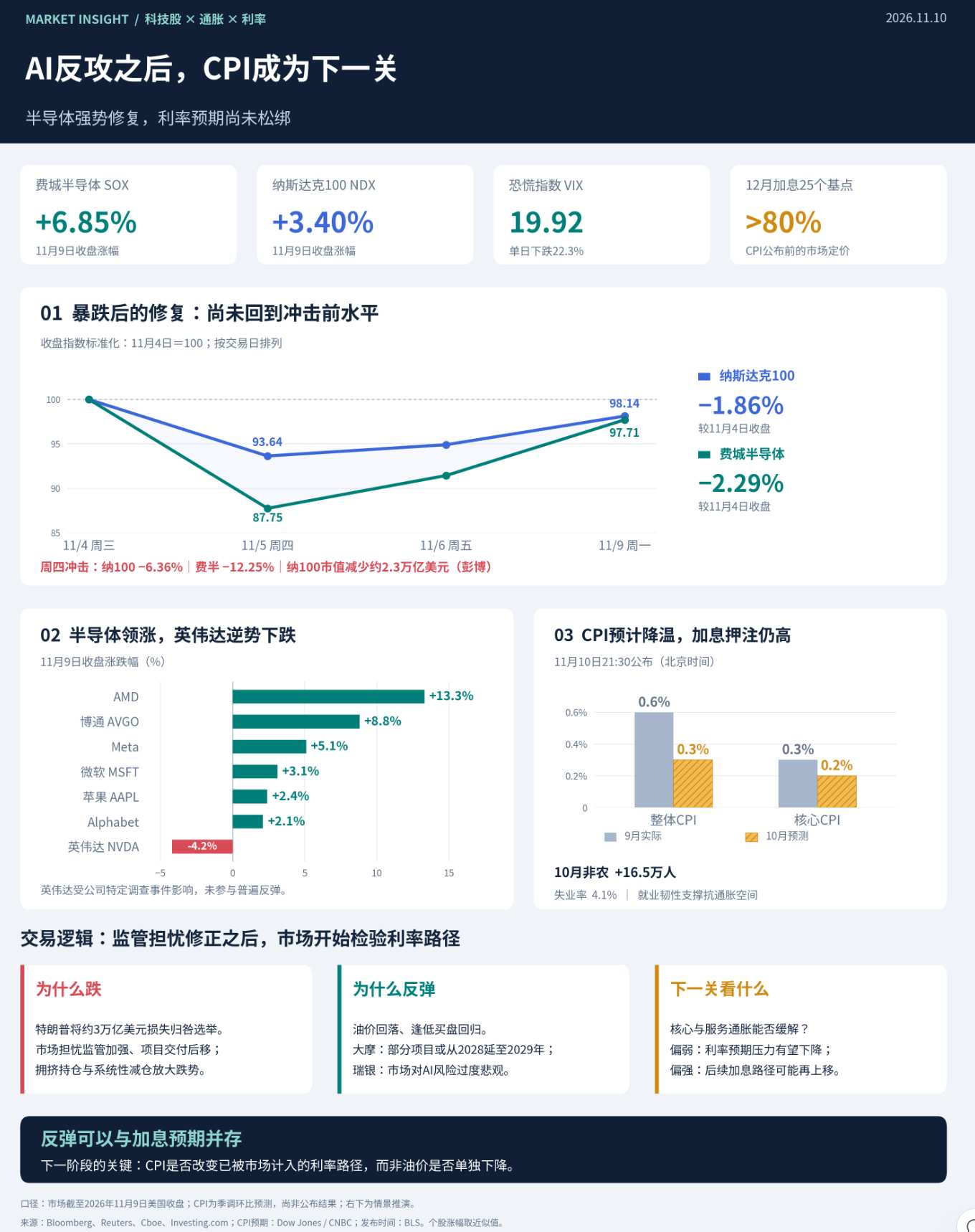
The Zhitong Finance App learned that by the close of the US stock market on Monday, the Nasdaq 100 index had risen 3.40%, and the Philadelphia Semiconductor Index, which can be called the “global AI computing power trading weather vane,” had a massive rebound of 6.85%. The market mitigated the pessimistic pricing of the AI regulatory impact that swept through the Democratic Party's midterm elections under the Senate and House of Representatives.
However, recent developments show that long-term US bond yields of 10 years or more are still near the high level of more than 20 years, and the fall in international oil prices has yet to eliminate the pressure of the Federal Reserve's monetary policy austerity: the US CPI for October, announced tonight at 21:30 Beijing time, is expected to rise 0.3% and 0.2%, respectively; against the backdrop of 165,000 new non-farm payrolls and the unemployment rate falling to 4.1%, the market's bet on the Federal Reserve's interest rate hike of 25 basis points in December is still over 80%.
What the current CPI inflation data really needs to answer is whether energy cooling can drive broader price pressure relief, or whether service sector stickiness and AI construction demand continue to support the Federal Reserve's tightening policy. Technology stocks have just seen a strong recovery from regulatory concerns and concentrated sell-offs, and inflation data immediately became an important variable to test the sustainability of the counterattack. Strong employment has increased the economy's ability to withstand interest rate hikes. Service price stickiness and data center demand for electricity, equipment, and construction personnel may prolong price pressure. The market's bet on the December interest rate hike of 25 basis points is still over 80%.
Philadelphia Semiconductor faces a big CPI test after surging nearly 7%! Can technology stocks go a step further in repairing the market?
The massive sell-off of US technology stocks last Thursday has a clear historical weight — the Nasdaq 100 index fell 6.36%, the biggest one-day decline since March 2020; according to Bloomberg statistics, the index's market value of about 2.3 trillion US dollars evaporated in a single day, setting a record for the index's single-day market value loss. The Philadelphia Semiconductor Index fell sharply by 12.25% over the same period. Even after the rebound on Friday, the two indices had a cumulative sharp decline of about 4.91% and 12.15% last week, which is enough to indicate that the sell-off impact was concentrated on the semiconductor sector, which previously carried extremely high growth expectations, and a wide range of popular technology assets.
Over the weekend, Trump blamed the Democratic Party for the loss of about 3 trillion US dollars in a single day in US stocks and promised that the market would return on a larger scale and with a stronger attitude. However, the actual transmission chain of the market is more specific — investors have recently widely feared that the new Congress and some state governments are strengthening AI supervision, data center approval, and energy cost sharing requirements, which may delay project delivery, causing the fulfillment time of trillion-dollar AI infrastructure orders and AI data center investment returns related to AI chips.
This significant change in expectations met with the original overvalued and overcrowded positions, and then expanded through a systematic reduction in positions, resulting in a major sell-off of technology stocks in the US stock market far exceeding the impact of a single policy news. Kobeissi Letter, a well-known investment agency, also explained it mainly as a sudden change in mood colliding with high leverage, rather than a complete reversal of AI fundamentals associated with AI computing power within a day.
Monday's rebound reflected a correction to these pessimistic expectations. AMD rose about 13.3%, Broadcom rose about 8.8%, and tech giants such as Microsoft and Meta also strengthened markedly; the VIX Panic Index fell sharply by 22.3% to 19.92. However, Nvidia was affected by a specific incident in the company — that is, the founder Wong In-hoon's affair scandal, bucked the trend and fell by about 4.2%.
Regarding excessive market concerns, Morgan Stanley believes that the influence of AI data center supervision led by the Democratic Party may be mainly reflected in the postponement of some construction projects from 2028 to 2029, and the trillion-dollar capital expenditure cycle surrounding AI infrastructure can continue for a long time; UBS also believes that the market is overly pessimistic about pricing AI politics, credit, and expenditure risks.
Energy cooling clashes with overheating demand. A key CPI report reflecting October's inflation situation will be released on Tuesday
The drop in gasoline prices in October brought some relief to consumers, but Federal Reserve officials are increasingly concerned that inflationary pressure in other sectors of the economy is becoming more difficult to contain.
According to data from the US Energy Information Administration, gasoline prices at gas stations fell by more than 4%, temporarily relieving the pressure caused by rising more than $1 per gallon over the past year.
However, the consumer price index for the month to be released by the US Bureau of Labor Statistics at 8:30 a.m. on Tuesday is expected to show only a slight slowdown in price increases.
Meanwhile, Federal Reserve officials said they are concerned that inflation, initially fueled by President Donald Trump's tariff policy and the war with Iran, has lasted longer than expected, and that price pressure is emerging in industries not directly affected by the impact.
At a time when the Federal Reserve is becoming more and more confident about the state of the labor market, the issue of cost of living has become its top concern.
“We are getting closer to what has historically been generally regarded as full employment, and the main problem has always been with inflation. We visited all parts of our jurisdiction and talked to people, and all we heard was about the affordability and cost of the enterprise.” Chicago Federal Reserve Chairman Austin Goulsby said at a local event on Monday, “Therefore, we must face up to our failure to meet our goals in terms of costs and inflation.”
According to Dow Jones's unanimous expectations, overall CPI is expected to rise 0.3% month-on-month; after excluding volatile food and energy costs, core inflation is expected to rise 0.2% month-on-month. Although both will be lower than the 0.6% and 0.3% month-on-month increases in September, this still means that price pressure continues.
Due to the government shutdown a year ago, the Bureau of Labor Statistics was unable to collect some data and compile a complete index level, the year-on-year reading will not be released in October. Missing data means there are no index values to compare.
By interpolating data for the same period last year and setting an estimation base, the Bank of America estimated the overall and core year-on-year increases of 3.8% and 2.7%, respectively, which were 0.1 percentage points higher than in September, and significantly higher than the Federal Reserve's 2% target.
Goulsby said that the current inflation trend has deviated from the normal impact path of supply shocks and tariffs, and infrastructure construction carried out by hyperscale cloud vendors around artificial intelligence is exacerbating this situation.
“These effects should have subsided, but we are now beginning to see that inflation is heating up in some areas that may not be driven by oil prices and tariffs, such as many service sectors. Today, the AI data center construction matter, in my opinion, is beginning to seem more and more like demand in the traditional sense is overheating.” he said.
He added that huge investments in data centers are creating demand for construction workers, electricity, and equipment. Even if AI is expected to lead to long-term productivity gains, these investments are likely to increase current price pressure.
The Fed's interest rate curve is still under significant upward pressure
Although the Federal Reserve voted in October to keep the benchmark interest rate unchanged, according to data from the CME “Federal Reserve Watch” tool, the market currently believes that the probability that the central bank will raise interest rates by 25 basis points at the next meeting in December is over 80%.
Goulsby did not have the right to vote in the Federal Open Market Committee, which is responsible for setting interest rates this year, but he will have the right to vote in 2027. He did not clearly state whether he favors further rate hikes, but indicated that the current situation might justify action.
“The traditional view is that active action should be taken early to prevent the economy from overheating, because once overheated, it would be very painful to eliminate this state of affairs.” He said, “Therefore, I think we must be alert to this risk.”
When the CPI was announced, the US economy was growing strongly: GDP grew at an annual rate of 3.4% in the third quarter, and 3.5% in the fourth quarter according to the Atlanta Federal Reserve's tracking forecast. The labor market also appears to be quite stable. The number of non-farm payrolls increased by 165,000 in October, clearly exceeding expectations. The unemployment rate fell slightly to 4.1%, but the wage growth rate after deducting inflation was still negative.
This keeps inflation data in the spotlight. The Bank of America said that the impact of tariffs is weakening, but the burgeoning demand for AI infrastructure may drive some commodity prices to rise further. Furthermore, the bank remains cautious about sticky service prices, as well as price pressures on health insurance and automobiles.
The bank's judgment on the future of the Fed's policy has always been hawkish, believing that as long as there is no further sharp sell-off in the stock market that could change the central bank's decision, the possibility of raising interest rates in December is very high.
“This will be the last inflation report before the Federal Reserve's December 8-9 meeting. If our predictions are correct, we think this will actually lock in another 25 basis point rate hike, if other conditions remain the same.” Bank of America economist Stephen Juno said in a client report, “Unless there is an undisputed reading of weakness and a month-on-month increase of only 0.1%, we doubt that the inflation data will prevent the Federal Reserve from raising interest rates in December. The greater risk we face in this judgment comes from financial markets.”
It should be noted that the “last inflation report” in the quotation of this article is, to be precise, the last CPI inflation report before the Federal Reserve's next FOMC monetary policy meeting; the October Personal Consumption Expenditure Price Index (PCE) will still be announced on November 25.
Gasoline price cuts are not enough to relieve the Federal Reserve's austerity pressure, and huge demand related to the AI infrastructure process has become a new variable in inflation
Wall Street is more in agreement on the direction of the cooling of inflation in October, and there are still differences on the extent. Wells Fargo expects overall and core CPI to rise 0.28% and 0.21%, respectively, after the seasonal adjustment; UBS forecasts 0.26% and 0.23%; Barclays expects both 0.2%; and Royal Bank of Canada is expecting 0.3%.
Wells Fargo and Barclays both believe that moderate readings are not enough to change the benchmark judgment of raising interest rates again in December; the Royal Bank of Canada is more concerned about the risk that imported goods, automobile-related costs and service prices will continue to rise.
The change in the Federal Reserve's concerns is that inflation may spread from cost shocks caused by energy and tariffs to pressure on demand that is more difficult to subside on its own. Chicago Federal Reserve Chairman Goulsby pointed out that the rise in some service prices is already difficult to explain by simply using oil prices and tariffs, and AI data center construction is beginning to show the characteristics of overheating demand in the traditional sense.
Judging from the industrial transmission mechanism, centralized data center construction will compete for power access, equipment production capacity, and skilled construction personnel; when these resources, which are closely related to AI infrastructure and the daily operations of enterprises, are difficult to expand in the short term, large-scale investment growth will first drive up the benchmark cost, and the cost reduction effect of AI to increase the productivity of the whole society will often take longer to be realized. Therefore, AI can help curb inflation for a long time, push up some prices during the construction phase, and can be established at the same time at some initial stages.
Strong employment has increased the Federal Reserve's policy space to continue fighting inflation. 165,000 new jobs and the unemployment rate fell to 4.1%, weakening the reason for an immediate shift to supporting growth. Stephen Juneau, a senior economist at Bank of America, believes that unless there is a clear weak month-on-month reading of only 0.1%, the inflation data may not be enough to stop interest rate hikes in December; in contrast, the bigger variable is whether the financial market will once again experience a serious sell-off. Due to the lack of a base figure due to the government shutdown last year, the average year-on-year increase in overall and core CPI will not be announced this time; the 3.8% and 2.7% estimates by Bank of America are model results after supplementing the base.
For global technology stocks that are rebounding drastically, the key is whether the CPI changes the path of interest rate hikes that the market has taken into account. With the probability of interest rate hikes in December already exceeding 80%, data in line with expectations may not constitute a new major impact; if core inflation and service prices are clearly strong, the market may further raise interest rate expectations for 2027, lower the current value of forward profits, and raise the interest rate threshold for new financing.
Conversely, if cooling covers more core segments, it may ease concerns about continuing interest rate hikes and provide a more favorable environment for profit resilience and bargain buying. Monday's rebound has shown that stocks can rise while interest rate hikes are still high; tonight's data will test the balance between this earnings support and valuation pressure.