
Unexpected! Japan actually interfered in the foreign exchange market three times during the summer, hitting a record 15.4 trillion yen in three days
The Zhitong Finance App learned that the Japanese side confirmed that it had entered the foreign exchange market three times this summer to interfere with the foreign exchange market and buy yen to hold the exchange rate, confirming the operation of previous market reports. This includes Japan collaborating with the US to support the yen for the first time in nearly 30 years.
Japan's Ministry of Finance released daily intervention data for the previous quarter on Monday, showing that the intervention continued for a total of three days. This was beyond what traders had anticipated — the market originally determined that the intervention only occurred within two days. On July 30, Japan bought 7.98 trillion yen (equivalent to 50.4 billion US dollars) in a single day, setting a single-day intervention record; the next two days invested 5.55 trillion yen and 1.87 trillion yen, respectively.
The total cost of three days was 15.4 trillion yen, making it the largest amount of foreign exchange trust yen purchased in a single month in Japan. Japan and the US have previously confirmed that the two sides joined forces to intervene on July 31. This is also the first time since 1998 that the two countries have collaborated to protect the yen.
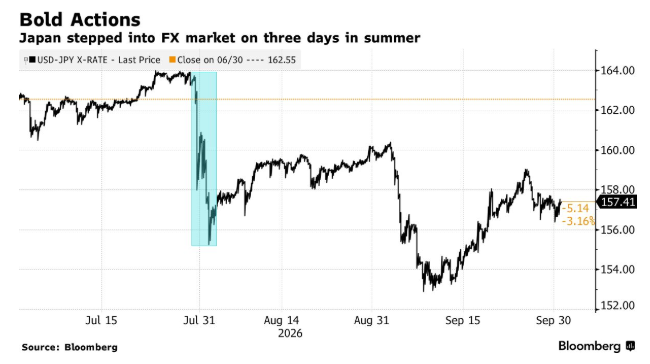
This rare joint intervention with the US side initially had a huge impact on the market. US Treasury Secretary Scott Bessent and Japanese Treasury Secretary Katayama Satsuki said that the intervention was aimed at curbing disorderly changes in the exchange rate, and at the same time stated that they are ready to take another action at any time if necessary.
The joint intervention once made some market participants think that the yen's long-term weakening may come to an end. The yen rebounded to a high of 152.89 yen per dollar in early September, then gradually rebounded; in early Tokyo trading on Monday, the yen traded around 158.30 per dollar.
The data disclosed on Monday also confirmed that July 30 was Japan's sole intervention. This day coincided with the day before the Bank of Japan's monetary policy decision. This point in time is clearly different from previous operating routines. The market interpretation is that Katayama Satsuki and foreign exchange director Jun Mimura are experimenting with new strategies, which caught traders by surprise. Previous interventions (including operations during Golden Week) were generally chosen after the Bank of Japan's decision and the release of major economic data.
Earlier relevant data showed that in order to raise funds for the summer intervention, Japan probably sold some overseas securities, including US Treasury bonds. According to data released separately by the Ministry of Finance on Monday, Japan's overseas securities holdings at the end of October were 835 billion US dollars, up from the previous month.
However, the size of this position does not fully represent Japan's subsequent intervention ammunition. Following the implementation of the joint intervention, Japan and the US have confirmed that Japan can use the Federal Reserve's Foreign and International Monetary Authority Repurchase Facility (FIMA Repo Facility) to obtain US dollar liquidity without directly selling US debt. This also overturned the opinion of some traders: they originally thought that Bezent opposed selling US debt, which would limit Japan's room for intervention.
This three-day intervention is less than three months away from Golden Week's record-breaking market protection operation. At the time, the Japanese authorities also made a big effort to enter the market, but the yen continued to be under pressure, and the market was increasingly betting that the Japan-US spread would widen further.
Since the joint intervention, Japan and the US have issued warnings to speculators several times. Katayama Satsuki stressed that the authorities' position has not changed and that they will resolutely take strong action when necessary.
Higher levels have also sent this kind of signal. At the September summit, US President Trump and Japanese Prime Minister Sanae Takaichi jointly expressed concern about the weakening of the yen and showed that they did not want to see the yen continue to depreciate.