
The dividends of the Trump era are counting down! Wall Street is rushing for the “last train” of giant mergers and acquisitions, and 2027 will be the final window period
The Zhitong Finance App learned that Trump's return to the White House reshaped the political game pattern behind mergers and acquisitions, and revived the idea of chasing major deals that were difficult to implement before. Today, the American business community is in a race against time.
The Democratic Party suffered a setback in the midterm elections, and the corporate board of directors suddenly felt a sense of urgency. Executives are calculating in their minds: under Trump, while the M&A friendly supervisory team is still in place, this may be the last window for them to complete a transformative deal.
Exchanges with top investment bank advisors showed that the midterm election results have prompted companies to consider whether they should speed up the pace and advance a major strategic layout. The market has reached a consensus: once the Democratic Party makes a comeback, it may block such major mergers and acquisitions. During Trump's second term, the merger and acquisition boom continued to heat up, bringing record revenue to Wall Street, and the Democratic Party may become a drag on this wave.
Kevin Welfare, co-head of the investment banking department at J.P. Morgan Chase, the world's top investment banking institution, said that companies should be prepared to proceed with transactions in an still complicated business environment.
“There is no greater risk than taking for granted that everything will return to normal sooner or later.” According to Welfare, who is based in New York, “Standing by the military is certainly a choice, but at a time when the industry is iterating so fast, this is the wrong choice.”
Fernando Rivas, a senior banker at Wells Fargo, said bluntly at an industry conference in Boston on Thursday: in the short term, the mentality of “never lose the opportunity, the time will never come” will once again dominate the M&A market.
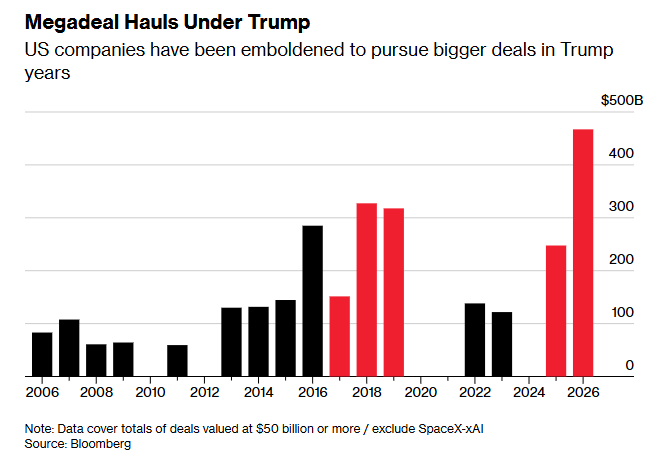
Trump's two terms have given birth to a huge number of large-scale mergers and acquisitions. According to an analysis of compiled data, over the past 20 years, more than half of all announced deals involving US companies with a target amount of at least 50 billion US dollars occurred during his presidential term.
This year alone, a number of landmark mergers were born in key core fields such as electricity and technology. For example, this month, MRVL.US (MRVL.US) announced that it would spend more than 100 billion US dollars to acquire laser manufacturer Lumentum (LITE.US), setting a new transaction record; in another major deal, the US Department of Justice unconditionally approved Paramount's acquisition of Warner Bros. Exploration for 110 billion US dollars, with no additional anti-monopoly rectification requirements.
This type of transaction has a complicated structure, and the urgency of time is particularly prominent. Large mergers and acquisitions often take months to negotiate, and the global regulatory approval cycle is even longer. If companies wait until the 2028 presidential election is fully launched before starting, this deal is likely to become a political bargaining chip in the election campaign.
Paul Nally, an assistant professor of management at the Wharton School of Business at the University of Pennsylvania, said, “If a major transaction takes a long time from planning to completion of the approval process, then it must be promoted now, preferably officially before mid-2027. There's not much time left for the market.”
Power balance steering
Under the new market pattern, the potential merger between Musk's SpaceX (SPCX.US) and Tesla (TSLA.US) may become an important litmus test for large-scale mergers and acquisitions. Once this deal comes to fruition, it will rank among the largest and most politically sensitive corporate alliances in history. It will also test the actual influence of this billionaire on Trump at a time when Washington's power landscape is being restructured.
According to previous reports, Musk — who invested nearly $500 million to support the Republican candidate in key midterm elections — is pushing to announce the merger of his two largest companies in the first half of 2027. But the situation has become more difficult; shares of both SpaceX and Tesla have fallen due to fears that the Democrat-led Congress will investigate Musk's commercial and political deals and seek to slow the artificial intelligence (AI) boom he has long advocated.
Although the Democratic Party is unable to take over the US Department of Justice and the Federal Trade Commission, and the M&A supervisory team will maintain the status quo, taking control of the Senate and House of Representatives will give the party a new method: to question large-scale and sensitive mergers and acquisitions through hearings, investigations, and subpoenas, while guiding the public and regulators to step up scrutiny of related companies.
A number of large deals that are in progress, or have even been partially completed, may become the first targets to be targeted when the new National Assembly takes office in January next year.
DoorDash Inc. (DASH.US)'s $17 billion acquisition of Instacart's parent company Maplebear Inc. (CART.US) has drawn criticism from prominent Democrats, including New York Mayor Zohran Mamdani, who said the deal would mean “higher prices, harsher exploitation, and greater economic inequality.” Meanwhile, lawmakers, including Senators Ed Markey and Richard Blumenthal, have pointed the finger at New Era Energy (NEE.US)'s $67 billion acquisition of Dominion Resources (D.US), warning that it could weaken competition and drive up consumer costs. Senator Corey Booker vowed congressional oversight to analyze the Paramount Warner Bros. deal completed last month.
Paul Humphries, co-head of the Global Industry Group at Fuld Law Firm, said, “Congress has limited time and resources, and will not launch an investigation into every transaction. I expect the focus will be on specific directions, particularly on the two major topics of human costs and corporate accountability.”
“Even if the deal has been regulated and released, Congress can still summon executives and issue subpoenas to put a merger and acquisition under the political spotlight,” Humphreys added.
The AI boom has subsided
For deal makers, an even more pressing problem is the decline in the AI market. During Trump's second term, many major mergers and acquisitions were initiated based on the logic of AI industry expansion. During the midterm elections, several states voted on data center construction issues, and in the end, voters unequivocally rejected the rapid expansion of data centers within the US.
The market is already worried about the huge capital expenses of AI, but now it is starting to price digital infrastructure to support AI development and may usher in stricter supervision. The Philadelphia Semiconductor Index (chip sector weather vane) recorded its biggest one-day decline since the impact of the COVID-19 pandemic in March 2020 last week.
The market correction also made the risk of Maywell Technology's acquisition of Lumentum even more prominent. Since the midterm elections, both companies' stock prices have plummeted, adding yet another variable to an all-stock deal, and the strategic logic of this deal largely depends on continued investment in data centers and AI connectivity.
Many Wall Street agencies have previously expanded the recruitment of employees with political connections, betting on opening up the Trump administration and understanding its regulatory ideas, which is the key to leading to large-scale mergers and acquisitions. However, the midterm election results may reverse this layout, forcing investment banks to establish communication channels with the Democratic Party earlier than expected.
Nari of the Wharton School said, “The parties involved in the deal have just figured out how to deal with Trump's White House and its M&A regulatory ideas. After the blue wave arrived, they must now also have a congression-level game strategy.”