
Lisa Su Expects 80% Revenue Growth in 2027. AMD Stock Is Still a Strong Buy, But It Demands Flawless Execution.
In early September, Advanced Micro Devices (AMD) executives took the stage at two investor conferences with the same message: A new kind of artificial intelligence (AI) was pulling in chip demand faster than they had planned. Two months later, CEO Lisa Su put a number on this demand and told investors AMD expects revenue to grow more than 80% in 2027.
Down almost 38% from all-time highs, AMD stock is valued at a market cap of over $700 billion. Despite the ongoing pullback, the chip maker has returned more than 6,000% over the last 10 years.
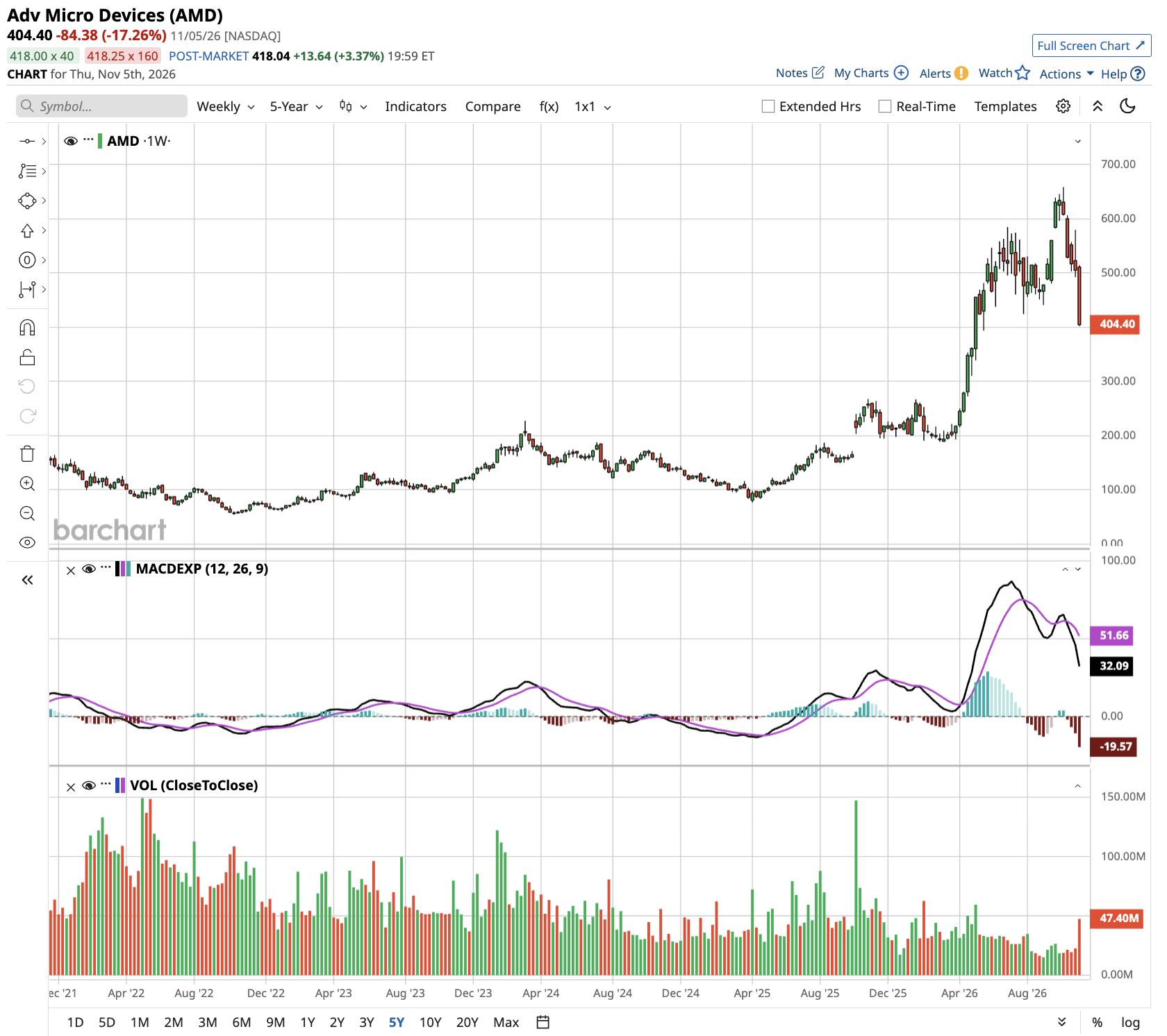
Is AMD stock still a good buy right now?
How Agentic AI Changed AMD's Server Story
AMD senior vice president Dan McNamara told the Goldman Sachs Communacopia + Technology Conference on Sept. 11 that early chatbots were simple, where you sent a prompt and received a reply.
Agentic AI is, however, different, as software agents run simultaneously, using multiple tools and querying databases. McNamara said AI agents run entirely on CPUs, or central processing units, the general-purpose chips in servers.
At its Financial Analyst Day last November, AMD forecast the server CPU market at $60 billion by 2030. CFO Jean Hu told the Citi Global TMT Conference on Sept. 8 that the figure is now more than $220 billion.
Investor relations executive Matt Ramsay said AMD aims to generate $100 billion in the server business, which translates to a market share of over 45%. Hu also projected server CPU revenue to grow more than 70% in 2027.
Lisa Su Raises the Bar for 2027
On the Nov. 3 earnings call, Su raised the above CPU revenue estimate and expects sales to double in 2027.
Data center AI revenue, which includes its Instinct AI chips, should grow even faster than AMD projected 90 days earlier. Data center should also make up more than 80% of total revenue next year. Su said the 80% company growth is more than twice the long-term model AMD laid out last November.
Hu emphasized that operating expenses should grow at less than half the pace of revenue, which should boost profit margins. Su was also clear about the limit. "Demand is higher than supply," she told Barclays analyst Tom O'Malley.
However, AMD has worked to secure wafers, packaging, memory, and other parts.
How Did AMD Perform in Q3
The third quarter gave Su's forecast some proof, given it reported revenue of $13.4 billion, an increase of 45% year over year. Data center sales almost doubled to $8.5 billion, while data center operating income surged 168% to $2.9 billion. Its outlook in Q4 stood at $17 billion, an increase of 66% year over year. Data center sales accounted for 64% of revenue, up from 47% last year.
AMD's full rack AI system is Helios. Su said AMD started shipping its MI455X chips in volume to tech giants including Anthropic, Meta Platforms (META), Microsoft (MSFT), OpenAI, and Oracle (ORCL).
Hu said the fourth quarter will be the first time AI sales top server sales. Partners have also committed to more than 240 platforms for Venice, AMD's newest server chips, 20% more than the last generation.
Investors should note that investing in AMD stock carries certain risks.
- Hu told the Citi conference that wafers, memory, advanced packaging, and substrates are all in limited supply. Su says demand already exceeds supply, so a parts shortage could slow AMD’s shipments.
- AMD reported a gross margin of 56% in Q3 and guided to 55% in Q4. AI chips earn lower margins than AMD’s other products, but the gross profit should increase, driven by solid demand.
- Client and gaming revenue fell 8% to $3.7 billion in Q3. Gaming sales were down 40%, and AMD forecasts PC shipments to fall by a double-digit percentage in 2027, as memory costs rise.
- AMD reported a free cash flow of $554 million in Q3, compared to $1.53 billion last year. Its inventory also rose by $3 billion to $11.5 billion.
- AMD gave a customer warrants, which let it buy AMD shares later. These warrants lowered earnings per share to $1.46, after a $1.1 billion non-cash charge.
- Hu said the charge should grow as shipments continue and may rise with AMD’s share price. However, these charges do not affect adjusted earnings or free cash flow.
- Lastly, Hu named Meta, OpenAI, and Anthropic as AMD's three anchor customers. Bank of America (BAC) analyst Vivek Arya asked whether they have the financing and data center space. Su said AMD has good visibility into 2027 and works closely with them.
Is AMD Stock a Good Buy Now?
AMD beat its own guidance, raised its outlook, and is growing profit faster than sales. However, the forecast needs flawless execution, coupled with strong supply and a few large customers that continue to spend heavily on AI.
Analysts tracking AMD stock forecast adjusted earnings per share to expand from $4.17 per share in 2025 to $44.31 per share in 2030. If AMD stock is priced at 30x forward earnings, below its five-year average of 34.6x, it could more than triple from current levels.
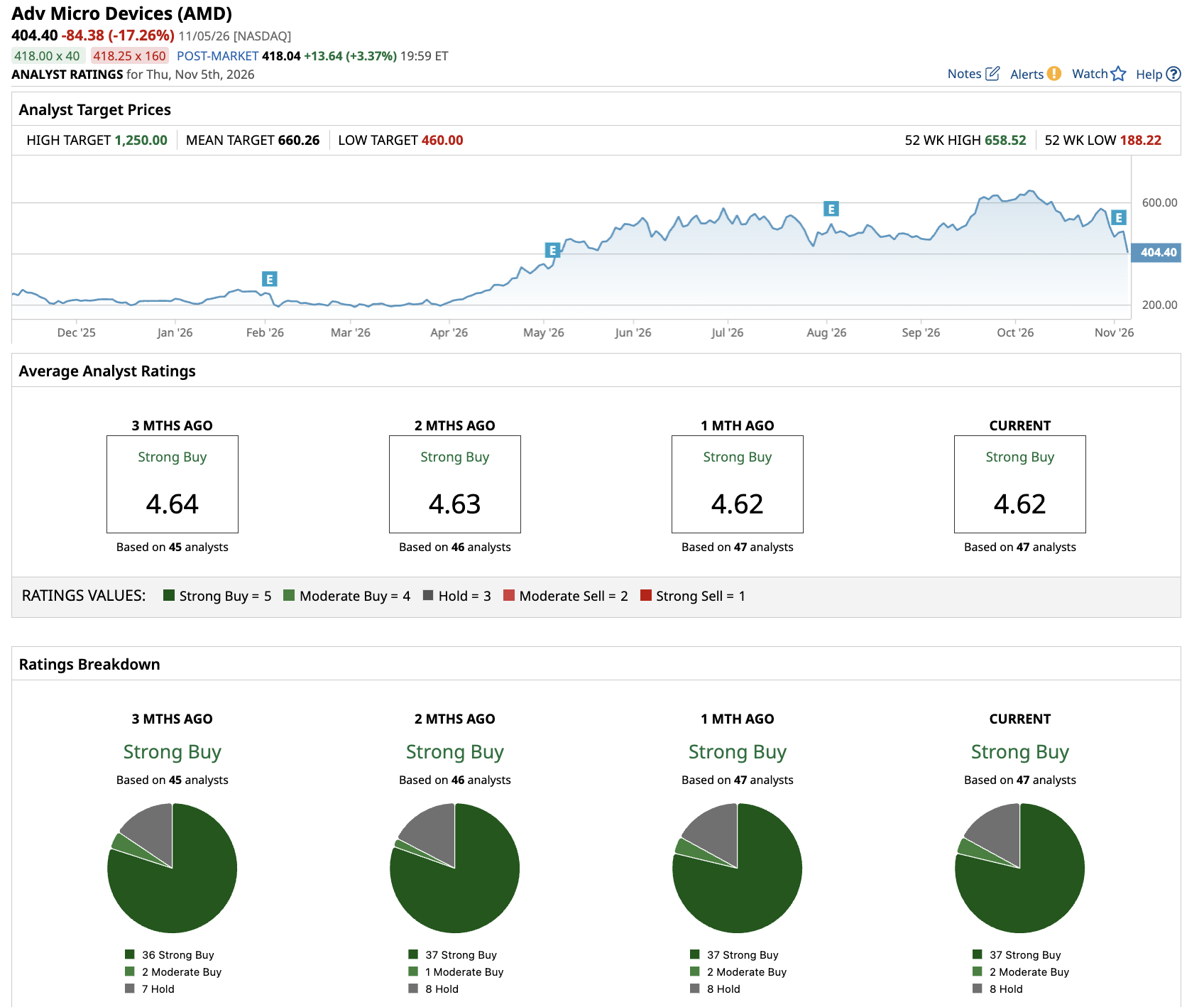
Out of the 47 analysts covering AMD stock, 37 recommend “Strong Buy,” two recommend “Moderate Buy,” and eight recommend “Hold.” The average AMD stock price target is $660, above the current price of $405.
On the date of publication, Aditya Raghunath did not directly have a position in any of the securities mentioned in this article. All information and data in this article is solely for informational purposes. For more information please view the Barchart Disclosure Policy here.