
Data Centers Aren’t Dead; They’re Just About to Go Micro. These Are My Top VPP Stocks to Watch.
Just about the entirety of the “energy trade” this year has been dominated by the state of crude flows out of the Strait of Hormuz. But in the wake of the “Blue Wave” election results that turned even the powerhouse State of Texas over to Democratic challengers, it’s worth remembering that the universe of energy investments goes well beyond oil & gas.
In other words, alternative energy isn’t going anywhere. Back on August 18, I wrote:
For investors in search of the next big thing in the energy space, how about virtual power plants (VPPs)?
Power grids and software now have the technology to connect to and reverse-flow electricity from home power-producing sources, including electric vehicle (EV) batteries, solar panels, and gas or propane generators. Google (GOOG) (GOOGL) is an early adopter, per its pact with Voltus.
The market is quite fragmented, and software continues to evolve with the help of artificial intelligence (AI). But in a nutshell, you – the homeowner – can sign up to allow your utility to draw power from your battery storage system or to turn on your generator during periods of extreme power demand.
Already, individuals can sell power from their electric vehicle (EV) batteries back to the grid. But the virtual power plant (VPP) niche is set to grow much more quickly and be much more complex than a Tesla battery pack.
Imagine solar panels and advanced battery storage equipment in every new home built. Don’t discount the possibility of micro data centers, either.
Powering Data Centers in the Post-“Blue Wave” Era
That’s a particularly compelling reason to consider the VPP theme now after midterm elections that changed the political landscape in places like Texas, where approximately one-quarter of all new data center and AI buildout capacity is planned.
“I’m not ruling data centers out. It’s not that I hate data centers,” clarified Texas Governor-elect Gina Hinojosa in remarks to CNN after her historic victory. “We just need to stop what we are doing until we have protections for Texans.”
Against the backdrop of a regulatory environment that could be shifting rapidly, virtual power plants – with their relatively smaller scale and ability to leverage alternative power sources on a flexible basis – could quickly rise to the forefront. What’s more, VPPs could potentially even benefit from expedited adoption and approval processes as legislators and data center operators seek out mutually beneficial economic solutions.
Behind the Meter for Everyone
If you had a chance to listen to our July 17 “Market on Close” livestream with guest Larry Stalica, he discussed a near-term future where power demand will move away from our aging centralized grid and toward modular sources. It’s a model he described as a “distributive generation solution” with “small generation sources” located closer to the data centers, communities, and homes where they’re needed.
Larry is a nuclear engineer, but in layman’s terms, it’s what you and I might describe as “behind the meter for everyone.” And with electricity rates on the rise amid soaring demand, it’s a proposition that carries considerable consumer appeal.
“As coordinated aggregations of flexible household technologies such as thermostats, batteries, and EVs, VPPs are uniquely positioned to provide affordability benefits to residential customers both by putting downward pressure on rates and by paying participants for the services they provide to the grid,” wrote The Brattle Group in an October 2026 report compiled for Everyday Electric.
There are obvious economic benefits to the companies embedded in the VPP supply chain, too. According to Brattle:
“Sunrun and Tesla scaled participation in Puerto Rico’s Customer Battery Energy Sharing (CBES) program sevenfold in just over a year by auto-enrolling new third-party owned batteries.”
If those names sound familiar, it’s because many VPP stocks are already established in a related industry. That makes it relatively accessible for investors to participate in this fledgling energy niche without speculating on a big upcoming IPO or a pre-revenue start-up.
A Behind-the-Meter Trade for Every Investor
As we shift the discussion to actionable ideas, it’s worth underscoring here that the VPP space is still relatively fragmented, and many players are still privately held or in the startup phase.
Given that, it’s worth considering a broader exchange-traded fund (ETF) to invest in the theme, which eliminates the heightened risk of trying to “pick winners” – particularly since many of the top publicly traded VPP stocks right now are actually hyperscalers, automakers, or solar stocks that are dabbling in this newer niche as a non-core business line.
Our Barchart ETF Finder is one way to drill down on the best clean energy ETF for your personal preferences, but a highly liquid fund in the space is the iShares Global Clean Energy ETF (ICLN). ICLN offers wide exposure to wind, solar, batteries, fuel cells, and more key components to the VPP narrative. More focused offerings can be found in our listings of Battery ETFs and Clean Energy ETFs, as well.
For those looking to play the field with individual stocks, the best-looking chart of the bunch currently belongs to Alarm.com (ALRM).
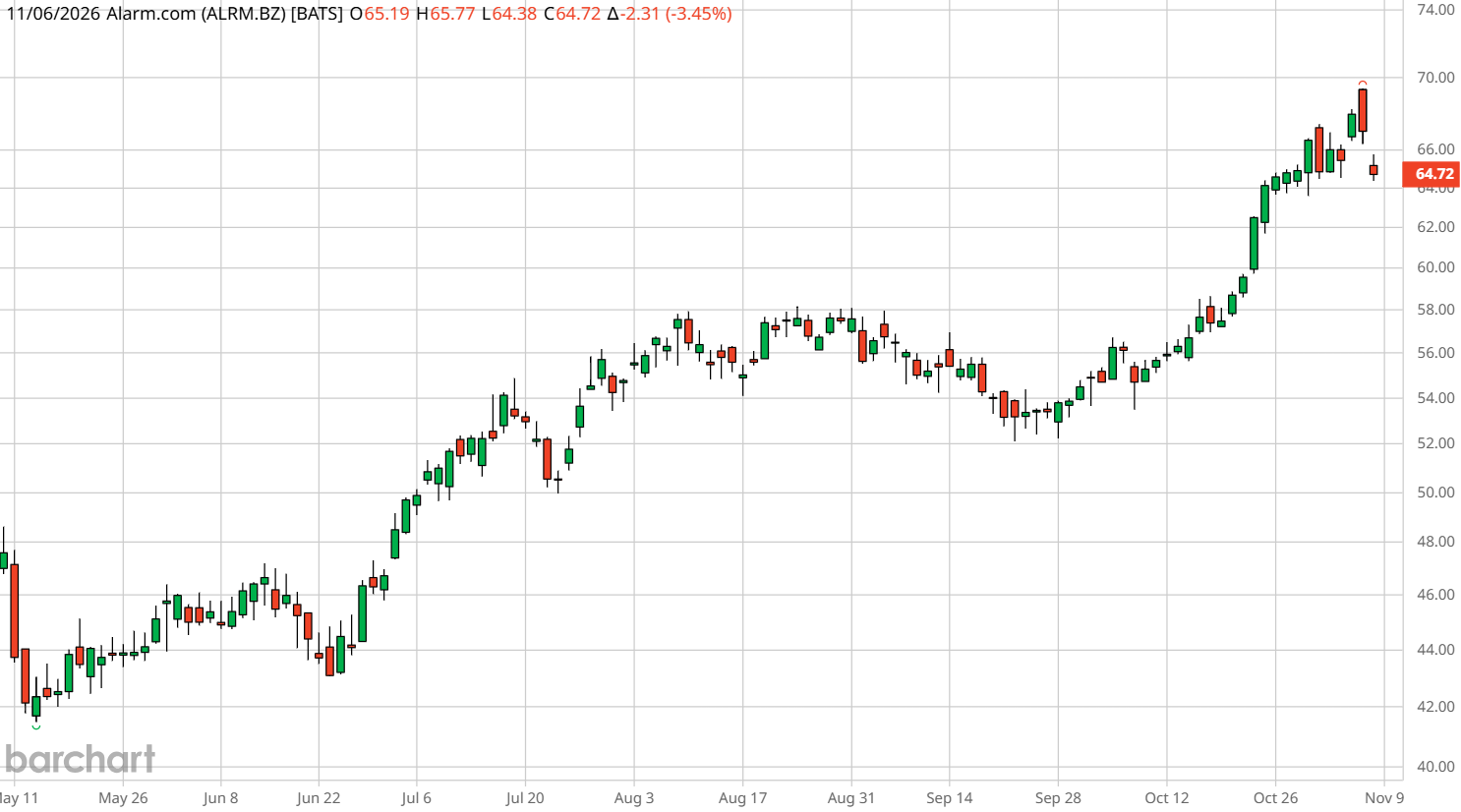
The company’s EnergyHub subsidiary is a North American software market share leader via its Edge DERMS platform for utilities. EnergyHub says the platform connects customer devices to the grid and intelligently optimizes their performance – which “creates a VPP that can be deployed faster, at lower cost, and with greater flexibility than conventional power plants.”
And ALRM is just the tip of the VPP iceberg. Whether you prefer an established megacap hyperscaler or a lower-profile supply chain player, these are some of the other standout VPP stocks on my radar:
- Tesla (TSLA): Already a dominant force in the residential and commercial VPP space through its Autobidder platform, Megapack utility-scale installations, and the Tesla Energy ecosystem (aggregating rooftop solar and Powerwall home batteries), Tesla runs some of the largest active VPP networks in major utility markets like California, Texas, and New England, which can be tracked at the company’s VPP Dashboard.
- Google (GOOG) (GOOGL): The Alphabet unit is now coupled up with Voltus, a distributed energy company, on a deal to build a 1-gigawatt VPP serving the PJM grid region – expanding on their 100-MW deal announced earlier in the year.
- Ford Motor (F): Ford formed a utility working group in July 2026 with five major utilities — American Electric Power (AEP), BC Hydro, Consumers Energy, Exelon (EXC), and Pacific Gas and Electric Co. (PCG) — to help define scalable interconnection processes for bidirectional EVs, like its upcoming Fathom, and help consumers participate in utility programs like VPPs.
- Sunrun (RUN): The solar and storage provider boasts a footprint in markets including California, Texas, and Puerto Rico, and says its Sunrun Distributed Power Plants (DPPs) exceed traditional VPPs by dispatching new, incremental generation and storage.
- ABB Ltd. (ABBNY): ABB launched ABB Ability Virtual Power Pools, a control and optimization software system that automates control of power generation units, storage, and controllable loads, allowing utilities and aggregators to manage distributed generation and storage assets.
- Eaton Corporation (ETN): Eaton delivers electrical power management and smart grid technologies, including energy storage integration and microgrid controls essential for flexible load and VPP deployments.
- Stem, Inc. (STEM): Stem pioneered AI-driven energy storage optimization via its PowerTrack software platform. While many competitors target residential homes, Stem anchors the commercial and industrial (C&I) market, managing massive portfolios of solar and battery assets globally to serve as a software backbone for asset owners and utilities.
To track, screen, and chart our favorite stocks and ETFs in this emerging energy trade, check out this curated VPP Stocks watchlist, along with the VPP ETF Watchlist.
– John Rowland, CMT, is Barchart’s Senior Market Strategist and host of Market on Close.
On the date of publication, Barchart Insights did not directly have a position in any of the securities mentioned in this article. All information and data in this article is solely for informational purposes. For more information please view the Barchart Disclosure Policy here.