
Dear Constellation Energy Stock Fans, Mark Your Calendars for November 9
Earnings season is when Wall Street gets out its calculators, sharpens its pencils, and starts looking beyond the headline numbers. Sure, earnings beats and misses matter, but management commentary on what lies ahead often carries just as much weight, shaping investor sentiment and a stock’s next move. Next in line is Constellation Energy (CEG), a major U.S. nuclear and clean energy producer that supplies reliable electricity to businesses and utilities.
The company is scheduled to report its Q3 2026 results on Monday, Nov. 9, before the market opens. Its earnings track record is fairly encouraging, with EPS estimates beaten in three of the past four quarters and revenue expectations also topped in three, missing only in Q2 of 2026. For Q3, Wall Street is now looking for impressive growth on both fronts.
With AI data centers hungry for round-the-clock power, major nuclear deals, and billions in federal support, Constellation Energy has plenty going on. Yet its share price has not exactly followed the upbeat headlines.
So, let’s take a closer look at Constellation Energy and what investors should expect.
About Constellation Energy Stock
Headquartered in Baltimore, Constellation Energy is a Fortune 200 company and one of the world’s largest private-sector power producers. With approximately 55 GW of generating capacity spanning nuclear, natural gas, oil, geothermal, hydro, wind, and solar, its fleet can power the equivalent of 27 million homes. The company supplies nearly 10% of U.S. clean energy and is the country’s largest nuclear energy operator.
Beyond power generation, Constellation is also a leading competitive retail electricity supplier, serving around 2.5 million customer accounts nationwide, including 80% of Fortune 100 companies.
Meanwhile, the rapid expansion of AI infrastructure is creating another major growth opportunity. As technology giants race to build data centers, access to reliable, round-the-clock electricity is becoming increasingly critical. With its extensive nuclear fleet, Constellation Energy is well-positioned to benefit from this rising demand, putting it at the center of the AI-driven power boom. The company is also investing in innovation and new technologies to support a more reliable and sustainable energy future. Constellation Energy currently commands a market capitalization of around $87 billion.
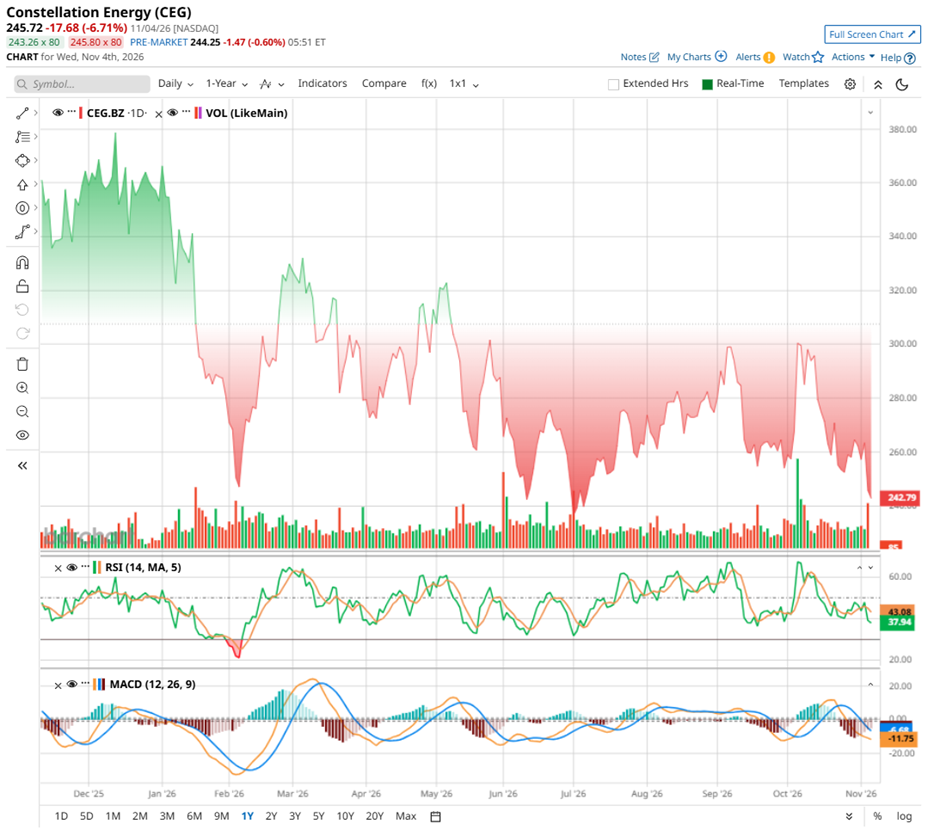
Despite securing some headline-grabbing nuclear deals, Constellation Energy’s shares have had a rough ride. Shares have fallen 40.5% from their Oct. 15, 2025, peak of $412.70 and are down 32.3% over the past year. The weakness has continued in 2026, with CEG losing 30.4% YTD and 23.5% over the past six months.
There have been some bright spots, though. The stock jumped on Oct. 6 after announcing major long-term power agreements with Google, covering a combined 3,590 MW. However, concerns about AI spending, higher interest rates, and a cooling nuclear-energy trade continue to weigh on sentiment.
CEG’s 14-day RSI is hovering around 38, indicating weak momentum and bringing the stock closer to oversold territory, though it has not reached the conventional 30 threshold. Meanwhile, the MACD line remains below the signal line, with negative histogram bars confirming bearish momentum and suggesting that selling pressure continues to outweigh buying interest.
And while the recent price weakness may have made CEG look more attractive, its valuation still deserves a closer look. The stock trades at 20.1 times forward earnings, above the sector average of 18.88 times. So, investors are still paying a premium, meaning Constellation will need consistent earnings growth to justify its price tag. That said, shares are trading below their own historical median, offering some perspective on the recent pullback.
That said, investors looking to earn a little while waiting for the longer-term story to play out also get a modest dividend. Constellation pays $1.71 per share annually, which translates to a forward yield of 0.69%. It won’t exactly make income investors jump out of their seats, but it does offer a small additional return while they wait for the company’s growth plans to deliver.
A Closer Look at Constellation Energy’s Mixed Q2 Earnings Report
Constellation Energy’s Q2 2026 results, reported on Aug. 6, presented a mixed picture, with earnings comfortably beating expectations while revenue fell short of Wall Street estimates. The company brought in $7.5 billion in revenue, up 23% year over year (YOY), while adjusted operating EPS climbed 33.5% to $2.55, easily beating consensus estimates. On the commercial front, Constellation signed approximately 920 MW of long-term nuclear power contracts during the quarter, and its electricity output reached 40 terawatt-hours (TWh).
However, the operational numbers were not quite as impressive. Nuclear generation slipped to 44,160 GWh from 45,170 GWh a year earlier, while the fleet’s capacity factor declined to 93% from 94.8%. There was some improvement in non-refueling outage days, which fell to 20 from 22 in the year-ago quarter, suggesting fewer interruptions from repairs and other operational issues outside scheduled refueling. Still, that improvement was not enough to prevent an overall decline in nuclear output.
Cash flow also remained relatively flat. First-half operating cash flow came in at $1.55 billion, compared with $1.58 billion in the year-ago period. Meanwhile, Constellation ended June with $697 million in cash against $5.6 billion in debt, making access to credit and refinancing capacity important factors to watch.
Looking ahead, management struck a more optimistic tone, raising its full-year 2026 adjusted operating EPS guidance to the $11.50 to $12.50 range, bringing the midpoint to $12, up $0.50 from its previous outlook. The company attributed the improvement to strong commercial execution and disciplined capital allocation, including share repurchases.
Constellation has already deployed approximately $2.2 billion toward buybacks in the four months since its March business outlook and still has $2.8 billion remaining under its authorization. Beyond earnings, management sees plenty of room to grow through rising corporate and data center demand, additional long-term nuclear power agreements, and progress on the Crane nuclear restart.
Meanwhile, analysts tracking Constellation Energy anticipate Q3 revenue of $9.4 billion, while EPS is expected to rise 28.3% YOY to $3.90. Looking ahead to fiscal 2026, EPS is projected to grow 29.7% annually to $12.18 and then rise 9.2% YOY to $13.30 in the next fiscal year.
What Do Analysts Expect for Constellation Energy Stock?
Despite CEG’s recent share price struggles, Wall Street has not given up on the stock just yet. Bank of America Securities analyst Rinny Singh maintained a “Buy” rating with a $346 price target, while Morgan Stanley also stayed bullish, assigning a “Buy” rating with a $391 target.
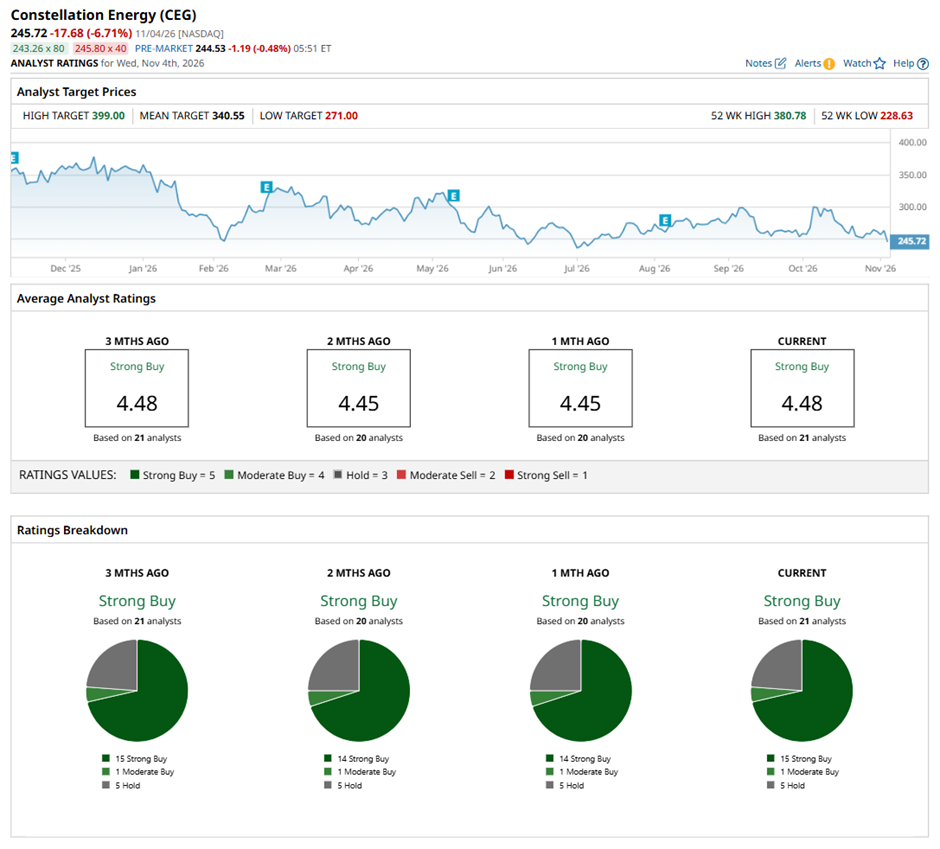
Overall, analyst sentiment remains upbeat, with CEG carrying a “Strong Buy” consensus rating on Barchart. Among 21 analysts covering the stock, 15 have assigned a “Strong Buy,” one recommends a “Moderate Buy,” and another five advise investors to “Hold.”
The average price target of $340.55 implies potential upside of 38.6%, while the Street-High target of $399 suggests the stock could climb 62.4% from its current level.
On the date of publication, Sristi Suman Jayaswal did not directly have a position in any of the securities mentioned in this article. All information and data in this article is solely for informational purposes. For more information please view the Barchart Disclosure Policy here.