
3 Australian Building Materials Stocks With Pricing Power As Rates Bite
Hot inflation, a likely RBA rate hike and a weaker jobs market are reshaping the outlook for Australian housing construction, with higher funding costs pressuring some builders while potentially rewarding those with stronger balance sheets and pricing power. For investors, this mix of risk and resilience can create a narrow window to reassess exposure before sentiment swings again. This article profiles 3 housing construction and building materials stocks that appear positively exposed to these shifting conditions.
The three stocks below are just a starting sample from this corner of the market. The full screen surfaced 7 more Australian housing construction and building materials companies with equally compelling stories that are not covered here. If you want to identify and analyze the broader opportunity set, head straight into the Australian Housing Construction and Building Materials Stocks screener.
Wagners Holding (ASX:WGN)
Wagners Holding is a pure play on the concrete and materials side of the housing cycle. Most of its business is tied to cement, aggregates and ready mixed products that feed directly into residential and infrastructure demand.
Wagners Holding generates most of its A$504 million revenue from Construction Materials at about A$329 million, with Project Services contributing A$82 million and Composite Fibre Technology adding A$93 million, while its market cap sits near A$933 million.
"Expansion of Wagners Holding concrete plants and quarry assets, supported by elevated capital expenditure on new fixed plants and greenfield quarry sites such as Frazerview, positions the business to supply multi year construction demand in Southeast Queensland and potentially lift group revenue and earnings."
How that build out interacts with a still developing pressure on returns could be the swing factor for future profitability.
If that return profile is the real hinge, you probably want the full narrative for Wagners Holding to see how funding costs and pricing power could be decoupling here.

James Hardie Industries (ASX:JHX)
James Hardie Industries plugs directly into the housing construction theme through its fibre cement boards, siding and decking that feed both new builds and renovations, yet its story now turns just as much on how it scales a much bigger North American opportunity.
James Hardie Industries, an Ireland headquartered building products group, manufactures fibre cement, fibre gypsum and cement bonded boards sold globally into residential and commercial projects, and as part of this screener it brings large cap scale with a market value around A$22.8b.
"The integration of AZEK has more than doubled James Hardie Industries' North American serviceable addressable market to about US$23b. Management continues to focus on capturing material conversion from wood and vinyl exteriors, which directly targets higher long term revenue growth."
What happens to margins and cash generation hinges on how one unresolved cost pressure collides with that bigger revenue runway.
That collision point is exactly where you want the full narrative for James Hardie Industries to see whether cost pressures are masking an accelerating earnings story or simply stretching the cycle.

Big River Industries (ASX:BRI)
Big River Industries gives you direct exposure to the Australian housing construction theme, supplying timber, panels and formwork across new builds and renovations through its Panels and Construction operations.
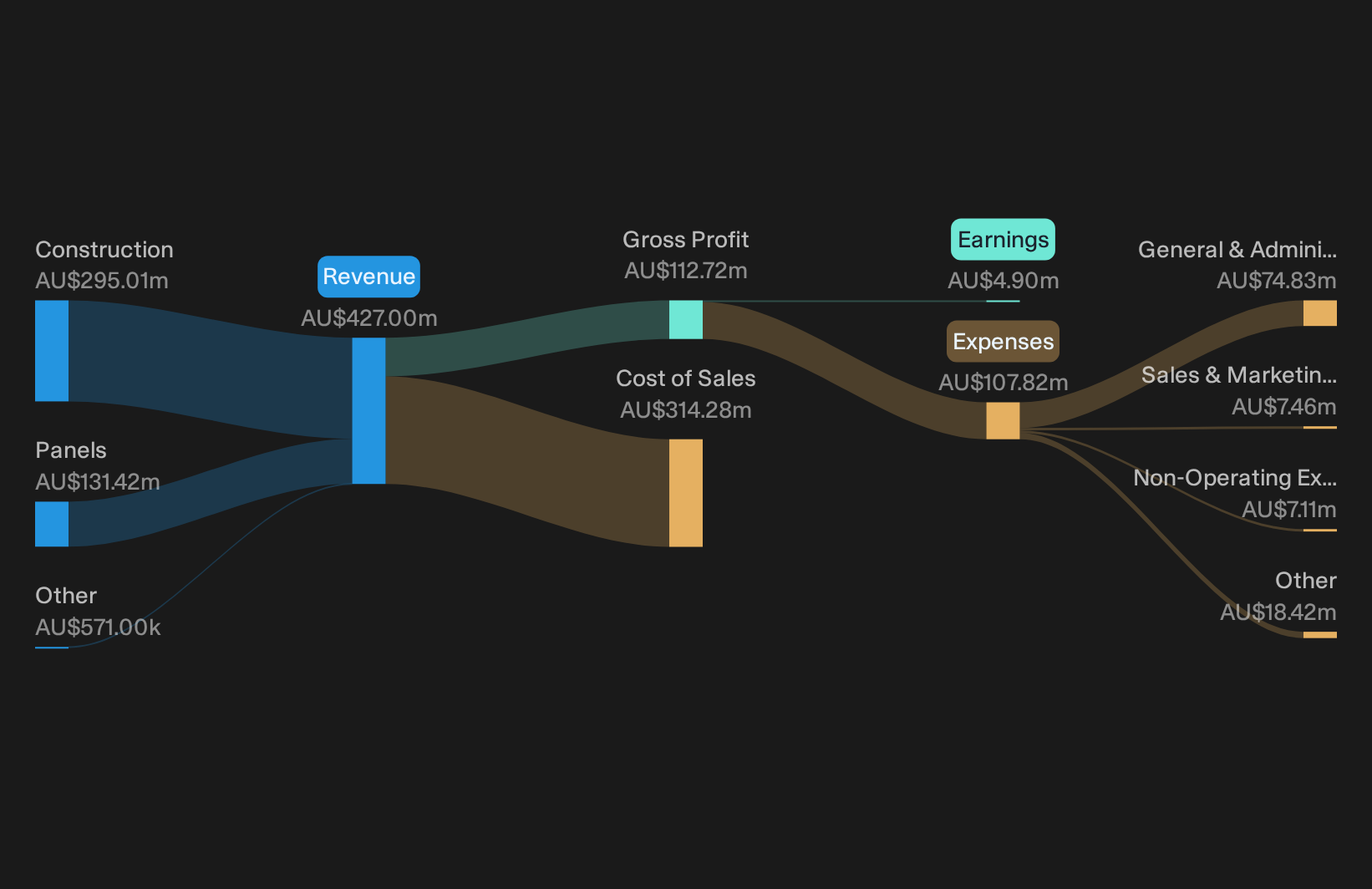
Big River Industries generates about A$131 million from Panels and A$295 million from Construction, with most sales tied to Australian customers, and carries a market cap near A$105 million.
For investors watching rate sensitive building activity, Big River Industries offers a more traditional materials exposure that still hinges on how product mix evolves from here.
"Ongoing mix shift toward higher margin cladding and bespoke decorative and technical panels, supported by new laminating capability at SLQ and product development at Campbellfield and Grafton, is geared to support gross margin and EBITDA margin as these categories expand as a share of sales."
What happens when that mix shift collides with one stubborn cost pressure could be the real test of how far margins can stretch.
That pressure point is exactly where the full narrative for Big River Industries lays out whether Big River Industries has an accelerating margin story or just a fragile mix shift.
Seeking Alternatives Before The Crowd
Fresh themes often move first, and laggards can end up chasing momentum once prices start rising. Scan under the radar for now, while it matters, and consider positioning early.
- Target income resilience with potential inflation protection by scanning a curated 5 dividend fortresses designed to help keep payouts flowing across different rate and sentiment environments.
- Explore future enablers of data and automation through a focused list of 53 AI infrastructure stocks that may support the next phase of computing demand.
- Follow the energy transition from a different angle by reviewing a hand-picked group of 16 top copper producer stocks connected to electrification and long-term metals demand.
Have feedback on this article? Concerned about the content? Get in touch with us directly. Alternatively, email editorial-team@simplywallst.com