
Main Street Capital (MAIN) Could Be 6% Undervalued As Dividends Rise Despite Softer Earnings
Main Street Capital dividend moves under the earnings spotlight
Main Street Capital (MAIN) has paired slightly softer third quarter earnings with a richer payout, lifting its regular monthly dividend into early 2027 and adding a special cash distribution for December 2026.
This mix of lower reported profit per share and higher cash returns puts the focus on two questions for investors: How durable is the income Main Street Capital generates from its lending portfolio, and how well insulated is that income from rising funding costs after recent fixed income offerings?
Recent trading has started to reflect this income story. Main Street Capital’s share price has risen over the past week and month, with a 7 day share price return of 3.17% and a 30 day share price return of 6.08%. However, the 90 day share price return declined 2.58% and the year to date share price return is down 7.68%, while longer term total shareholder returns of 4.93% over 1 year and more than 70% over 3 and 5 years show why many holders continue to watch dividend changes and funding costs so closely.
Look beyond Main Street Capital and compare its dividend profile, leverage and income focus to a curated 7 dividend fortresses that investors are watching for resilient cash payouts.
Main Street Capital has climbed after its dividend news, yet the share price still sits below both analyst targets and intrinsic estimates. Where does fair value really land between those reference points and the recent move?
Most Popular Narrative: 6% Undervalued
On the most followed view, Main Street Capital screens as modestly undervalued, with a fair value of about $60.33 against a last close of $57.01. This puts the spotlight on how dependable its earnings and dividend engine really are.
The main thing that has to go right is that new lower middle market platforms and the expanded private loan and external management businesses keep producing realized gains and fee income large enough to offset higher funding costs and lower dividend income from exited positions.
The current valuation implies the share price already reflects strong realized gains, a low-cost operating model and a conservative balance sheet. If these advantages fade or earnings weaken, Main Street Capital stock could trade below current levels.
See why 105 investors see Main Street Capital as 6% undervalued.
Result: Fair Value of $60.33 (UNDERVALUED)
Still, the story can shift quickly if higher interest expenses from new debt weigh more heavily on margins, or if dividend income from portfolio companies keeps thinning out.
Find out about the key risks to this Main Street Capital narrative.
Another View: Main Street Capital through a cash flow lens
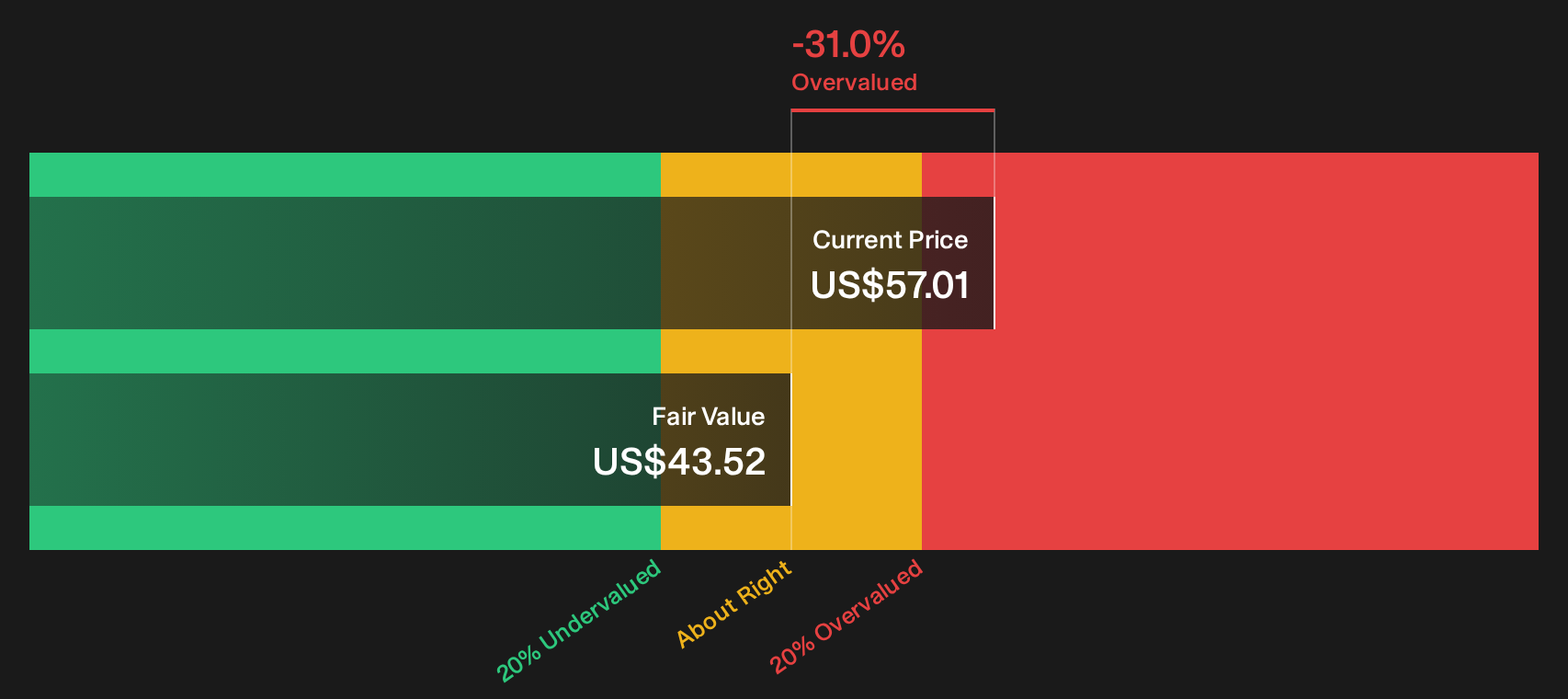
There is a different take on Main Street Capital when the SWS DCF model is used instead of earnings multiples. On that framework, the estimated future cash flow value is $44 per share while the stock trades at $57.01. That points to an overvalued picture and leaves readers to ask which set of assumptions feels more realistic.
To unpack how that gap is built from specific cash flow forecasts and discount rate choices, Look into how the SWS DCF model arrives at its fair value.
Simply Wall St performs a discounted cash flow (DCF) on every stock in the world every day (check out Main Street Capital for example). We show the entire calculation in full. You can track the result in your watchlist or portfolio and be alerted when this changes, or use our stock screener to discover 36 high quality undervalued stocks. If you save a screener we even alert you when new companies match - so you never miss a potential opportunity.
Next Steps
Mixed signals on Main Street Capital can feel confusing, so move quickly from headline impressions to your own view by weighing both the upside case and the risk factors. To see both sides set out clearly, start with 1 key reward and 5 important warning signs.
Looking for more Main Street Capital style ideas?
If you like how Main Street Capital blends income, valuation and balance sheet discipline, do not stop here. Use targeted screeners to spot your next lead.
- Target dependable income streams by reviewing a curated group of 7 dividend fortresses that focus on sustaining higher yields through varied conditions.
- Hunt for potential mispricings by scanning a focused universe of 36 high quality undervalued stocks that pair quality fundamentals with discounted valuations.
- Prioritise resilience by filtering for 31 resilient stocks with low risk scores that score well on balance sheet strength and measured risk profiles.
Have feedback on this article? Concerned about the content? Get in touch with us directly. Alternatively, email editorial-team@simplywallst.com