
Charter Communications (CHTR) Stock May Be Below Fair Value After Cox Deal
Charter Communications has seen a sharp reset in its share price in recent years, and the latest shift in its business after the Cox Communications acquisition puts fresh attention on a simple question for you as an investor: Is the current US$118.07 stock price a fair reflection of what the cable group actually earns today and what those earnings can support over time?
- Over the past 5 years the share price has fallen 82.9%, which puts the spotlight firmly on whether the earnings that underpin Charter Communications still justify even the lower market valuation.
- The recent loss tied to a US$6.3b franchise impairment charge and subscriber declines, alongside a US$2b expense reduction plan and targeted synergies from the Cox deal, can reshape future earnings quality and timing, which matters directly for any earnings based valuation.
- There is a second opinion on Charter Communications worth weighing. See what analysts think Charter Communications's shares could be worth.
The issue now is whether the current price for Charter Communications is properly aligned with what its earnings suggest the stock should be worth.
If you want to test the same earnings question that hangs over Charter Communications against a wider group of companies, scan through the 39 high quality undervalued stocks.
Does Charter Communications Look Undervalued on Earnings?
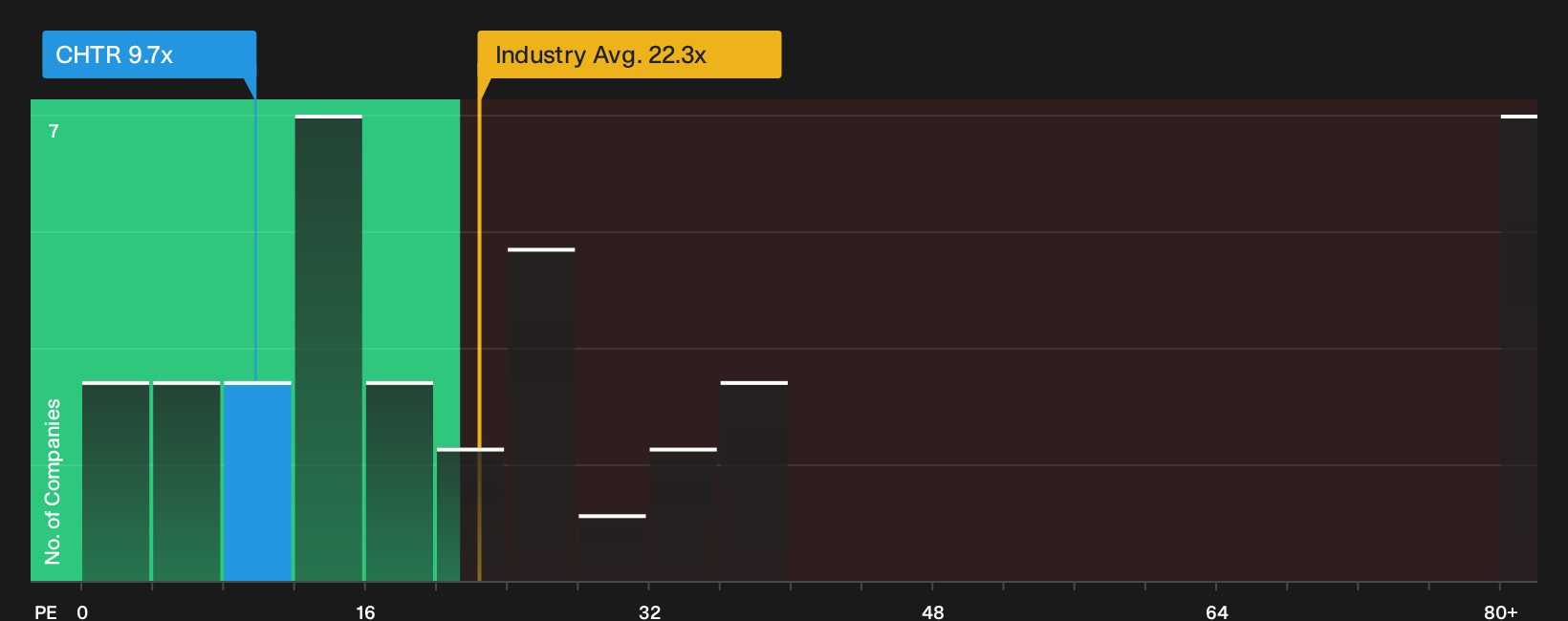
The P/E ratio fits Charter Communications because earnings are still the main anchor for how investors judge the business. On that yardstick, the stock trades at about 9.7x earnings, which is well below the media industry average of roughly 22.3x and also under the peer group level near 13.8x. That gap shows the market is putting a lower price on each dollar of Charter Communications profit than on comparable media companies.
The valuation model that blends the firm’s growth profile, margins, size and risk suggests a higher P/E would typically line up with those fundamentals. As a result, the current 9.7x screens on the undervalued side against that tailored yardstick. Because the third quarter loss stemmed largely from a US$6.3b impairment charge and ongoing subscriber pressure, the low multiple also reflects investor doubts about how durable earnings will be as the Cox integration and US$2b cost program play out. The key question for you is whether that skepticism is too harsh or justified, which is exactly what the full multiple breakdown aims to help you test. Explore the numbers behind Charter Communications's P/E valuation.
The Charter Communications Narrative: What Would Justify Today's Price?
Simply Wall St Narratives for Charter Communications pick up where the P/E puzzle leaves off and explain what kind of future growth, margins and earnings path would need to unfold for the current share price to look either conservative or too generous. Each scenario links Charter Communications' potential catalysts and key risks to its own implied fair value, so you can track over time which storyline appears to be getting closer to reality on the Community page.
Charter Communications splits opinion, with some community members arguing the reset has gone too far while others see the current price as already baking in the good news.
Bull case: 60% undervalued
"CHTR is nearing the end of a large multi-year network upgrade and capex, which has been coming in at roughly 11.5B for three years…"
Discover why this Narrative puts Charter Communications at 60% undervalued.
Bear case: 74% overvalued
"Although Charter Communications is promoting converged connectivity with mobile and video bundles that reduce churn, the company’s own expectation for around a 1% decline in standalone 2026 EBITDA…"
Explore why this Narrative puts Charter Communications at 74% overvalued.
Before moving on from Charter Communications, there is one more piece to check
Numbers only tell part of the story for Charter Communications, because the people directing capital and the way they are rewarded can either support or undermine any valuation case. See who runs Charter Communications and how they are paid.
Have feedback on this article? Concerned about the content? Get in touch with us directly. Alternatively, email editorial-team@simplywallst.com