
What Citigroup Holders Bought Into
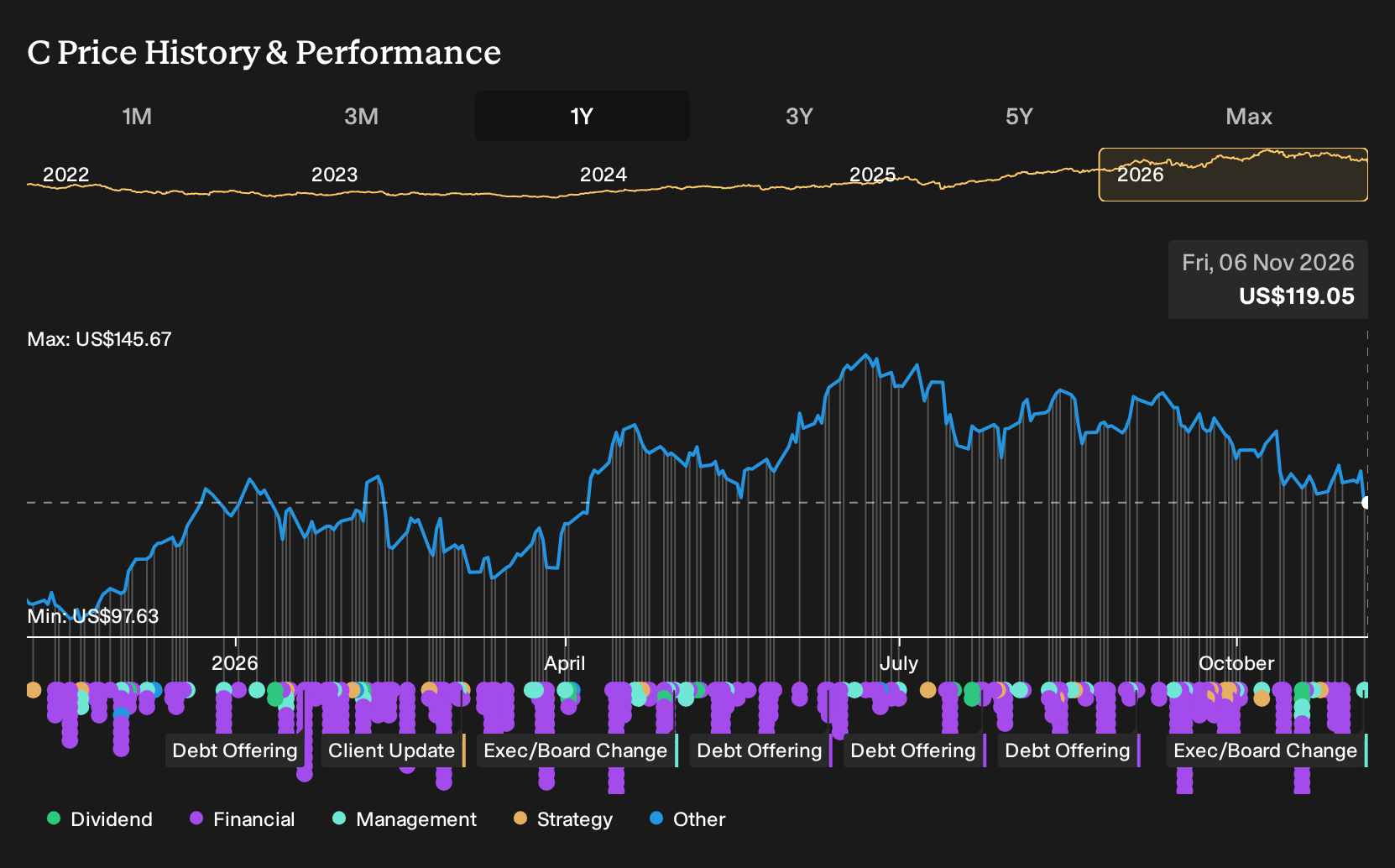
If you had been weighing Citigroup in early November 2025, the split between a bullish US$233 fair value and a bearish US$77 view already forced a hard question about what to trust more: the GENIUS Act upside or the cost and risk of the bank’s overhaul. For Citigroup shareholders, the return over the past year was 20.6%, including dividends. If you were deciding back then, which part of that record would have carried more weight, the digital asset promise or the drag from heavy transformation spending?
The useful thing about a Narrative is that the reasoning is checkable: the assumptions sit beside the argument, and together they imply an estimated Fair Value you can disagree with.
Citigroup has already moved. Pinpoint other ways to investigate the theme among 18 cryptocurrency and blockchain stocks.
The Two Citigroup Stories Investors Had To Hold In Their Heads
The shares cost US$101 at the start of the period, so anyone looking at Citigroup then had to decide which story felt more realistic.
The bullish narrative put fair value at US$233, based on 6.0% revenue growth, a 34.0% profit margin and a future P/E of 14.0x over a 10-year span. It leaned heavily on the GENIUS Act framework and Citi Token Services as a potential engine for cross-border payment activity.
The more cautious view argued for a fair value of US$77. It treated heavy transformation spending, regulatory pressure and credit risk as live threats that could keep expenses high, even as a US$20b buyback program ran in the background.
What The Citigroup Results Actually Tested
Citigroup’s Q3 2026 report showed revenue of US$21,423m and net income of US$4,840m, up from US$19,836m and US$3,439m in Q3 2025, with net margin rising from 17.3% to 22.6%. That outcome leaned toward the bullish story that assumed stronger profitability. However, the GENIUS Act and digital asset angle still relies on later news and remains only partly tested.
The useful takeaway is simple. When a thesis leans on margin expansion, like the Citigroup bull case did, you check the reported net margin first and then see whether revenue, costs and new projects line up with that improvement.
What Citigroup's Recent Run Already Prices In
Citigroup now trades at US$119 after a 20.6% gain over the past year. The selected Narrative places its own Fair Value above that level, tied to how services, digital payments and AI driven efficiency might feed through to returns over time.
The key question for anyone paying today is whether Citigroup can keep turning services growth and AI driven productivity into sustained double digit returns on tangible common equity.
"The main requirement is that Citigroup continues to convert its services growth, AI driven efficiency efforts and business simplification into sustained double digit returns on tangible common equity, without allowing regulatory and conduct risks to erode that progress."
That disagreement has a full argument behind it. → Uncover the higher Fair Value this Narrative argues for
Another Way To Think About Citigroup
Citigroup pulls you toward digital assets and tokenized cash. One step away, a different banking giant works on a related task.
Where Citigroup leans on token services, this peer leans on tokenized funds. It is building vehicles designed to plug into evolving payment and settlement plumbing.
Large clients there already rely on AI financing, security projects and payment flows. Those needs look familiar if you follow what Citigroup is trying to build.
The open question is simple. As more money moves in token form, who ends up closest to recurring transaction and asset management fees?
The case is on the record, with the assumptions it rests on. → See the Narrative that values this company 25% above its price
Have feedback on this article? Concerned about the content? Get in touch with us directly. Alternatively, email editorial-team@simplywallst.com