
“Profit resilience” became the key word in the Q3 earnings report. How far can Chunli Healthcare (01858) go after four consecutive gains in stock prices?
After the market on October 30, Chunli Healthcare (01858) disclosed the company's 26Q3 quarterly financial report.
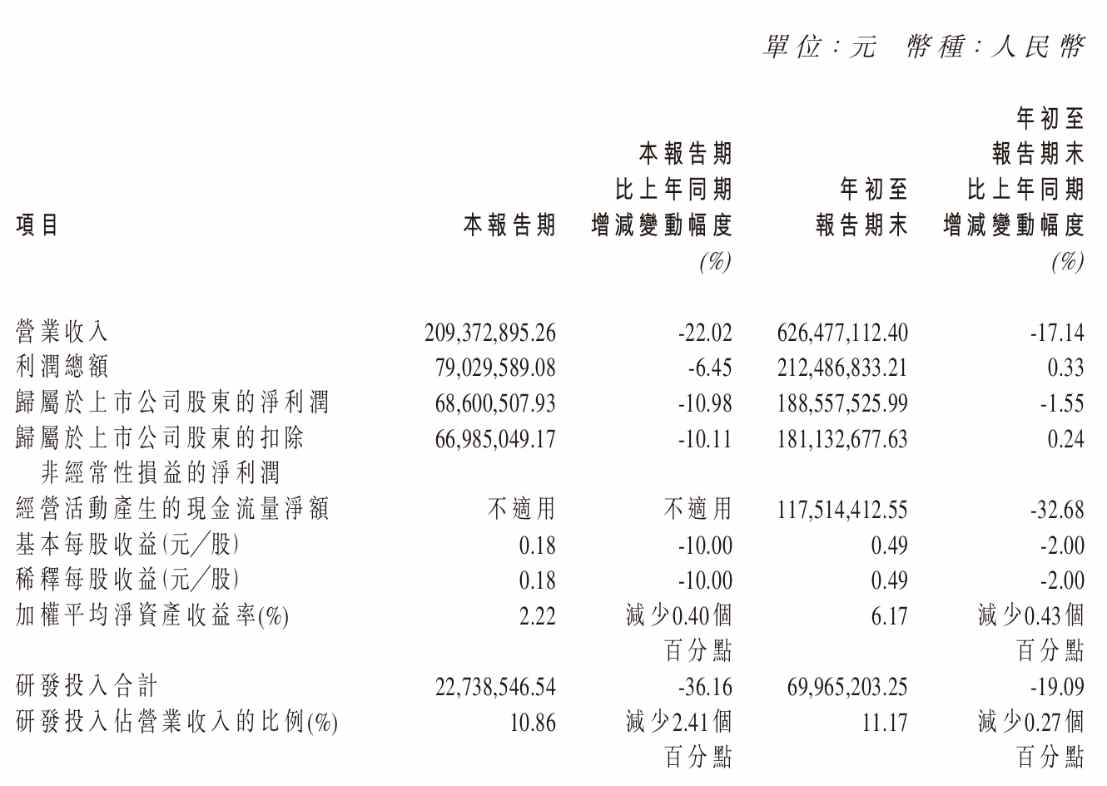
According to financial reports, the company's revenue for the 26Q3 single quarter was 209 million yuan (RMB, same unit), down 22.02% year on year; net profit due to mother during the same period was 686.05 million yuan, down 10.98% year on year; corresponding net profit deducted from mother was 669.85 million yuan, down 10.10% year on year.
In the first three quarters of this year, Chunli Healthcare's revenue was 626 million yuan, down 17.14% year on year; net profit due to mother during the same period was 189 million yuan, down 1.55% year on year; net profit corresponding to deducted non-return mother was 181 million yuan, up 0.24% year on year.
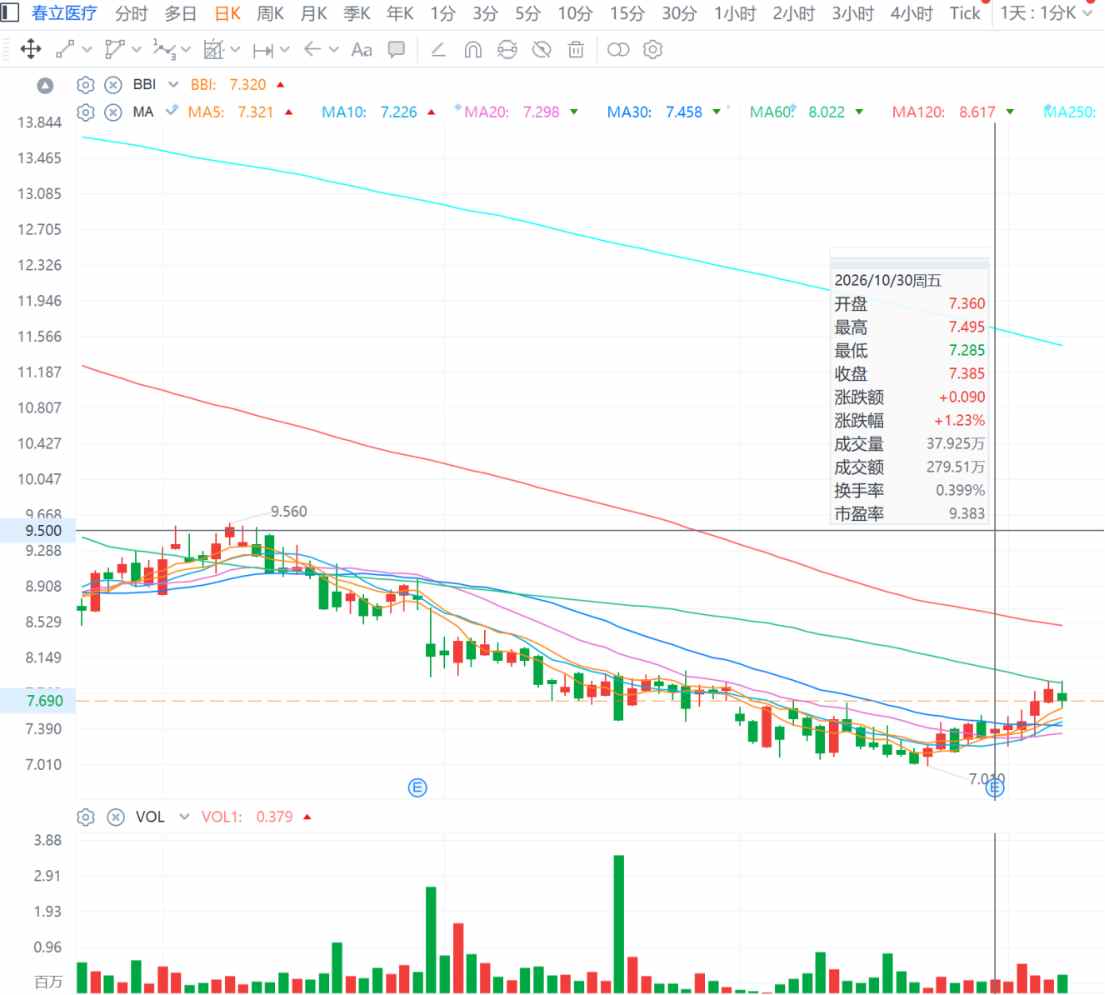
The Zhitong Finance App observed that Chunli Healthcare's H share price bottomed out and rebounded after hitting a phased low of HK$7.01 in the intraday session on October 23. By the close of trading on October 30, the company's stock price had slowly rebounded to HK$7.39. After the disclosure of this Q3 earnings report, Chunli Medical's stock price not only did not retreat, but instead accelerated its rise out of the “Four Lianyang” market. At one point, the high stock price was pushed to HK$7.88.
From shrinking and stabilizing at the bottom to an accelerated rebound
Looking back at Chunli Medical's recent upward trend, the key turning point was undoubtedly October 23. Although it is still 7 days until the disclosure of the company's 26Q3 earnings report, signs of technical bottoming out have already appeared ahead of schedule.
It is easy to see that before October 23, Chunli Medical's H share price had continued to fall from its high in late September and closed at HK$7.03 on October 22. On the same day, the company's stock trading volume had shrunk to only 299,500 shares, down about 72% from 1.085 million shares on October 20. As fundraisers in the market tend to agree that they are reluctant to sell, Chunli H Shares has also reached a critical window to establish stability.
On October 23, although Chunli Medical's H share price hit a new low of HK$7.01 in the intraday period, it once again rebounded to HK$7.18 at the close, reaching the 5-day and 10-day EMAs; in terms of energy, its full-day trading volume fell further to 153,500 shares on the same day, the lowest single-day trading volume in the range, thus forming the classic bottom signal of “long shadow line+ground volume”. Meanwhile, Chunli Medical's A-share price rose 2.22% on the same day, and there was a net inflow of 615,000 yuan in main capital, indicating that institutional capital began to choose to take on the initiative at a low level.
The combined performance of AH volume and price also further confirmed the effectiveness of Chunli H shares in building a stable base.
After it was determined that the stock price had bottomed out, Chunli H Shares welcomed sector beta catalysis the next day. On October 26, A-share Tianyi Medical's Q3 earnings report that exceeded expectations ignited the device sector. On the same day, while Tianyi Medical's stock price rose by more than 10%, the intraday stock prices of Dabo Healthcare, Tianzhihang, and Yahuilong all rose more than 7%, and many device-weighted stocks collectively eventually followed suit, driving the medical device index to rise more than 2% in the intraday period to lead the pharmaceutical industry chain.
According to the Zhitong Finance App's observation, at the institutional level, brokerage firms are intensively setting the “inflection point”, indicating that the device industry is expected to achieve both a recovery in performance and valuation. Among them, CITIC Construction Investment Securities pointed out in the latest updated research report that with the improvement of medical equipment tenders, the impact of high-value consumables and IVD collection is gradually being clarified, and many leading device segments will enter a period of accelerated performance.
Under the influence of the beta sector, Chunli's H share volume rose on October 26. It closed up 2.16% on the same day, corresponding to a trading volume of 444,500 shares, further confirming the rebound and paving the way for the subsequent rise in H share prices after the disclosure of the company's financial reports.
From October 23 to November 5, after Chunli's H share price stabilized at the 5-day EMA and 10-day EMA on October 28, its moving average system showed a typical short-term bullish arrangement pattern, and the stock price continued to move along the 5-day EMA under the catalyst of financial reports, and initially entered an acceleration phase in November. The OBV index continued to rise from -4.52 million to -1.96 million during the same period. The trend and price increased simultaneously, and the characteristics of net capital inflows were obvious.
The momentum index shows that on October 23, the DIF line of the Chunli H share MACD index quickly converged towards the zero axis. Although the trend was clear even though the gold fork had not reached zero on that day; after that, its MACD bar continued to expand on October 23, and the red bar continued to expand for 8 consecutive days, corresponding to the continued opening of DIF and DEA scissors, indicating that the company's stock price had entered a phase of accelerated trend.
At the same time, Chunli's RSI index for H shares also continues to strengthen. According to the data, its RSI6 index quickly rebounded from 31.00 on October 23 to 78.03, and has now entered the overbought zone; RSI12 has also strengthened to a strong area of 72.40 at the same time
Only RSI24 is still in the 49.70 area, indicating that the company's stock price momentum in the medium term is still recovering.
“Profit resilience” has become the core of this round of market pricing
As of November, the 26Q3 financial reports of listed domestic orthopedic medical device companies such as Dabo Medical, Weigao Orthopedic, Chunli Medical, Sanyou Medical, and Kellitai had all been released. Financial reports show that after nearly two years of industry recovery, orthopedic track performance was further divided this quarter.
According to the data, in the Q3 quarter of this year, Sanyou Medical's net profit decreased 22.47% year on year, and net profit corresponding to deducted non-return to mother decreased 32.18% year on year; Weigao Orthopedic's net profit to mother decreased by 30.60% year on year, and net profit from non-return to mother decreased 11.12% year on year. In contrast, against the backdrop of a 17.14% year-on-year decline in current revenue, Chunli Healthcare increased 0.24% year over year after deducting non-net profit.
As can be seen from the disaggregated profit table data, in the first three quarters of this year, Chunli Medical's sales expenses, management expenses, and R&D expenses decreased by 37.67%, 24.37%, and 19.09%, respectively. This compounded the scale effect brought about by the increase in sales volume of collected products, thus basically covering the revenue gap, making it ultimately achieve positive growth after deducting non-net profit. However, in the current uncertain environment of normalization of collection and geographical turbulence, the market is clearly more willing to pay valuation premiums for companies whose “profit is more certain than revenue”.
On the other hand, the margin of safety provided by its own extremely undervaluation is also one of the important reasons for the current rebound in Chunli Medical's stock price.
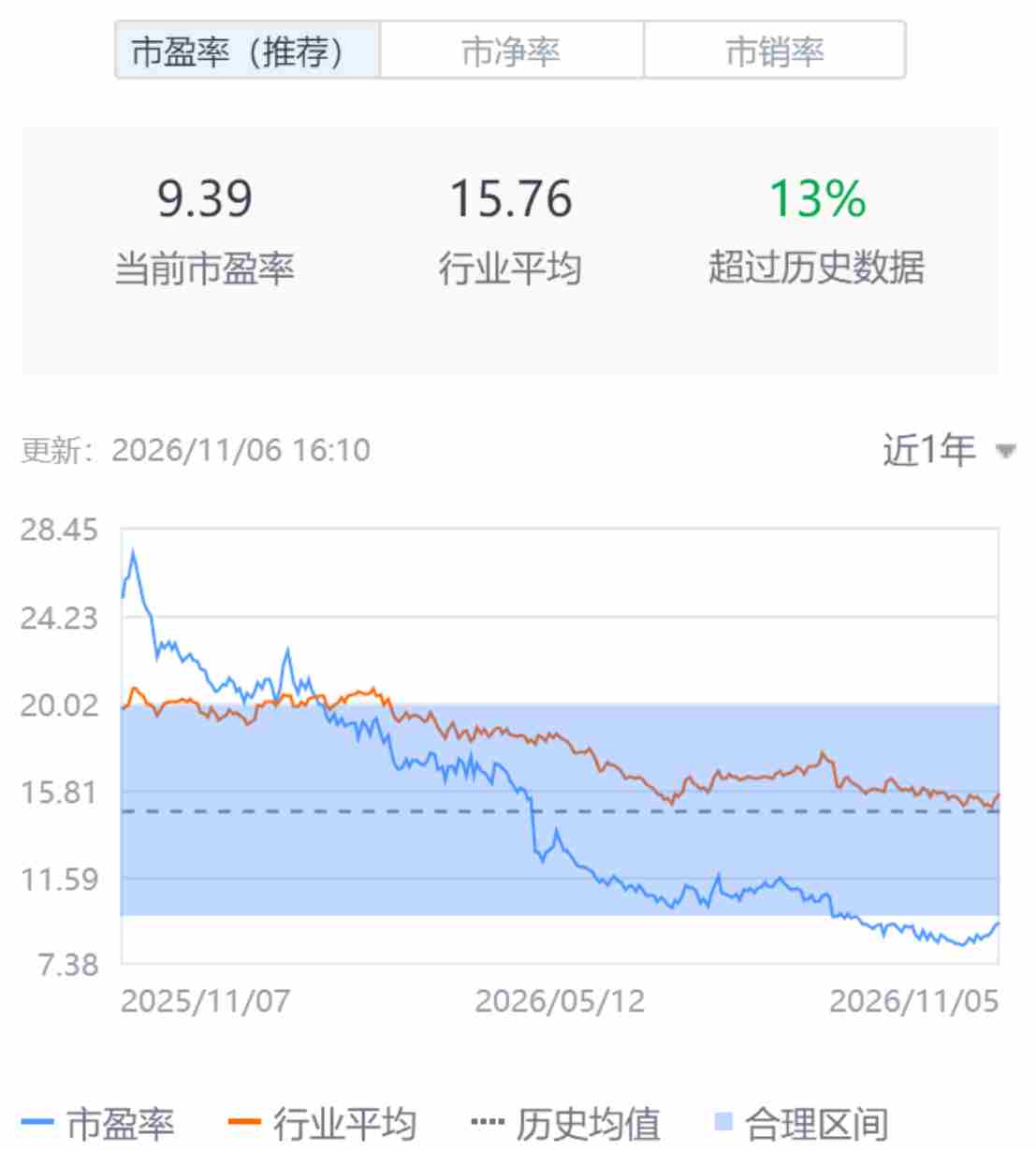
From a valuation perspective, after a long period of falling stock prices, Chunli Medical's current valuation is significantly lower than the industry average. In the research report updated by Huatai Securities on November 3, the agency gave key valuation data for Hong Kong stocks: Currently, the PE (2026E) of Chunli Medical H shares is only about 9.3 times, and the PB valuation is only 0.78 times broken. Furthermore, its current EV/EBITDA is 7.25 times, and the corresponding dividend ratio has reached 5.42%.
It is easy to see that the PE valuation performance of Chunli H Shares is already significantly lower than the PE level of 15.76 times the industry average. It is also 13% lower than the company's PE average valuation in the past year, which is clearly undervalued.
Also, judging from the liquidity performance, the current average daily turnover of Chunli's H shares is only about 460,000 shares, while the corresponding turnover is between HK$3 million and HK$6 million, indicating that it has become a small-cap stock with extremely low liquidity.
However, because of this, the price discovery process for Chunli Medical H shares catalyzed by institutional research reports has become more intense. On November 3, Chunli's H shares closed up to 808,000 shares, reaching 2.1 times its previous average daily volume, thus driving its H share increase to 8.24% within three days, overtaking 7.07% of its A-share increase over the same period, and emerging from the “A share premium and weak rise in Hong Kong stocks” stock price performance that is different from normal conditions.