
What SJVN Doubters Saw Before The Drop
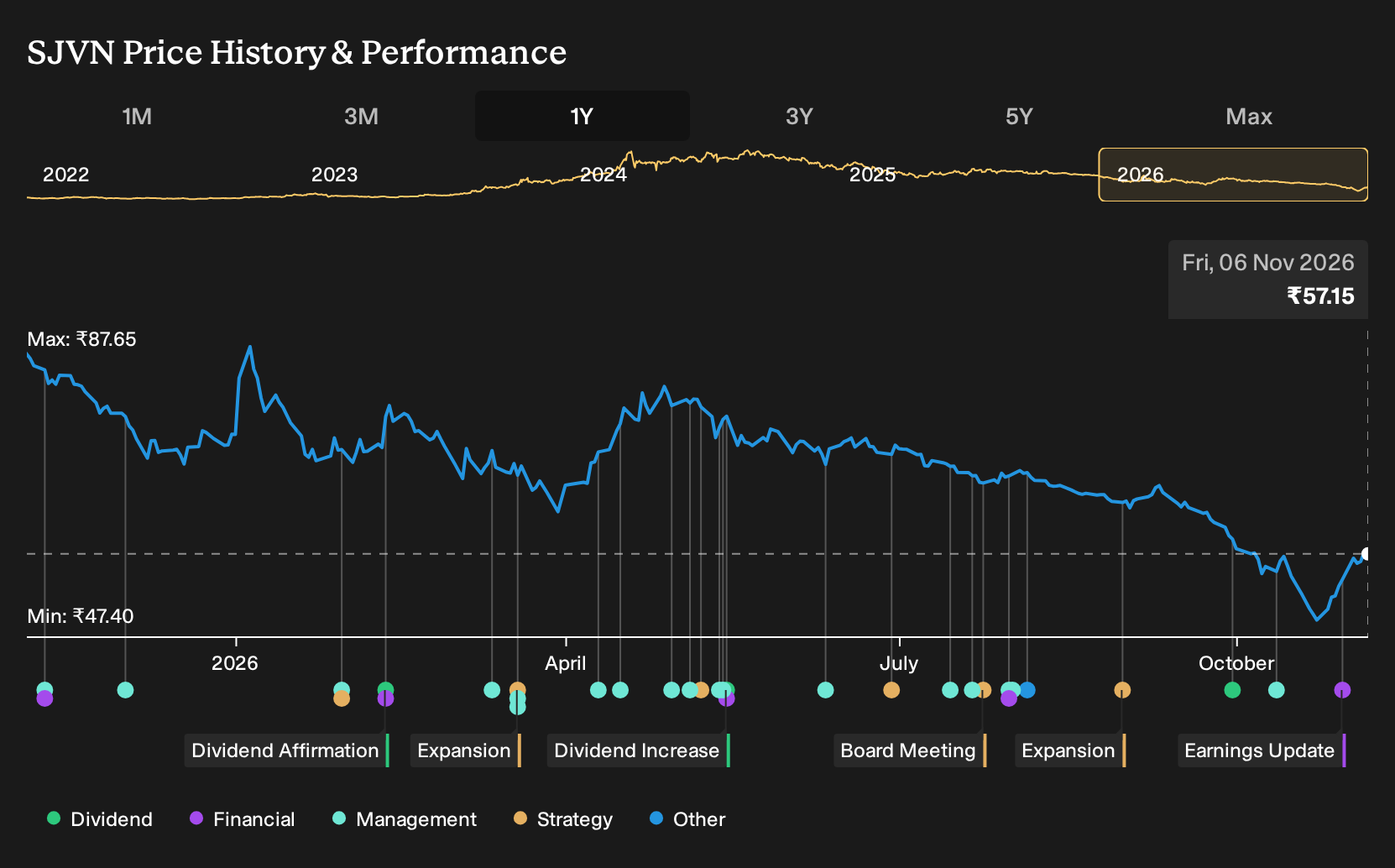
If you backed SJVN for its government partnerships and growth plans, the result would have stung. Holding SJVN over the past year would have meant a 31.2% loss, including dividends. That outcome sits awkwardly beside bullish expectations of rapid capacity expansion, rising margins and value from a listed renewables arm. If you were weighing an investment on 6 November 2025, what did that original case miss about execution risks, technology shifts and hydro reliance?
If the move has made SJVN harder to judge, start where the gap is still open and scan 227 high quality undervalued stocks.
The Two SJVN Stories Investors Were Weighing
The shares cost ₹85.93 at the start of the period, and anyone looking at SJVN then had to pick between two very different futures for the utility.
The bullish narrative pointed to a Fair Value of ₹95, a price implied by those optimistic assumptions. This view was built on SJVN using its government partnerships and renewables arm to secure premium margins from new capacity and PM Surya Ghar work.
The bearish view saw Fair Value closer to ₹46, again implied by its own forecasts. This perspective was anchored in concerns that hydro dependence, project delays at Arun 3 and Bikaner, and rising finance costs could weaken earnings quality over time.
What The Results Changed For The SJVN Debate
The clearest datapoint came later. By Q2 2027, SJVN reported revenue of ₹22,443.2m and net income of ₹6,573.9m, both higher than Q2 2026. Net margin slipped from 29.8% to 29.3%. That combination supported the optimistic case on scale and earnings power, while reminding investors that the margin expansion story was not yet settled.
The lesson is simple. When a thesis leans on richer profitability, track the actual margin line every results season and see whether it moves in the promised direction.
What You Are Really Paying For In SJVN Today
SJVN now trades at ₹57.15, with this Narrative’s Fair Value sitting above that level. The argument leans less on sheer megawatts and more on how existing and under construction assets are used, priced and financed.
A buyer today would need to believe SJVN can turn more of its larger, mixed portfolio into efficiently utilised, contracted projects that lift consolidated margins.
"The 3,926.5 MW under construction across hydro, thermal and solar creates scope for SJVN to rebalance its earnings mix once these assets are operational, with a larger share of regulated or contracted cash flows. This can help dampen the impact of finance costs and depreciation on reported earnings."
Not everyone reads the same price the same way. → See the higher figure this Narrative lands on, and how it gets there
Where SJVN’s Lesson Points Next
SJVN highlights how capital heavy power projects depend on regulation and contracts. You can look one step sideways from that story.
Some utilities now focus on very large power hubs for data centers. Their pitch is simple. Keep massive new loads supplied without pushing local bills sharply higher.
To do that, one player is pairing gas generation, renewables and storage on single multi asset sites. The aim is steadier cash flows from long commitments around those hubs.
The interesting question is how far that model travels. As more digital infrastructure appears, who captures the value of keeping it reliably switched on?
It is written up in full, assumptions and all. → Explore the Narrative that puts this company 25% above its price
Have feedback on this article? Concerned about the content? Get in touch with us directly. Alternatively, email editorial-team@simplywallst.com