
Nasdaq Rout Gives Way to Unusual Options Activity and Bullish Bets on Nvidia, AT&T and Alphabet Stocks
As I begin writing Friday’s unusual options activity commentary less than an hour into trading, the S&P 500 is up more than 1% on blowout job numbers, while the VIX is down more than 13% to 24.30.
I’m not sure what led to yesterday’s meltdown. The markets seemed impervious to bad news. The Dow did the best yesterday, up 3.44%, while the tech-heavy Nasdaq 100 lost 6.36%, its worst day since 2020, reducing its 2026 gain to less than 6%.
With 55 days left in 2026, the S&P 500 could post a negative return for the year. Most likely, despite today’s bounceback, it will be the worst annual performance since 2022.
In yesterday’s options trading, volume was 93.3 million, 1.5 times the 90-day average. Approximately 51% of the trade volume was for options expiring in 6 days or more. That’s quite high. Interestingly, puts and calls were evenly divided, which, given recent history, is a bearish indicator.
There were 10 unusually active options yesterday, with Vol/OI (volume-to-open-interest) ratios of 50 or higher, including 4 over 100, which isn't that high given the day’s volume.
It won’t be as easy as I thought to find some interesting options trades from yesterday’s trading, but I’ll try my best.
Have an excellent weekend.
Is Nvidia Worth Buying Now?
Chart Kid Matt’s Matt Cerminaro likely thinks so. In his Monday post, he noted that Nvidia’s (NVDA) forward P/E was 14.1x, 380 basis points below the S&P 500 Value Index’s forward P/E. As of Nov. 2, NVDA traded at a 21% discount to the S&P Value Index.
“Here’s the bottom line: this is either the fattest pitch that AI bulls have seen within the entire cycle, or the market will make me look stupid a year from now,” Cerminaro wrote. Since last Friday’s close through Wednesday’s close, NVDA is down 11.2%.
As I write this, it’s up 6%, but well off the Oct. 30 close of $204.64. If it were cheap at around $202 on Monday, it is even cheaper at $192, one might surmise. Jensen Huang, in my opinion, is one of the best CEOs on the planet, so I definitely think it will be considerably higher in 3-5 years.
In the meantime, Nvidia had two of the top five unusually active options yesterday, with Vol/OI ratios of 144.55 and 78.03. Both expire in a week. The two calls point to a Bull Call Spread. 
The options flow confirms it.

As you can see above, two trades for 4,113 contracts occurred at 10:48:35 ET yesterday. They were part of a new multi-leg trade. In this example, the institution bought a Nov. 13 $192.50 call for $4.04 per share and sold a Nov. 13 $197.50 call for $2.49 per share in premium income to partially offset the cost of the long call for a net debit of $1.55 per share.
Here’s how the bull call spread looks today. As you can see, the net debit has increased by 90 cents to $2.45, which pushes the breakeven to $194.95, up from $194.05. You'll achieve the maximum profit of $2.55 is achieved if Nvidia’s share price is above $197.50 at expiration next Friday. Even with the 90-cent move, the likelihood of making money on the bull call spread is 45.9%, so you’ve still got time to make this bet.

AT&T Is a Better Short-Term Bet

AT&T (T) had two unusually active options yesterday. Both puts. The options flow set up either a Bear Put Spread or a Bull Put Spread. The two trades for 898 contracts happened at 14:47:44 ET.

Based on yesterday’s trade, the bull put spread involves selling the Nov. 13 $21.50 put for $0.34 in premium income and buying the Nov. 13 $21 put for $0.20, for a net credit of $0.14. The trader makes money if the share price is $21.37 [$21.50 strike price - $0.14 net credit] or higher a week from today.
The maximum profit of $14 per contract occurs if the share price is at $21.50 or higher at expiration. The maximum loss of $0.36 [$21.50 strike price - $21 strike price - $0.14 net credit] occurs if the share price is at or below $21 on Nov. 13. The likelihood of making or losing money on this bet is 55%/45%.
The bear put spread involves buying the Nov. 13 $21.50 put for $0.34 and selling the Nov. 13 $21 put for $0.20 in premium income, for a net debit of $0.14. If the share price is below the breakeven of $21.36 [$21.50 strike price - $0.14 net debit] a week from today, the bear put spread makes money.
The maximum profit of $14 per contract occurs if the share price is at $21 or lower at expiration. The maximum loss of $0.36 [$21.50 strike price - $21 strike price - $0.14 net debit] occurs if the share price is at or above $21.50 on Nov. 13. The likelihood of making or losing money on this bet is 34%/66%.
The odds say the bull spread is the way to go.
Is Alphabet’s Terrible October in the Rearview Mirror?

Alphabet (GOOGL) had 10 unusually active options in yesterday’s trading, with DTEs (days to expiration) ranging from 8 to 161. However, the Jan. 15/2027 $325 call caught my attention.
Looking at the options flow for GOOGL for Jan. 15/2027, the two calls shown below traded at the same time yesterday and the trade sizes matched. This multi-leg trade was the highest volume for the $325/$360 combination. Eight other multi-leg trades had trade sizes above 1,000 and the same $325/$360 combination.

I haven’t looked at the other eight, but these two scream a bull call spread. The institution that made these trades bought 7,500 Jan. 15/2027 $325 calls for $4.75 per share and sold 7,500 Jan. 15/2027 $360 calls for $1.28 per share in premium income, for a net debit of $3.47 per share. The bull call spread lowered the long call cost by 27%, or $960,000.
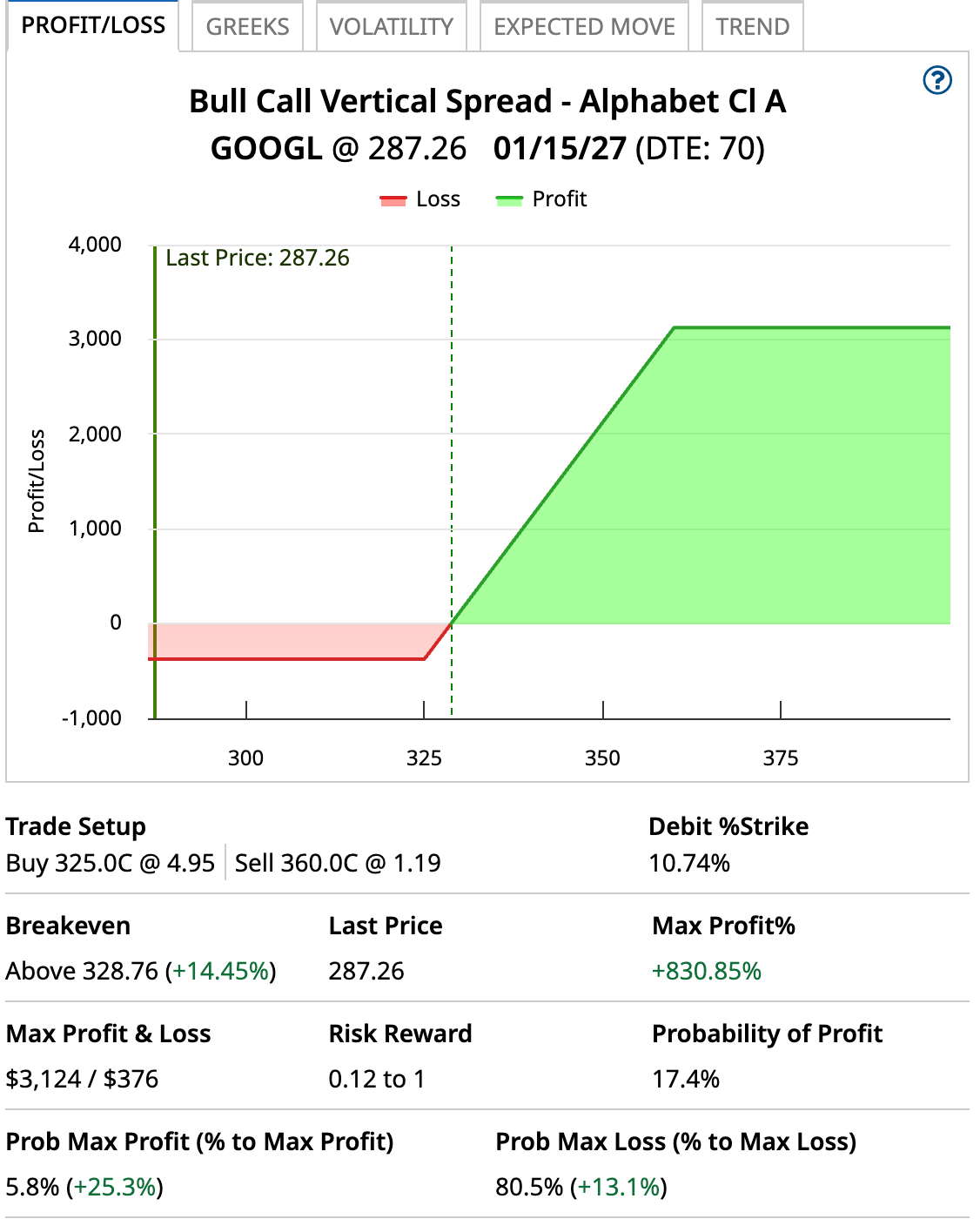
The net debit today for the $325/$360 combination is $3.76. It’s a low-risk, high-reward bet.

The profit/loss picture chart is shown below. For every call, you’re risking $376 to generate as much as $3,124 [$360 strike price - $325 strike price - $3.76 net debit * 100] in profit, an 830.85% return over a little more than two months. You make some money if the share price is $328.77 or higher at expiration, maxing out at $360.
It’s probably better odds than a Powerball ticket.
On the date of publication, Will Ashworth did not directly have a position in any of the securities mentioned in this article. All information and data in this article is solely for informational purposes. For more information please view the Barchart Disclosure Policy here.