
Should Earnings Beat Require Action From Callaway Golf (CALY) Investors?
- Callaway Golf reported Q3 2026 sales of US$436.9 million and net income of US$45.7 million, with earnings per share turning positive versus losses a year earlier.
- The company raised full year revenue and adjusted EBITDA guidance while committing US$15 million to a 3D printing facility for titanium clubs, highlighting a push for higher margins and product differentiation.
- We will look at how Callaway Golf’s investment narrative is affected by margin gains tied to its upgraded full year guidance.
Scan how Callaway Golf’s margin-focused playbook compares with other equipment makers by reviewing a hand picked set of list of solid balance sheet and fundamentals (24 results) in the same space.
Callaway Golf Investment Narrative Recap
To own Callaway Golf, you need to be comfortable with a story built on margin repair more than rapid sales growth. The Q3 print fits that script. Revenue of US$436.9 million was lower than a year ago, yet net income of US$45.7 million and positive EPS from continuing operations point to cleaner profitability as product timing and mix shift.
The near term swing factor is whether this margin progress holds as launch schedules move and discretionary golf and apparel demand stay healthy. The biggest operational risk is input cost pressure and any slowdown in equipment or soft goods spending that could squeeze gross margin and keep free cash flow tight.
The most relevant new development for this catalyst mix is Callaway Golf’s US$15 million commitment to a 3D printing facility for titanium clubs. Management expects it to be running by mid 2027. That puts more of the future margin story on manufacturing efficiency, product differentiation and the ability to justify premium pricing over time.
This project also raises the execution bar. The business now needs to manage capital spending, supply chain complexity and product cycles while still working on SKU rationalisation and store closures. If the facility ramps smoothly and pairs with existing margin actions, it could support earnings quality. If not, it adds another source of operational and cost risk.
Callaway Golf’s narrative projects US$2.2 billion revenue and US$213.5 million earnings by 2029, with analysts assuming revenue remains broadly flat over the next 3 years and earnings rising from US$80.6 million today to that US$213.5 million level, an increase of roughly 2.6x.
Uncover why Callaway Golf's fair value indicates a 28% potential upside to its current price, which could narrow quickly.
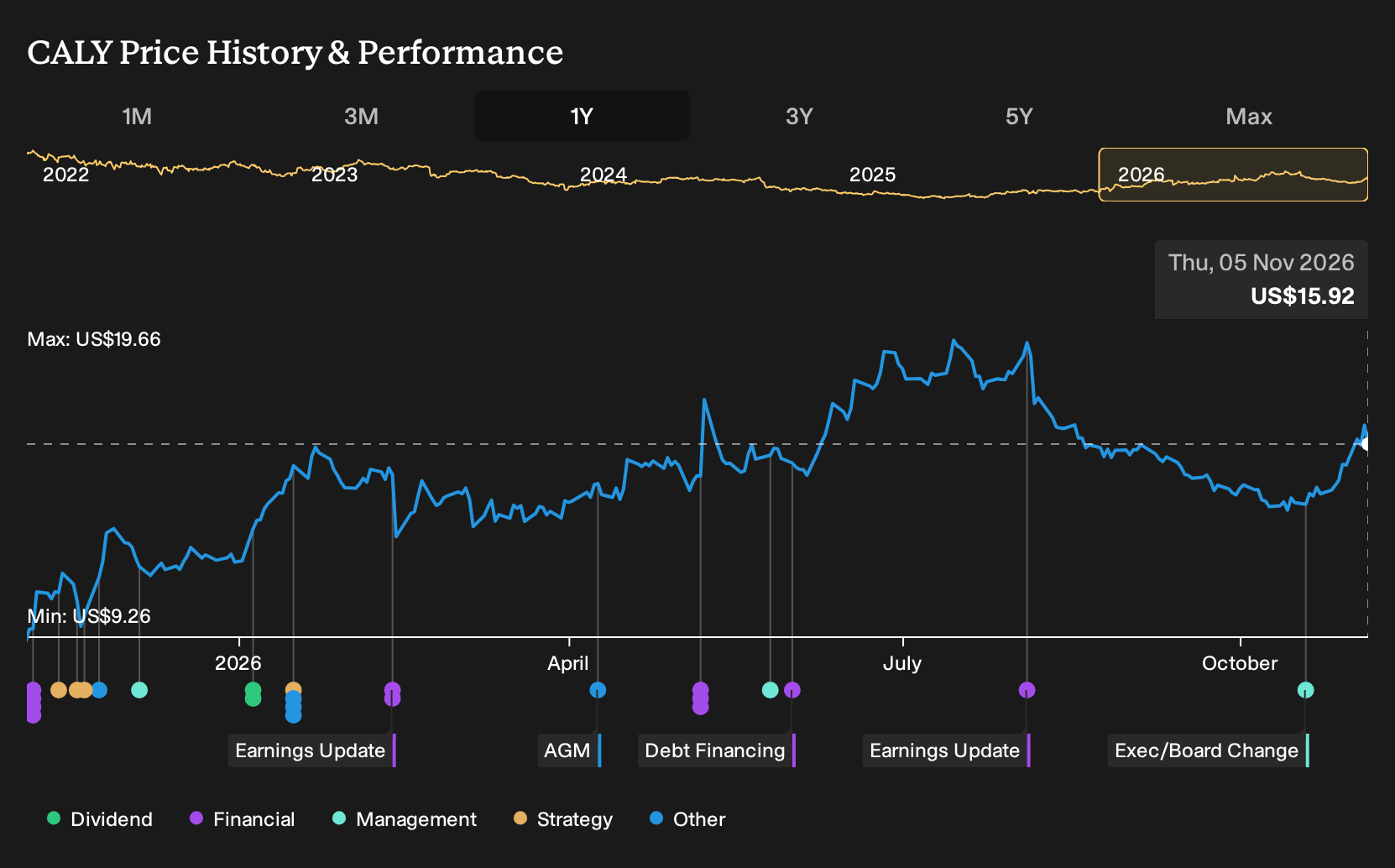
Exploring Other Perspectives
One alternate angle on Callaway Golf focuses on tariff volatility rather than margin repair. The most cautious analysts were working off roughly US$2.1b revenue and US$206.6 million earnings by 2029, tied to a US$17.0 price target. That is materially more restrained than consensus and could shift as these Q3 results are digested.
Explore 2 other Callaway Golf fair value estimates, including one that suggests it could be worth just $20.40!
The Verdict Is Yours
Don't just follow the ticker. Dig into the data and build a conviction that's truly your own.
- A great starting point for your Callaway Golf research is our analysis highlighting 3 key rewards and 2 important warning signs that could impact your investment decision.
- See our latest analysis for Callaway Golf. The report includes a comprehensive fundamental analysis summarized in a single visual, the Snowflake, making it easy to evaluate Callaway Golf's overall financial health at a glance.
Looking For More Ideas Beyond Callaway Golf?
If you want to pressure test your view on Callaway Golf, compare it with other listed businesses that share similar financial traits. The Simply Wall St Screener lets you filter for balance sheet strength, earnings quality and income potential so you can build a shortlist that actually fits your approach.
- For investors who care most about financial resilience, start with a 32 resilient stocks with low risk scores that score well on stability while keeping downside risk in check.
- If you want to pair resilience with value, scan a 42 high quality undervalued stocks that combine solid fundamentals with pricing that may not fully reflect their financial profile.
- Income focused readers can look at a 6 dividend fortresses that aim to offer yields above 5% without ignoring balance sheet strength.
Have feedback on this article? Concerned about the content? Get in touch with us directly. Alternatively, email editorial-team@simplywallst.com