
$172.7 billion poured into the Monetary Fund, the largest single week since the pandemic! Before AI plummeted, global capital built a cash line
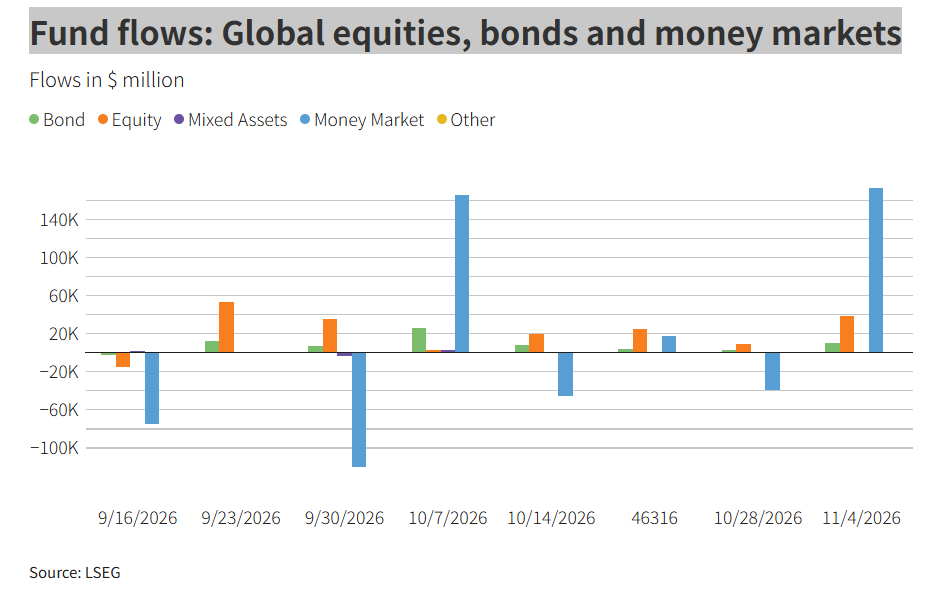
The Zhitong Finance App learned that the latest capital flow data shows that global capital has not yet been fully withdrawn from stocks, but the requirements for liquidity, cash flow, and certainty of return on investment have increased markedly. According to LSEG's capital flow, in the week ending November 4, the net inflow of global equity funds reached US$38.63 billion, for the seventh week in a row; at the same time, the net inflow of global money market funds reached US$172.71 billion, the largest single week since the global COVID-19 outbreak in April 2020, of which US money market funds attracted US$117.97 billion.
In addition, global bond funds also received a net inflow of $9.91 billion. This combination of stocks, bonds, and cash management tools simultaneously shows that investors continue to maintain risk asset allocations while significantly enhancing their ability to cope with uncertainty about elections, AI capital expenditure, and interest rates.
The above batch of LSEG capital flow data, as of this Wednesday, can be described as reflecting changes in global capital allocation that had taken place before the subsequent sharp decline in technology stocks. Thursday's market further amplified this pessimistic pricing and investors' cautious sentiment. The Nasdaq 100 index fell 6.36%, the biggest one-day decline since March 2020; the Philadelphia Semiconductor Index fell 12.25%, and the S&P 500 index fell 4.36%.
After the Democratic Party recaptures both houses of Congress, the market is concerned that stricter data center regulations may delay project delivery and change the pace of order fulfillment for chips, servers, and related equipment. Previously, concerns surrounding the scale of AI investment, financing burdens, and commercial returns were reflected in stock prices. The VIX Volatility Index, which has the title of “Panic Index,” rose 69.66% to 28.18 points in a single day, indicating a sharp rise in investors' pricing of recent market fluctuations; trend strategies reduced positions, rebalancing leveraged products, and active investors reduced risk exposure, further amplified price adjustments.
On Friday, the shock spread to the Asian tech supply chain, but market performance was uneven. The Korea Composite Index fell below 5,000 points in the intraday period and triggered a meltdown, eventually closing at 5059.69 points, down 6.02%; the Nikkei 225 Index closed down 5.96%, and the Taiwan Weighted Index closed down 4.51%. India's Nifty 50 Index rose 2.01%, and the Sensex Index rose 2.17%: the fall in crude oil prices reduced the burden of energy imports, and the relatively low exposure to capital-intensive AI investment also made India and some Asian stock markets without a dazzling “AI aura” an important direction for capital reallocation. The Asian market seems to be trading two things at the same time — export pressure due to cooling AI capital spending expectations, and growth recovery due to falling energy costs.
From chasing AI expansion to screening cash flow! Technology has cooled down, financial health care and bonds have been increased, and capital has been re-balanced between growth and defense
The LESG data stream also shows that net stock fund purchases and index collapse can occur simultaneously, mainly because fund redemptions, stock position adjustments, and derivatives deleveraging do not fall within the same statistical caliber, and the timing of occurrence is different. Stock inflows as of Wednesday cannot be directly explained as underwriting capital after Thursday's sharp decline; even if there are continuous subscriptions, centralized position reduction, futures sales, and hedging demand, may still overwhelm short-term purchases.
Large inflows from the IMF have enhanced the liquidity of funds, but their uses also include corporate cash management and deposit allocation, and cannot all be regarded as funds that are about to return to the stock market. A more accurate judgment is that investors are still willing to take stock risks, but are paying more and more attention to position structures and cash reserves to avoid market sell-offs and fears. According to LSEG capital flows, global money market funds unexpectedly attracted net inflows of up to US$172.71 billion, the largest single week since April 2020.
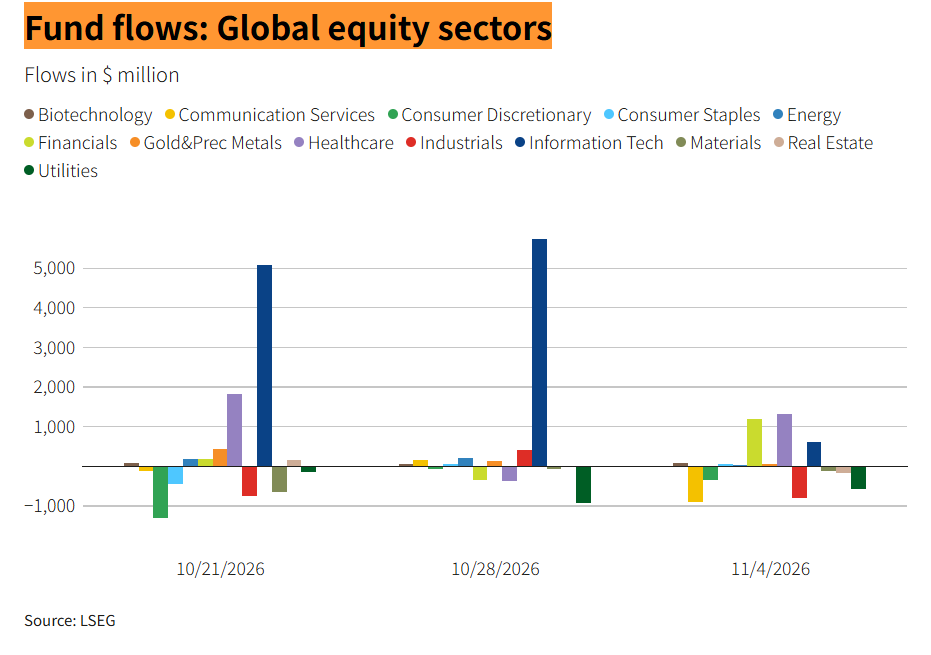
Regional and industry configurations already reflect this kind of screening. According to LSEG's capital flow, the net inflow of European equity funds was US$13.25 billion, the largest since August 12; the net inflow of global tech sector funds fell to a three-week low of US$6236.1 million, while the net outflow of US tech sector funds was US$160.2.3 million. Global healthcare and financial sector funds have attracted $1.33 billion and $1.2 billion respectively, which means that incremental capital is not continuing to focus on AI in one direction.
Falling energy prices will help reduce production costs for European companies, ease pressure on residents' purchasing power, and ease inflation's restrictions on policy interest rates. As of Friday's pre-market pre-market trading session, Brent crude oil fell about 15.6% for the week, and the European Stoxx 600 index still rose slightly by 0.05%, which is significantly better than the MSCI Global National Index, which fell by 2.91%. The investment implication behind these capital flows and the latest market dynamics is that when the investment and return of AI expansion begins to be scrutinized more closely, energy costs are improved, profit sources are scattered, and cash flow visibility is visible. At the same time, the European stock market's lower exposure to AI computing power risk assets and higher exposure to industrial and healthcare stocks that act as physical assets can also become an important basis for attracting global capital.
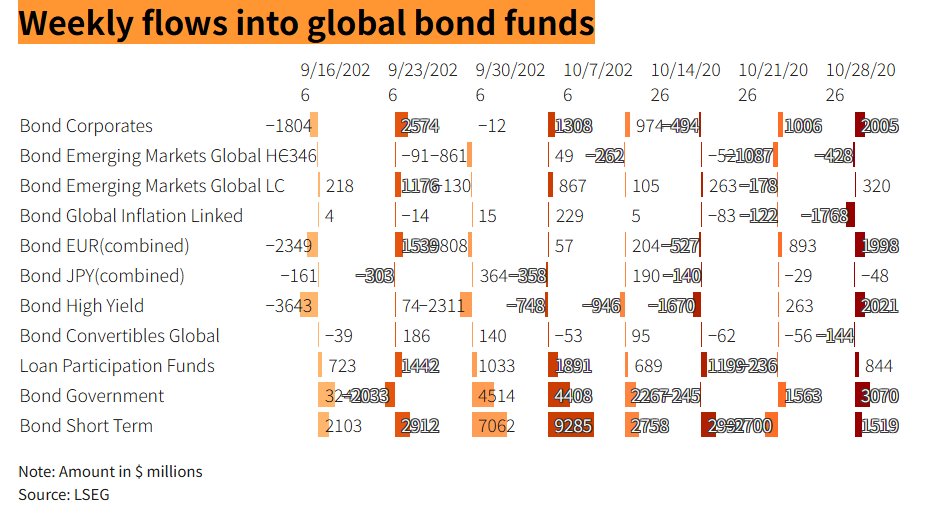
The bond allocation reflects another set of trade-offs. According to LSEG capital flows, global government bond funds have attracted 3.07 billion US dollars, and US long-term government bonds and treasury bond funds have attracted 2.66 billion US dollars; at the same time, global high-yield bond funds still received a net inflow of 2.02 billion US dollars. These debt-based data flows indicate that during the week there was not only a decline in interest rates and demand for safe assets, but also retained the will to obtain credit benefits.
As far as global stock market valuations are concerned, falling treasury bond yields can ease the pressure on discount rates, but if the decline is accompanied by worsening growth expectations, rising risk premiums, and declining profit forecasts, technology stocks may continue to be pressured. Therefore, whether low interest rate expectations/downward expectations for long-term US bond yields of 10 years or more can be transformed into a rebound in technology stocks depends on whether the company's ability to deliver cash flow stabilizes market expectations and whether the pressure to concentrate on reducing positions can be mitigated.
The midterm elections were compounded by concerns about AI burning money, and fund inflows to the US money market hit a six-month high
For the week ending November 4, US money market funds recorded their biggest weekly net inflow in six months. Cautious sentiment ahead of the US midterm elections, as well as concerns about increased AI spending and increased cash consumption by large tech hyperscale cloud computing companies, boosted investors' demand for safe-haven assets.
According to LSEG's capital flow, investors made a net investment of 117.97 billion US dollars in US money market funds during the week, unexpectedly setting the largest weekly net investment since May 6.
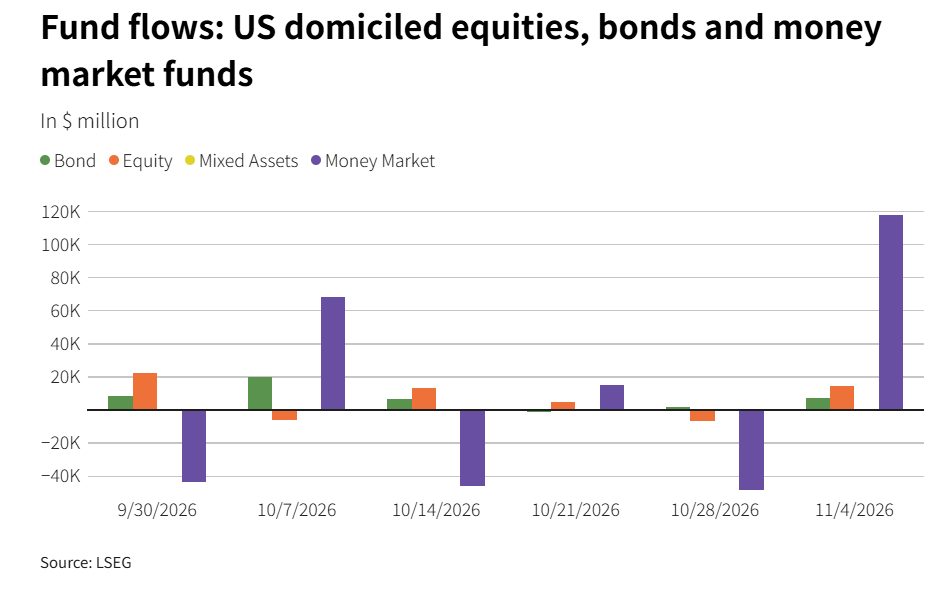
According to LSEG capital flows, US equity funds attracted a net inflow of US$14.81 billion, reversing the previous week's net outflow of US$6.54 billion. The fall in energy prices and the fall in US Treasury yields from October highs supported market sentiment.
The Democratic Party won control of the Senate and House of Representatives in the US midterm elections held on Tuesday, raising market concerns that increased regulatory scrutiny could curb the rapid expansion of the AI industry. These concerns dragged down the market on Thursday, with the Nasdaq Composite, S&P 500, and Dow Jones Industrial Average falling 5.52%, 4.36%, and 3.44%, respectively.
Investors made net purchases of US$10.35 billion in US large-cap funds, US$1.64 billion in cross-market capitalization equity funds, and US$4227.7 billion in small-cap equity funds during the week, while also net selling US$1.07 billion of mid-cap funds. LSEG's capital flow also showed that among US sector segment funds, technology, industry, and communication services funds had net outflows of US$160.23 million, US$624.6.7 million, and US$9656.8 million, respectively. By contrast, financial and health-care funds attracted net inflows of $1.3 billion and $1.09 billion, respectively.
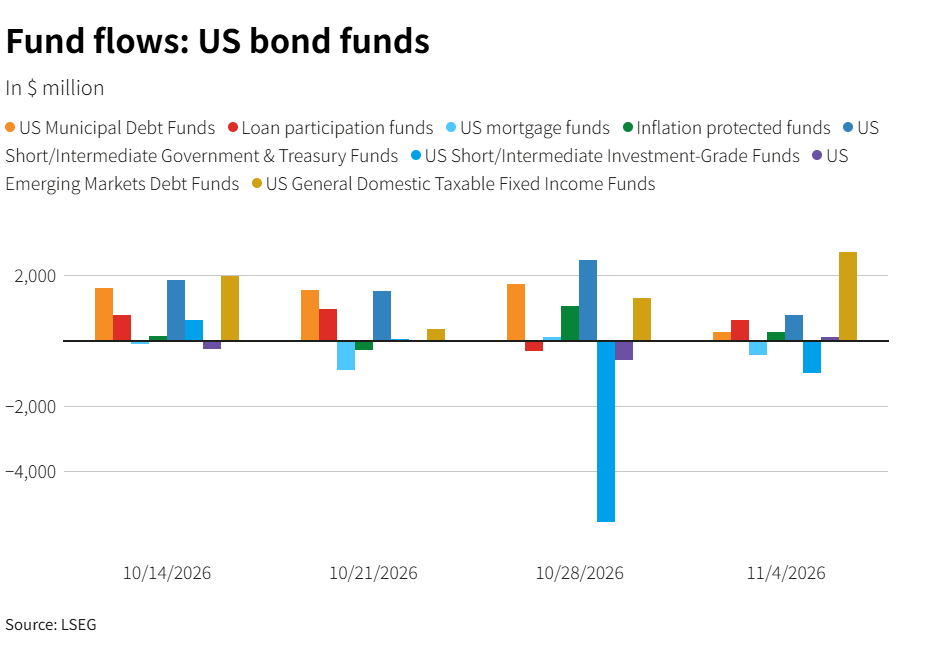
According to LSEG capital flow, US bond funds received a net inflow of US$7.31 billion, the highest level in four weeks. In addition, general domestic taxable fixed income funds, as well as longer-term government bonds and US Treasury bond funds, recorded significant net inflows of US$2.62 billion and US$2.66 billion, respectively. Investors also bought $794.32 million in short to medium term government bonds and US Treasury funds.