
“Anticipate Your Predictions” Intensify Tech Stock Stampede! After the $2.3 trillion market value evaporated, “fast money” machinery sales still haven't declined?
The Zhitong Finance App observed that this round of collapse in technology stocks that has taken the world by storm seems to show an increasingly clear reversal chain: investors are concerned about the accelerated penetration of energy inflation and the expansion of AI computing power infrastructure after the Democratic Party took control of both houses of the US Senate and House of Representatives, and selling semiconductors and a wide range of global technology-themed stocks. Price breakdowns trigger CTAs and volatility strategies, such as CTAs and volatility strategies, such as “fast money” type quantitative strategies, reduce institutional capital positions on a large scale. Active capital also traded ahead of time to trade these predictable sales markets in the global stock market price.
Systemic fund investment institutions that focus on the so-called “quick money” strategy (collectively summarized by analysts as CTA strategy funds) and volatility target strategies, the scale of their sales seems to have not stopped. Systemic fund investment institutions, which focus on CTA strategies, volatility target control, trend tracking, etc., have a rapid pace of position adjustment and commonly use high leverage. They are often called “fast money” (fast money) in the financial media. Almost all systemic funds are extremely dependent on quantitative algorithm models, so they can all be classified as “algorithmic funds.”
The historic collapse of US tech stocks on Thursday revealed how “predicting your predictions” can amplify policy concerns into a stampede on trading. US technology stocks can be described as experiencing a historic sell-off on Thursday. The Nasdaq 100 index fell 6.36%, and the market value of about 2.3 trillion US dollars evaporated. What is behind this is a negative impact caused by the interaction of AI policy risks and crowded positions. The Democratic Party's victory in the midterm elections triggered a reassessment of the market's prospects for data center expansion and supply chain growth; active trading capital reduced positions ahead of schedule in an attempt to avoid the expected CTA “quick money” machine sales, but further lowered prices, triggered trend tracking CTAs on a large scale to adjust positions, and expand demand for subsequent position reduction strategies through rising volatility.
Simply put, the Democratic Party's big victory in the midterm elections raised market concerns about restrictions on AI data center expansion; “fast money” mechanical sales in anticipation of active capital trading were pessimistic, further lowering prices, triggering large-scale reduction of trend-tracking fund CTAs, rebalancing leveraged ETFs on a larger scale than institutional expectations, and increasing subsequent sales demand for risk control strategies through rising volatility. In the end, by the close of US stocks on Thursday, the Nasdaq 100 index had fallen sharply by 6.36% on the same day, and the market value of about 2.3 trillion US dollars had evaporated, and the VIX index soared nearly 70%.
Wall Street's shared expectations of “sell first, wait for others to sell and then buy back” became a force that amplified selling pressure; when there were insufficient compensatory purchases and retail investors' habitual undertakings of low prices subsided, the rebound at the end of the session completely lost support. Wall Street financial giant J.P. Morgan estimates that leveraged ETFs are close to closing and selling more than 60 billion US dollars, of which about 90% are concentrated on technology-related products, and the volatility target portfolio may still reduce stock exposure by about 50 billion US dollars in the next few days. The CTA capital reduction exposure is still not completely closed. According to Barclays Bank estimates, the volatility target strategy may still release about 135 billion US dollars of pressure to reduce positions in the next 24 to 48 hours.
All of this means that some of the day's rebalancing pressure has been released, and the trend tracking CTA to decide to go long or short based on price trends, momentum signals, and volatility target strategies are lagging behind in reducing positions, but they may continue to affect the market. The key to subsequent repairs is whether the supply of machinery can gradually weaken, and whether active capital can be re-accepted after AI profit expectations have stabilized — seeing sales in advance does not mean that investors can lock in the bottom of the market ahead of time.
The crazy withdrawal of “fast money” boosted global technology stocks to plummet, and the $2.3 trillion US stock market value instantly evaporated
On Thursday, as investors scrambled to withdraw from US technology stocks, sales of a trend tracking systemic strategy amplified the decline, causing the Nasdaq 100 index to quickly experience a record collapse measured by market capitalization losses.
The tech stock benchmark index fell 6.4%, and its market capitalization evaporated by $2.3 trillion, setting a record for the biggest loss in market capitalization in a single day. The market is worried that the Democratic Party's victory may mean that AI infrastructure construction will be more strictly regulated, thereby curbing the growth of chip makers and data center suppliers, and these companies are the core driving force behind the stock market bull market. These concerns have fueled this decline.
Equity derivatives strategists at J.P. Morgan Chase said that as these concerns drove major indices below key technical levels, systemic funds were forced to cut their exposure, which accelerated the market decline. Unlike traditional investors, these quantitative funds usually trade in the direction of the stock market and respond to price changes and momentum signals rather than company fundamentals.
J.P. Morgan strategists led by Bram Kaplan said in the report that commodity trading advisory strategies, that is, CTA strategies, and other trend-tracking “quick money” trading strategies are likely to be drastically deleveraged and converted to net shorting US stocks. The decline in the morning trading session weakened several key momentum signals for major US indices, triggering further CTA sales.
According to J.P. Morgan Chase data, in the first hour and a half after US stock spot trading began, the net sales volume of S&P 500 futures was about 11 billion US dollars.
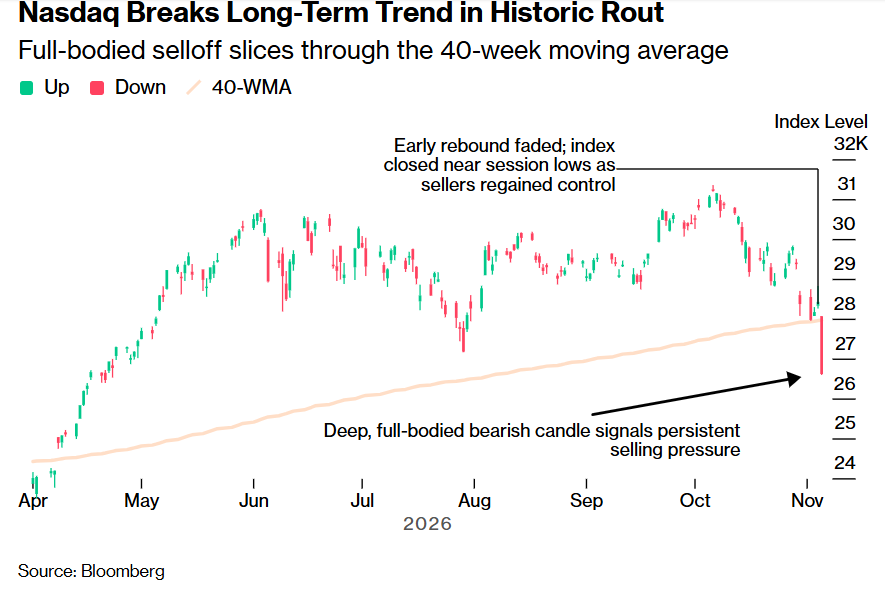
As shown in the chart above, the Nasdaq index fell below the long-term trend in a historic slump — a rare sharp sell-off that broke through the 40-week moving average.
The selling pressure brought about by “quick money” systemic strategy funds such as CTAs is probably not over yet. According to the J.P. Morgan Chase team's model, as volatility target portfolios reduce the target leverage level from the 67th percentile to about the 30th percentile, these portfolios are expected to sell about $50 billion in stock exposure in the next few days.
Trend tracking CTAs are mainly based on price trends and momentum signals to decide to go long or short. The volatility target strategy mainly adjusts positions according to changes in risk to maintain the preset combined volatility. Therefore, the probability that the two mechanical selling strategies overlap is very high — most CTAs also use the volatility target mechanism to control positions. After the price falls below the trend or momentum threshold, quantitative models often require sales that are executed according to pre-set rules, such as reducing long holdings or even establishing bears. Therefore, they are all “mechanical sales” in the strict sense of the word.
Also, according to Barclays stock tactical strategy model, these funds may reduce stock exposure by about 30 percentage points. This will be one of the largest single-day adjustments since the market turmoil during the COVID-19 pandemic. The model shows that within the next 24 to 48 hours, these funds may sell about $135 billion in US stock index futures.
The J.P. Morgan team said that leveraged exchange-traded funds also drastically cut their exposure for the second time in a week, and the latest round of sales once again focused on the technology sector. They said these funds have sold more than 60 billion US dollars of shares close to closing, of which about 90% are related to technology-related products, including semiconductors, NASDAQ 100, and technology industry ETFs.
Since leveraged ETFs have cut their exposure drastically, the size of their potential rebalancing transactions should be reduced in the future. Strategists' estimates show that its implied negative gamma exposure has dropped from about US$7.5 billion for every 1% market fluctuation to around US$6.5 billion.
Kaplan wrote, “As in the past sell-off period, capital inflows from investors buying on dips may have offset part of the need for rebalancing.”
“Predicting Your Predictions” - How Future Selling Pressure Intentions Can Quickly Evolve into Current Stampedes
The Asian close on Friday further reflected the concentrated direction of this round of shock: the Korea Composite Index fell by about 8.8% in the intraday period, falling below 5,000 points and triggering a meltdown, and finally closed down 6.02% to 5059.69 points; the Nikkei 225 Index closed down 5.96% to 57434.77 points; and the Taiwan Weighted Index fell 4.51% to close at 39701.64 points. The AI chip, storage, and electronic supply chains in South Korea and Taiwan have high exposure to US AI capital expenditure, so they are under pressure to adjust order expectations and shrink global risk positions at the same time.
However, at the same time as net sales of foreign capital in the Korean market, local individual and institutional investors are still making net purchases, which indicates to a certain extent that the key change in the market is insufficient capacity to bear the original price, and assets need to re-attract buyers through lower prices.
Although the three types of systematic “quick money” funds are sold at the same time, the trigger mechanism is different. CTAs adjust direction based on price trends and momentum signals; volatility control strategies reduce target positions based on risk models; leveraged ETFs require restoration of daily target leverage.
Take a look at multi-leveraged ETFs as an example. After the market falls, their net assets shrink faster than their nominal exposure. As a result, actual leverage is higher than the target, and exposure needs to be reduced through stock, futures, or swap adjustments. If an options trader is also in a negative gamma (short gamma) state, their hedging may also be reflected in continuing to sell when falling. As a result, various rules led to transactions in the same direction, transforming the initial fundamental shock into stronger price feedback.
The “rush” that Nomura strategist Charlie McEligot emphasized in his latest market watch report is taking place where these rules can be estimated in advance. Leveraged ETF sales pressure of about 52 billion US dollars was estimated in the big market, and the estimate given by Nomura was about 47 billion US dollars. Active traders cut or short positions early based on this, hoping to buy back at a lower price after the mechanical sale is released. However, early selling itself may push the index below more trend thresholds, increase implementation volatility, and further increase the need for systemic strategy adjustments.
Predicting future sales changes the current price, and the current price also changes the size of future sales. This is a negative amplification of “predicting your predictions.” It does not mean that an active trader has completed a sell order for a mechanical fund; in some cases, it may cause the latter to reduce the position even more. LSEG's capital flow statistics also confirm that part of the sell-off comes from systematic sales when investors try to trade ahead of schedule.
The late-session rebound did not occur as expected, which revealed the common dependency of this strategy: compensatory buying must be sufficient to absorb the remaining supply. Investors who have already cut their positions do hold cash, and taking a short profit may also lead to buying, but if prices continue to reach new lows, those who wait may delay making up, while those who have bottomed out early may end up losing money.
Goldman Sachs trader John Fred pointed out that some hedge funds were attracted by the rebound on Wednesday to buy back into hyperscale cloud vendors and sold these positions again on Thursday; Vanda Research observed that the usual dips for individual stocks offered by US retail investors also clearly subsided. At the same time, multiple allocations of semiconductors and energy are under pressure, and bond bears are being repulsed by the safe-haven market, which will further reduce the risk tolerance of some cross-asset portfolios. Overall, active capital, “fast money” systemic funds, and retail investors reduced their positions at the same time due to different reasons, which together led to a sharp decline in market carrying capacity.
An important change in the subsequent market was that the release rate of different sales markets began to diverge. After leveraged ETFs completed drastic reduction, their sensitivity to further rebalancing decreased: J.P. Morgan estimates that the implied negative gamma exposure corresponding to every 1% fluctuation in the market has dropped from about 7.5 billion US dollars to 6.5 billion US dollars, which means that subsequent fluctuations of the same magnitude may trigger minor adjustments; however, the delayed reduction in volatility control strategies is likely to continue. Market recovery requires a combination of weakening machinery supply and recovery of underwriting capital. Stabilizing prices and reducing volatility will help mitigate passive position reduction; while whether AI orders, capital expenditure, and profit expectations can be stabilized will determine whether the rebound can develop further into a continuous revaluation.