
The “blue wave” hits Trump's cryptocurrency landscape! WLFI fell more than 70% from its high point during the year. Can repurchases restore price support?
The Zhitong Finance App learned that World Liberty Financial (World Liberty Financial), a cryptocurrency company under the Trump family, announced a new WLFI token repurchase plan. Previously, the price of this token and Bitcoin, the world's largest market capitalization cryptocurrency, could be described as falling sharply after the US midterm elections this week.
Preliminary results from Tuesday's election show that the Democratic Party will regain control of both houses of Congress next year, and cryptocurrency prices have fluctuated sharply since then. Tokens linked to Republican President Donald Trump have been sold off particularly violently.
According to CoinGecko data, the WLFI token has declined by about 8% since election night, down more than 70% from this year's high. This round of sell-off has raised concerns once again: how the Trump family's cryptocurrency business is intertwined with the president's political fate. As the token deals with the aftermath of this week's election, a buyback plan could support its price.
World Free Finance published an article on the X platform on Thursday: “Our goal is to encourage holders to actively participate in WLFI governance and focus voting rights more on the most determined long-term holders.” WLFI allows holders to vote on proposals governing the agreement; the more tokens they hold, the more voting rights they have, within applicable restrictions.
According to CoinGecko's data, the maximum supply of WLFI tokens is 100 billion, and about 32% are currently in circulation.
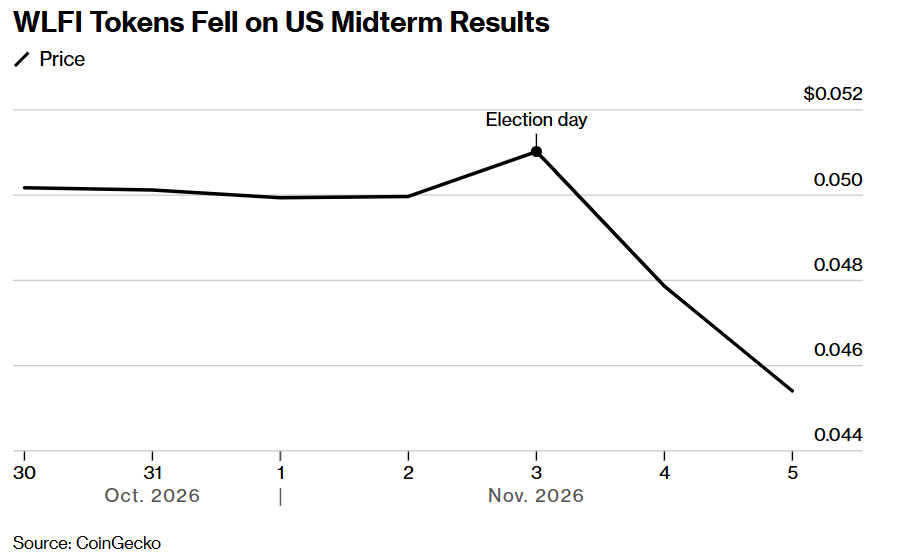
As shown in the chart above, the WLFI token declined due to the US midterm election results. Source: CoinGecko
World Free Finance said in a post that the initial buyback will be funded by a grant. The sources may include fee revenue from the project's USD1 stablecoin reserve, as well as other sources. The company did not disclose the size of the initial grant or purchase schedule, but said that the buyback will be “an ongoing part of our long-term strategy, the pace and scale” of which will be determined by ecosystem growth and participation.
World Free Finance did not immediately respond to requests for comment made during non-working hours in the US.
The company previously bought back WLFI, including implementing a buyback and destruction plan after the token began public trading in September 2025.
World Free Finance was co-founded by Donald Trump and his sons and other business partners a few weeks before the 2024 election. According to the website, DT Marks DEFI LLC, an entity linked to the president and members of his family, holds approximately 38% of the shares in World Free Finance Holdings. The company disclosure also revealed that the Trump family holds WLFI tokens, and their financial interests are related to the sale of the token and reserves supporting the USD1 stablecoin.
When the latest buyback plan was launched, the project was in a sensitive period. Not only was it facing a more severe political environment, but its governance token was also declining for a long time.
Trump's financial interests in the cryptocurrency space have drawn scrutiny from Democratic lawmakers. These interests raise questions about conflicts of interest as its government pushes a policy agenda that favors the industry. According to information disclosed in June of this year, the president received 1.4 billion US dollars in revenue from crypto-related businesses last year, of which about 594 million US dollars came from World Free Finance sales, which further heightened related concerns.
“Blue Wave” differentiates risk appetite: tech giants fix cash flow expectations, crypto assets revalue policy dividends
World Free Finance, a Trump family crypto company, announced a new WLFI token repurchase plan. The initial capital to be invested may include income from fees related to USD1 stablecoin reserves and other sources. According to CoinGecko data used in the report, WLFI has dropped about 8% since election night, down more than 70% from its high during the year.
The Democratic Party took back both houses of Congress, making Trump's related assets face stronger supervisory expectations, while the buyback attempted to support the token through additional purchases and the participation of long-term holders. The key is whether the repurchase funds can continue to be realized. The company has yet to announce the initial scale and time of purchase, nor is it clear whether the new plan will be destroyed, so it cannot be directly viewed as a definitive contraction in supply at present.
On Wednesday, Microsoft, Amazon, Alphabet, and Meta rose 6.7%, 6.1%, 3.2%, and 1.4%, respectively. Clear election results, and falling oil prices and US bond yields have improved market sentiment; data center expansion may slow down, and it has also caused investors to re-evaluate the capital expenditure pressure of tech giants and the value of existing computing power. Art Hogan, chief market strategist at B. Riley Wealth, pointed out that the slow pace of construction may reduce excessive expansion and increase the value of existing data centers. Tech giants have received a revaluation of cash flow and asset scarcity, while the semiconductor sector, which is closely linked to AI computing power, and Trump-related tokens are suffering from political-related premiums.
The crypto market is also facing uncertainty about the legislative process and conflict of interest investigations. Paul Howard, senior director of Wincent, believes that after the Democratic Party strengthens its influence in Congress, substantial progress in crypto legislation will rely more on cross-party cooperation. However, Bitcoin's actual path is to fall first, then rebound, then plummet: it returned above $80,000 on Wednesday, and fell about 6% to 75,700 US dollars on Thursday with the sell-off of technology stocks. According to related reports, the 24-hour crypto leverage position was stable at about 1.09 billion US dollars; as of around 4 p.m. Beijing time on November 6, the price was about 75,566 US dollars, and fell about 6.3% in 24 hours. This round of pressure also comes from changes in policy expectations and widespread deleveraging; not all logic is due to the midterm elections.