
High oil prices “eat away” demand, global oil markets are showing signs of oversupply
The Zhitong Finance App learned that analysts and traders said that although the Iran war has not been resolved and has disrupted Middle Eastern oil exports since March, the global oil market is showing signs of oversupply due to falling demand due to high oil prices.
At the beginning of 2026, the market generally expected an oversupply in the oil market. However, the war in Iran that broke out at the end of February triggered what the International Energy Agency (IEA) called the “largest supply disruption in history,” leading to a sharp decline in exports to the Middle East, completely reversing previous expectations of excess.
However, due to factors such as high oil prices, Wall Street banks and government forecasting agencies have lowered their 2026 global oil demand forecasts. As supply gradually recovers, weak demand is helping the market to rebalance.
J.P. Morgan: The oil market has returned to oversupply
J.P. Morgan Chase said in the report that the recovery of oil flows in the Middle East, increased production in other countries, and weak demand have once again pushed global supply to exceed consumption.
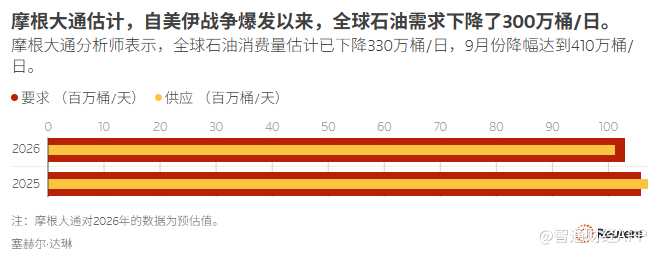
“We estimate that the global oil market returned to an excess of 1.1 million barrels per day in September and expanded to 1.4 million barrels per day in October, which is almost the same as the average surplus of 1.3 million barrels per day last year.” The bank indicated. The report also mentioned that global crude oil imports in October were higher than the 2025 average, yet demand was lagging behind.
Analysts at J.P. Morgan Chase estimate that since the outbreak of the US-Iran war, global oil consumption has dropped by about 3.3 million barrels per day, with a drop of 4.1 million barrels per day in September.
Goldman Sachs: Inventory has not declined in the past two months, and the market is generally balanced
The Iran war prompted industrialized countries to release record strategic oil reserves by the International Energy Agency (IEA), while commercial stocks were also heavily depleted. However, Goldman Sachs estimates that global inventories did not decline from September to October after a sharp drop in inventories within a few months of the outbreak of the war.
Goldman Sachs believes that compared to the supply shortage in March this year, the market was generally in balance between September and October. The bank said that last year's slight surplus, the rise in production outside the Gulf, and the decline in demand helped balance the market.
Gulf crude oil exports rebounded sharply, and the recovery of refined oil products was slow
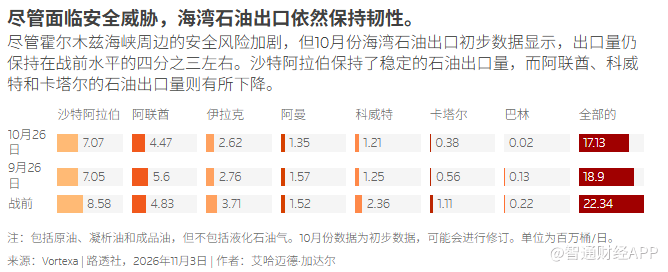
Both banks indicated that oil flows in the Middle East have rebounded since the beginning of the war. The region's oil shipments fell slightly in October compared to September, which was the highest level since the outbreak of the war in Iran. The two ship tracking companies said the October data may be revised as more shipping details come to light.
Despite heightened security risks around the Strait of Hormuz, oil exports from the Gulf region remained resilient, about three-quarters of pre-war levels. Among them, Saudi Arabia maintained stable flows, while exports from the United Arab Emirates, Kuwait, and Qatar weakened.
Ship-tracking company Vortexa said the Gulf region's crude oil and condensate exports averaged 14 million barrels per day in October, about 86% of pre-war levels; while exports of refined oil products averaged 3.1 million barrels per day, just over half of normal levels.
Futures structure divergence: excess spot vs. tight futures
One sign of short-term oversupply in the physical market is a change in the price curve for Brent crude oil swaps (i.e. CFDs). According to LSEG data, the contract price for this week's delivery is lower than the contract for next week's delivery, and the discount margin is the biggest since July. The prices for the second and third week contracts are also lower than next week's. This market structure, known as a positive spread (Contango), usually reflects the market's belief that there is sufficient supply for immediate delivery.
In contrast, Brent crude oil futures, which began delivery in January 2027, are still in the opposite structure, that is, backwardation (backwardation). Recently, prices are higher than forward contracts, which indicates that short-term supply is still tight.
Senior oil trader and market expert Adi Imsirovic said that if the swap market maintains a positive spread, Brent futures may also move into a positive spread structure as this change in the market structure usually begins in the spot market.