
Interpretation of US IPOs | Co-Production Runs Through a New Curve, Global Fashion (INHI.US)'s Content Transition and Profit Test
The listing process of Global Fashion (INHI.US) in the US is an advanced history of the gradual increase in the scale of fund-raising.
On January 8, 2024, Global Fashion Secretly submitted (first DRS document submitted). The first public prospectus (F-1 document) was submitted on June 17 of the same year. The initial plan was to issue 1.25 million shares. The maximum amount of capital raised was estimated at an issue price of 4-5 US dollars.
Since then, after 8 rounds of F-1/A revisions, the amount raised was phased out to 15 million US dollars and then contracted. By January 21, 2026, the company withdrew the old application using Form RW and re-submitted the F-1 documents the next day. The issuance scale was first raised to 3.75 million shares, and further expanded to 6.25 million shares in March (including about 7.187,500 shares of the Green Shoe).
On October 23, Global Fashion disclosed the fifth revised draft after re-submission, and the issuance terms remained unchanged. According to the estimated distribution range of 4-5 US dollars, the scale of fundraising increased sharply to 25 million to 31.25 million US dollars. This is 4-5 times larger than the initial scale of about 6.25 million US dollars, and has met NASDAQ's requirements for Chinese related companies to raise no less than 25 million US dollars in IPOs.
According to the prospectus, Global Fashion is a medium-sized domestic film and television content intermediary that started as a “series distribution+advertising agency” and is expanding towards “co-production”. The A-share listed company Jebsen Co., Ltd. holds 13.14 million Class A common shares, accounting for 32.85% of the total share capital before issuance, and is the largest single shareholder of Global Fashion.
In terms of performance, Global Fashion's revenue in 2024 and 2025 was US$206.313 million and US$36.95.48 million respectively, while net profit for the period was US$4.882 million and US$4.5175 million respectively, achieving both revenue and profit growth.
However, as the company's fund-raising volume continues to raise the valuation level, market doubts also arise, that is, can the steady fundamentals of global fashion match pricing expectations under the new valuation framework?
Content-related revenue accounts for over 90%, and joint production has become a new growth engine
Global Fashion's domestic operating entity is Beijing Zhongxi Heli Culture Media Co., Ltd., and the latter was founded in 2010. It first entered the market with TV advertising agents, obtained resources in batches from TV stations and then resold them to brands and 4A companies, using an asset-light model to earn media rebates and account differences.
Around 2016, Zhongxi joined forces to introduce Jebsen capital. The company extrapolated the boundary of ability from “selling advertising slots” to “selling content”, participated in variety production, series investment and copyright procurement, used content distribution to bind TV station and platform resources, and then used advertising agencies as an additional monetization layer to form a two-wheel structure of “content+advertising”.
As the film and television industry enters the stage of reducing volume and improving quality, China is working together to further shift the focus to the distribution side. It obtains the right to distribute series from producers and distributes them to TV and long video platforms. Revenue is mainly distributed commissions, copyright differences, and shares. Revenue from content assets gradually becomes the core of the company, and advertising agencies act as supplementary business.
However, after launching its listing in the US, Zhongxi Culture gradually switched from a “publisher” to a “content rights platform.” In addition to pure distribution, the company is experimenting with joint production and copyright share investment, using a small amount of investment in exchange for deeper distribution of series revenue, and also acting as an agent for smart screen advertising spots such as Lebocast to seize potential opportunities in digital media.
Through continuous business adjustments and expansion, Global Fashion's current revenue structure is mainly divided into three major segments, namely advertising agency service revenue, content asset revenue, and co-production content revenue. In 2025, these three segments accounted for 3.46%, 48.34%, and 48.20% of revenue, respectively. Obviously, content-related (content assets+co-produced content) revenue accounts for more than 95% of the company's total revenue.
Among them, revenue from content assets includes homemade content and authorized content. In 2025, homemade content accounted for 12.43% of total revenue, and revenue from authorized content accounted for 35.91% of total revenue. From this perspective, in content-related revenue, authorized content and co-produced content already account for more than 80% of the company's total revenue.
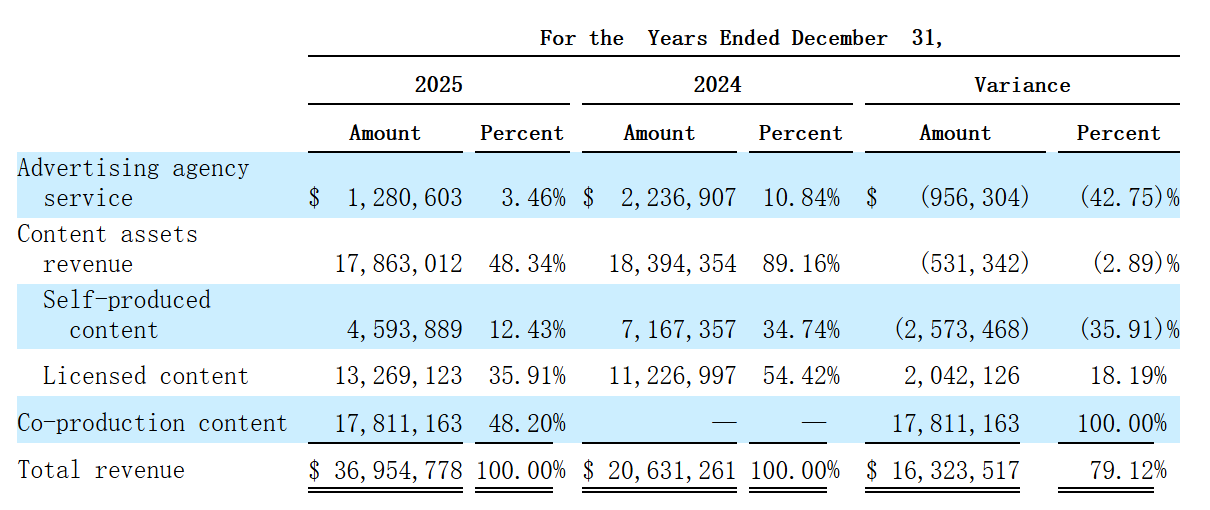
In 2025, the total revenue of global fashion surged 79.12% to US$36.95.48 million. This was mainly due to the company's substantial implementation of a “content rights platform” transformation while actively shrinking traditional businesses with low share and low elasticity. This made co-production content a new driving engine, and authorized content also developed steadily.
During the reporting period, co-production content achieved a breakthrough of zero, and recorded revenue of 178.11,000 US dollars, accounting for 48.20% of total revenue. This directly confirms the viability of the company's “small investment in exchange for deep drama revenue distribution” strategy.
While developing new business, the company's original basic license content business has maintained steady development. The business's revenue during the reporting period was US$13.2691 million, an increase of 18.19% over the previous year. This shows that the company's traditional “buyout/distribution” distribution network is still effective and has steady monetization capabilities in terms of series selection and channel distribution.
However, the nearly 80% increase in revenue was not simultaneously transmitted to the profit side. Net profit increased only 7.86% to US$4,517,500 in 2025, and the scissor gap between revenue and profit growth increased markedly. The main reason behind this is a shift in revenue structure.
As the share of high-margin advertising agencies and pure authorized distribution businesses declined, the share of low-margin co-production revenue reached nearly half, dragging down overall gross margin from 32.5% to 24.9%, a drop of nearly 8 percentage points.
At the same time, in order to expand the scale of co-production, the company undertook higher project operating costs, US listing compliance fees, and provision for potential bad debts. The total operating cost ratio increased from 8.5% to 8.79%, further squeezing profit margins.
Obviously, the growth of global fashion in 2025 stems from revenue expansion brought about by a shift in business models. Although revenue and profit are rising at the same time, the characteristics of the transition period of “high income, low gross profit, high expenses, and low net profit elasticity” have clearly emerged.
Continuity of co-production needs to be tested, and AI platforms and large-screen advertising become auxiliary lines for profit improvement
As can be seen from sorting through the past performance trends of global fashion, in the short to medium term, content-related business will remain the company's absolute main line. Among them, although the co-production business has become the company's new growth engine with revenue of 17.811,000 US dollars in 2025, the revenue from the business is still concentrated on the three projects “Pearl Girl,” “Exploring Nature III,” and “Water Dragon Yin,” and the company is not deeply involved in development, production and distribution. Essentially, it obtains content revenue share and cost recovery at the investment ratio, and its sustainability and project hit rate have yet to be verified by the market.
If co-production can move from “single drama participation” to “scale+optimization,” transforming the phased success of the three dramas to the ability to continuously obtain a share of high-quality content, the business is expected to upgrade from a simple investment division to a combined content equity pool, use multiple projects to hedge against fluctuations in a single drama, and gradually repair the net interest rate suppressed by the low gross profit structure after the scale effect and product selection capacity are improved.
At the same time, the distribution side is still the basic platform for the company's development. Global Fashion stated in its prospectus that about 40% of the net capital raised by the company will be used for TV series distribution. This shows that the company will not abandon high-margin licensing business; instead, it will use funds to deepen ties with producers, TV and streaming media, maintain a stable license revenue stream by selecting leading content in the drama “reduce volume and improve quality” environment, and provide ready-made exit and distribution channels for co-production projects and homemade content.
In addition to the main content line, AI platforms and large screen advertising are two auxiliary lines laid by Global Fashion to improve its profit structure. The company said it will invest about 20% of the net capital raised to build an AI-enhanced online trading platform. The direction is to shift processes such as distribution matching, ad space matching, and copyright share transfer from “people and channels” to online. If implemented, it is expected to reduce cost rates and improve profit elasticity.
In terms of the large screen projection business, the company acts as an agent for advertising space sales on the Lebocast screen mirroring application. According to the prospectus, LeboCast has covered more than 400 million large screen terminals and connected 1.3 billion mobile phones through SDK-level solutions at the receiving end and the sender end, making it an important channel for the company's digital advertising.
The company plans to invest about 10% of the net capital raised in the advertising business. Using the large screen projection scenario, “series distribution+large screen advertising space” will be packaged and sold to the brand. The marginal cost is low, and the advertising business itself has a high gross margin. The increase in share is expected to complement the profit level.
Overall, the growth logic of global fashion still revolves around the content business: in the short term, it relies on joint production and continuous distribution to increase revenue, while AI platforms and large-screen advertising are used as auxiliary means to reduce costs and increase efficiency, gradually releasing the effects of cost optimization and gross profit supplementation in the medium to long term. As the first year of the track change, 2025 is verifying the viability of the co-production model; the next few project cycles are the real window for testing “whether we can continue to make money after growing bigger”.