
As US bond yields fall, gold is expected to hit the biggest weekly increase since August
The Zhitong Finance App learned that technology stocks fell sharply on Thursday due to market concerns that the Democratic Party would tighten its regulatory policy on artificial intelligence (AI) after winning both houses of the US Senate and House of Representatives, and stimulated investors' demand for US bonds as a safe-haven asset, driving US bond yields to their lowest level since early September. Meanwhile, benefiting from lower US bond yields, gold is expected to rise more than 5% this week, or the biggest weekly gain since August. As of press time, gold is currently trading at $4,080.
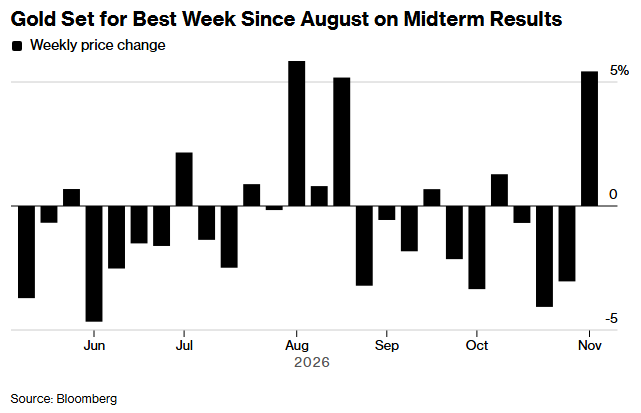
The midterm election results drive the price of gold and is expected to hit the best weekly performance since August
In addition to safe-haven demand, lower US bond yields are also affected by lower inflation expectations. Investors are betting that the Democrats who are about to take control of the National Assembly will push for an end to the war against Iran that is driving up energy prices, which will push oil prices down on Wednesday. Furthermore, investors are also betting that the Democratic Party's control of Congress will limit the Trump administration's room to expand the fiscal deficit and reduce the supply premium contained in long-term bonds.
Gold generally benefits from lower interest rates. However, some investors sold precious metals to make up for losses caused by the fall in the stock market, which curtailed the rise in gold prices to a certain extent. Furthermore, in theory, limited fiscal expansion is a relatively negative factor for gold, as some investors use gold as a hedge against high government spending and budget deficits.
After the previously announced number of jobless claims at the beginning of the week fell short of all market expectations, traders will be watching the US non-farm payrolls data for October later on Friday to find the next clues about economic trends and interest rate prospects.
Although this rebound in gold is the most obvious breakthrough since its sluggish trend for several months, the price of gold has fallen by more than one-fifth since the outbreak of the US-Iran war in late February. The sharp rise in energy prices caused by the war prompted a tightening of monetary policy.
OCBC Bank analyst Sim Moh Siong and others said in a report: “It is encouraging that gold is once again responding positively to the favorable macroeconomic environment. We are cautiously optimistic that the price of gold may be searching for a bottom. However, the easing of expectations of the Federal Reserve's tightening policy and the revival of investment demand are still the keys to maintaining the rise in gold prices.”
Looking ahead to the fourth quarter, global demand for gold ETFs, gold bars and coins, derivatives and OTC transactions in the Western market may face multiple macroeconomic forces: rising policy interest rates, higher bond yields, and a stronger dollar may curb demand for gold; while fiscal concerns, inflation risks, geographical conditions, and financial market pressure are expected to support gold demand.
Looking ahead to the gold market before the end of the year, Louise Street, a senior market analyst at the World Gold Council, believes that there is a general balance between positive and negative factors. Although rising interest rates and divergent inflation expectations may put pressure on gold prices, geopolitical risks are intertwined with financial market pressure, which may prompt market participants to turn to gold and seek stability.