
Investment boss Noble warns: Revolving financing lays a risk of collapse, Nvidia (NVDA.US) may repeat Cisco's mistakes
The Zhitong Finance App learned that senior investor George Noble issued a warning on Thursday that Nvidia (NVDA.US) is heading for a liquidation crisis similar to the internet bubble period because the company is providing financial support to customers who have purchased its artificial intelligence (AI) hardware.
The investor, who worked as an analyst for Peter Lynch, emphasized in a social media post that Nvidia's current weight in the S&P 500 index is about 8%, which is double the weight of Cisco (CSCO.US) during the peak of the Internet bubble in 2000. He believes that the semiconductor giant is falling into the “exact same” trap that caused Cisco's stock price to crash more than 20 years ago.
Noble directly compared the current situation to Cisco's reliance on vendor financing models at the turn of the millennium. At the time, the network equipment vendor provided loans to telecom startups that were unable to pay for the equipment in advance. Noble pointed out that when these telecom companies went out of business one after another, Cisco's stock price plummeted 89%, and dragged the S&P 500 index down by half as a whole.
Noble pointed out that today, Nvidia is taking a similar approach in a modern version: providing guarantees for customers' lease agreements and taking a stake in the startups that bought its chips. He warned that this revolving financing structure exposed Nvidia to a huge risk of default, and said that the more hardware Nvidia sells, the greater the risk the company faces once customers are unable to continue to pay their bills. “This is the largest capital mismatch in history,” he wrote, and warned that this practice created dangerous systemic vulnerabilities for Nvidia itself and the market as a whole.
In addition to the fundamental warning, Noble also cites technical analysis as supporting evidence. He shared a chart provided by macro investor Sam Kovach. The chart shows that Nvidia's daily upward trend, which has continued for several years, is gradually narrowing, forming a rising wedge pattern spanning several years; a partial enlarged view in the chart shows that the stock has begun to fall below the downward sloping upward support line.
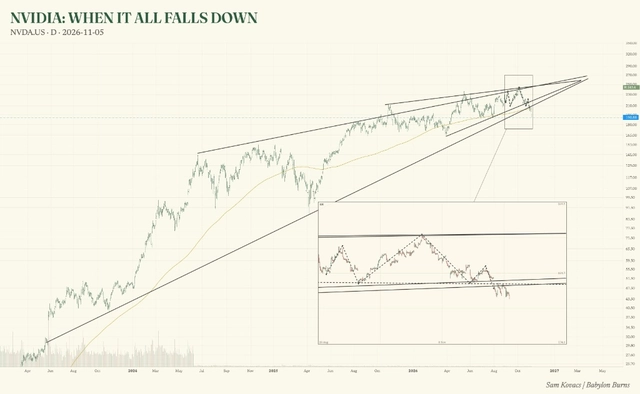
Technical analysts generally pay close attention to the rising wedge pattern because it is generally viewed as a bearish reversal pattern, which means that the stock price may move from rising to falling. As the market scrutinizes Nvidia's balance sheet more rigorously, the stock's upward momentum may finally begin to unravel. In particular, its stock price has now lagged behind the 200-day moving average.
Nvidia is deeply involved in AI infrastructure financing, and the scale of the guarantee has attracted attention
In fact, in recent years, Nvidia no longer only plays the role of an AI chip supplier, but has gradually expanded its business to areas such as data center infrastructure construction, customer financing support, and AI industry ecological investment. The company hopes to further expand the deployment scale of its GPU products and consolidate its dominant position in the AI computing market by helping customers resolve capital and infrastructure bottlenecks.
According to documents submitted by Nvidia in the second quarter of 2026, as of July 26, 2026, the company's equity investment scale reached 99 billion US dollars, with an additional equity investment commitment of 25 billion US dollars. At the same time, Nvidia also revealed that the total cloud service commitments it has signed with some AI cloud service providers have reached 36 billion US dollars, usually for a period of six years. According to the relevant arrangement, AI cloud service providers purchase Nvidia's data center infrastructure products, and Nvidia promises to purchase its cloud service capacity; if the relevant service provider fails to successfully sell this capacity to third party customers, Nvidia may be required to assume corresponding capacity procurement obligations.
What is more noteworthy is that Nvidia has also begun providing credit support for data center leasing for some AI cloud service providers. The company disclosed that as of July 26, 2026, its maximum risk exposure to guarantee the data center land, electricity and building shell leasing obligations of some AI cloud partners was US$3.5 billion.
Additionally, Nvidia signed a guarantee arrangement with SB Energy in August 2026 to provide credit support of up to 105 billion US dollars for the Ports Technology Campus project in Ohio, USA. The project will provide OpenAI with approximately 4.25 gigawatts of IT load capacity, involving nine data center construction phases and a 20-year lease arrangement. According to the agreement, the relevant guarantee liability will gradually take effect as the data center is completed and put into use at various stages, and will gradually decrease as OpenAI fulfills its lease payment obligations.
Nvidia emphasizes that these guarantees only cover a specific portion of leases and electricity payments, and do not mean that the company assumes the full cost of the project or all of the customer's obligations; the guarantee may also be terminated if OpenAI achieves a satisfactory credit rating. However, according to data disclosed by Nvidia, the $105 billion guarantee mentioned above was combined with the $3.5 billion guarantee of other AI cloud service providers, and the maximum total risk exposure of the company's related guarantees reached US$108.5 billion.
These arrangements show that Nvidia is helping the upstream and downstream AI industry chain obtain the capital and infrastructure needed to build data centers through guarantees, investments, and long-term procurement commitments. At the same time, however, if relevant customers are unable to obtain sufficient external financing, data center project construction delays, or AI computing needs fall short of expectations, Nvidia may also bear additional costs and financial risks as a result.
The $500 billion financing plan faces Wall Street scrutiny, and GPU collateral values are in focus
In August of this year, Nvidia also announced that it is cooperating with financial institutions such as Apollo, BlackRock, Brookfield, Goldman Sachs, and KKR to establish an independent AI computing infrastructure financing platform to mobilize more than 500 billion US dollars of third-party capital in the future to support AI infrastructure construction.
The core idea of the plan is to turn Nvidia GPUs and related AI infrastructure into assets that can be financed, and use chip mortgages and other methods to fund AI developers and infrastructure operators. Nvidia CEO Hwang In-hoon believes that AI computing resources are productive, durable, and transferable, and can continuously generate revenue over a long period of time, so they have the conditions to become long-term financing assets.
However, this funding model has not completely allayed Wall Street's doubts. Reuters reported on October 1 that some banks and credit investors are cautious about the value of GPUs as long-term collateral, believing that Nvidia's estimates of the chip's useful life and future residual value may be too optimistic. Huang Renxun once said that Nvidia's high-end GPUs can last up to ten years, but some banks usually evaluate the value of GPU assets according to a depreciation cycle of three to four years.
This means that if AI chips are iterated faster, or if market demand for previous-generation GPUs falls rapidly, the actual value of the collateral may be lower than the value estimated at the time of initial financing. Once the borrower's business conditions deteriorate, the chip's residual value is insufficient to cover outstanding debts, and lenders and companies providing guarantees may face losses.
Reuters also pointed out that the reason why some GPU mortgage financing transactions that have already been implemented can obtain high credit ratings largely depends on stable payment promises from third party customers. For example, Coreweave, which is owned by Nvidia, previously obtained an $8.5 billion GPU mortgage, and lenders mainly relied on Meta's contract payments to guarantee debt repayment. In contrast, if the financing project lacks long-term income protection provided by investment-grade clients, lenders may require higher guarantee ratios, more adequate risk buffers, and stricter repayment guarantees.
Furthermore, Nvidia's financing support is not limited to projects already disclosed. On October 29, Reuters quoted “The Information” report as saying that Nvidia is discussing providing multi-billion dollar credit guarantees with AI cloud service provider nScale to support the latter's debt financing needed to build Anthropic's data center. However, at the time of publication of the report, the relevant arrangements were still in the discussion stage, and the specific guarantee amount and financing terms had not been disclosed.
Whether AI demand can be converted into real cash flow determines whether the financing model can be sustainable
From Nvidia's perspective, supporting customers to build AI infrastructure through financing can ease financial constraints in the industry chain, push more GPUs into use, and generate continuous hardware sales and software ecosystem revenue for the company. In particular, with AI cloud service providers and model developers expanding rapidly, but their own balance sheets and long-term creditworthiness are not sufficient to support large-scale infrastructure construction, Nvidia's involvement in the financing process also has its commercial logic.
However, the problem is that whether financing arrangements can be established over a long period of time still depends on whether AI computing needs can be converted into sufficient commercial revenue and cash flow. If AI model developers are unable to achieve profits, enterprise customers are less willing to pay for AI services than expected, or if data center utilization is insufficient, it may be difficult for relevant operators to cover GPU procurement, financing interest, electricity expenses, and long-term rental costs.
Under these circumstances, Nvidia may not only face a slowdown in chip demand, but may also be under multiple pressures due to guarantee liabilities, procurement commitments, and equity investments. In particular, when AI infrastructure construction is highly dependent on debt financing, once the financing environment is tightened or collateral valuations decline, risks may spread along the related networks between chip suppliers, AI cloud service providers, model developers, and financial institutions.
Of course, the current AI industry is not exactly the same as the telecommunications industry around 2000. Today, cloud computing giants and large technology companies have more mature business models, stronger balance sheets, and actual AI infrastructure requirements; Nvidia also emphasized that its financing platform will introduce independent financial institutions, and partners will independently evaluate and underwrite specific projects. Therefore, the current financing model cannot simply be equated with supplier financing during the Internet bubble period.
However, as Nvidia gradually changes from a chip supplier to an investor, guarantor, and long-term buyer in the AI infrastructure ecosystem, the market's focus on its risk exposure continues to rise. The key question investors need to determine is not only how many GPUs Nvidia can sell, but also whether these GPUs can continue to generate sufficient cash flow and whether customers can maintain operations without further financial support from Nvidia.