
“I feel like I went back to 2008”: AI trading collectively crashed, chip stocks invested in bears, momentum ETFs recorded the biggest decline since the pandemic, and buyers went on strike
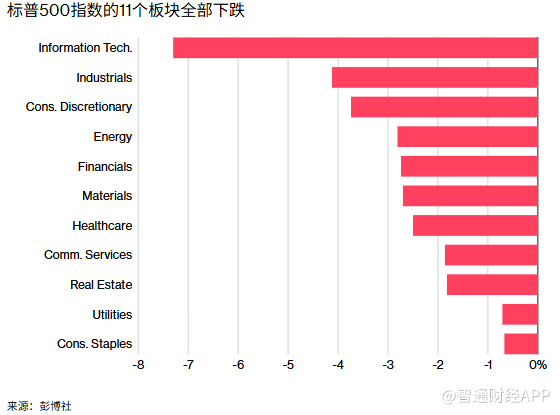
The Zhitong Finance App learned that on Thursday, Wall Street staged a mass evacuation. After the opening of the US stock market, sell-off intensified rapidly. From AI chip leaders such as Nvidia (NVDA.US) to defensive assets such as Walmart (WMT.US), the Nasdaq 100 index closed down more than 6%, the biggest one-day decline since March 2020.
Companies at the core of the artificial intelligence (AI) boom have been hit the hardest by this round of sell-off. Over the past few months, concerns surrounding the AI bubble have been looming; earlier this year, this boom had propelled the stock market to new highs, causing the market to worry that it was a bubble that was destined to burst. And the Democratic Party's overwhelming victory in the National Assembly election could herald a political shift, thereby putting the brakes on the rapid growth of the industry and affecting hundreds of billions of dollars that are pouring into its computing power equipment.
A reversal in policy expectations triggered a sell-off, leading AI leaders led the decline
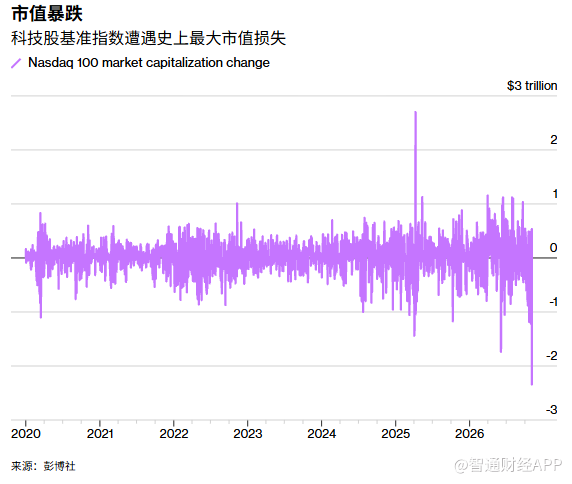
At the close, the Nasdaq 100 index fell more than 6%, the biggest drop since the COVID-19 pandemic triggered the sharp decline in March 2020. Nvidia, the company with the highest market capitalization in the world, fell by more than 9%, the biggest drop since January 2025, erasing all this year's gains. All 30 constituent stocks of the Dow Jones Industrial Average fell, the S&P 500 index fell 4.4%, and the much-publicized semiconductor stock index fell 12%, the worst single-day performance since the outbreak of the pandemic.
Due to market speculation that hedge funds are selling off their holdings, an ETF betting on so-called momentum trading recorded one of the worst single-day performances in more than a decade, and investors flocked to US Treasury bonds to take refuge.
“I feel like I'm back in 2008 or 2001,” said Greg Taylor, chief investment officer of PenderFund Capital Management, referring to the bursting of the internet bubble and the housing bubble. “The market is now too focused on a single theme, and the collapse of that theme. I think this is inevitable because we are paying too much attention to AI, which already accounts for too much of the market.”
This sell-off came to an end to Wall Street's previous two days of intense waves. Previously, due to dissatisfaction with high gasoline prices, the impact of AI, and the emergence of data centers in Texas and other places, voters clearly denied President Trump and his Republican Party in the midterm elections, and the Democratic Party won an overwhelming victory.
The initial market reaction propelled the stock market higher on Wednesday. Investors are betting that a politically divided Washington will counterbalance Trump's power and speed up the end to the Iran war; the war reignites inflation and pushes up interest rates. But then market sentiment reversed, and the focus turned to a potential rift in the AI boom, which hurt falling buyers.
“They really rushed,” said Michael O'Rourke, chief market strategist at JonesTrading Institutional Services LLC. “Earnings forecasts for next year make these stocks look like they have a very low price-earnings ratio. However, if such a policy change occurs, the environment facing data center construction will undergo a structural transformation. These predictions are no longer valid.”
NASDAQ pulls back, momentum trading reverses
The Nasdaq 100 index fell further into a pullback range, and its market capitalization evaporated by 2.3 trillion US dollars, down nearly 15% from the record high on October 6.
The fees paid by traders to prevent short-term fluctuations in the Invesco QQQ Trust Series 1 Exchange Traded Fund (QQQ) are higher than the SPDR S&P 500 ETF Trust (SPY) long-term volatility protection fees for the next three months, for the first time since the end of July. This is a sign of an uncertain trend in the stock market.
“As someone who is happy to see the sell-off, I'm more careful now,” said Marta Norton, Empower's chief investment strategist. She said she only invests in “companies that are doing very healthy business and look cheap on many traditional metrics.”
The rapid reversal of sentiment hit an ETF with a momentum trading strategy aimed at chasing high-performing stocks in the market. On days like Thursday, this strategy could cause painful losses, when the iShares MSCI US Momentum Factor ETF fell 8.2%, the biggest one-day decline since 2020.
Founder ETFS partner and portfolio manager Michael Monaghan said that many smaller hedge funds often adopt similar strategies, increasing selling pressure due to being forced to close positions, while other buyers are reluctant to enter the market.
He said, “We are facing a situation where buyers are on strike. Those large long funds that previously bought in small amounts are no longer continuing to buy, and those small funds are frantically selling off all positions.”
Chip stocks are bearish, and high-risk assets are under pressure
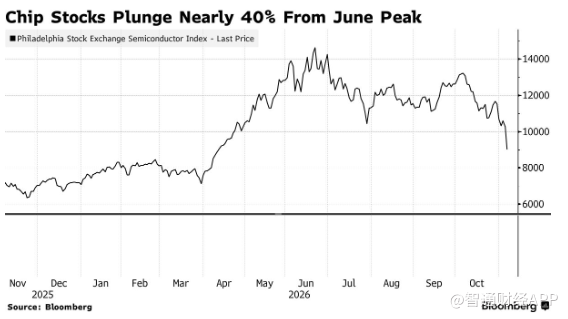
On Thursday, the Philadelphia Semiconductor Index (SOX) fell sharply by 12%, the worst single-day performance since March 2020. This brought the benchmark index into a bear market, falling more than 38% from its peak on June 22. The index covers chip leaders such as Nvidia, Intel (INTC.US), and Chaowei Semiconductor (AMD.US). These companies have been benefiting from a wave of AI device spending, but given high valuations, they are also one of the sectors most vulnerable to potential pullbacks.
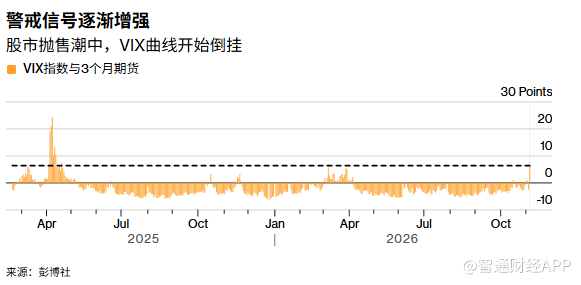
The Chicago Board Options Exchange Volatility Index (VIX) surged 11.57 points to close at 28.18 points, the highest level since March. The VIX Index is an indicator that measures the implied price fluctuations of the S&P 500 index. The VIX Index's expected volatility index recorded its biggest one-day increase since 2018. In 2018, large amounts of speculative capital poured into VIX short products, triggering a surge in volatility known as the “end of volatility” (Volmageddon). Furthermore, the spread between the spot price and the three-month futures level widened to the largest since April 2025. This usually indicates heightened investor fears and indicates a deeper decline.
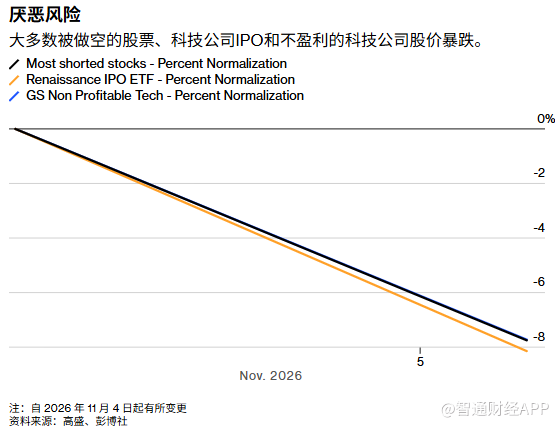
This decline has increased pressure on some stocks considered to be the riskiest in the market. The most shorted stock portfolio prepared by Goldman Sachs fell nearly 8%. Meanwhile, a portfolio of loss-making technology companies, including Roku (ROKU.US) and Peloton Interactive (PTON.US), fell 7.7%, the biggest one-day decline since the beginning of June.
Furthermore, the company with the weakest balance sheets and higher debt burdens fell by about 4%, the worst single-day performance since April 2025. The Russell 2000 index fell by about 4.5% and entered a pullback range. The index includes small companies that are often dragged down by higher interest costs.
The Wealth Alliance has previously cut AI stock exposure, and its president and managing director Eric Diton said that the boycott of data centers may affect profits. He said he was cautious in light of the sharp shift in sentiment and has been buying energy stocks to hedge against high oil prices.
“This sell-off is extreme,” he said, adding that he “can't be as optimistic about the market as a few days ago.”