
Goldman Sachs Trading Desk “The phone was blown up but the buyer couldn't wait”: the midterm election results triggered a decline in AI transactions, and the NASDAQ evaporated more than 2 trillion US dollars in a single day
The Zhitong Finance App learned that overnight in US stocks on Thursday, Goldman Sachs Group's stock trading desk was flooded with investor inquiries — everyone is asking the same question: How deep will the tech stock sell-off actually fall? However, it is difficult to find buyers who actually take over the market.
According to John Flood, head of Goldman Sachs American Equities Executive Services, Wednesday (midterm election day) is one of the busiest trading days for the bank's stock exchange during the year. By Thursday, the style of painting was quite the opposite. “Today was completely reversed,” Flood wrote in a report to customers on Thursday. “Our phone calls were bombarded with all kinds of calls asking about the market. Unfortunately, we haven't seen much (actual transactions).”
Long-term funds were frozen again, and hedge funds sold backwards
According to Flood, long-term investment institutions (long-only) have once again fallen into a wait-and-see freeze. This group of investors, who previously aggressively cut their risk exposure before the midterm elections, was caught off guard by Wednesday's rebound and re-attracted back to the market — now hedge funds are selling artificial intelligence hyperscaler (hyperscaler) stocks they had just bought the previous trading day.
What worries the market even more is the lack of buying orders. According to feedback from Goldman Sachs customers, brokerage brokers with large retail exposure reported that retail investors had a significant net sales imbalance for the second day in a row.
Selling pressure is transmitted from top to bottom — investors are using broad-based tools to reduce overall exposure. According to data provided by Flood, SPDR S&P 500 ETF trading volume was 160% of the 20-day EMA, Invesco QQQ (NASDAQ 100 ETF) volume reached twice the average, VanEck semiconductor ETF was 150% higher than average, and DRAM memory chip stock trading volume increased 75%.
“It feels a bit excessive,” Flood wrote. “It's always darkest before dawn.”
Trigger: Election politics collides with AI
The direct trigger for this round of tech stock sell-off was the Democratic Party's big win in the midterm elections and its potential impact on AI transactions that have continued to boost the market over the past three years. Voters strongly oppose building data centers in their own communities, and the Democratic Party, which now controls the Senate and House of Representatives of the National Assembly, is expected to hold hearings and conduct questions on the development of artificial intelligence.
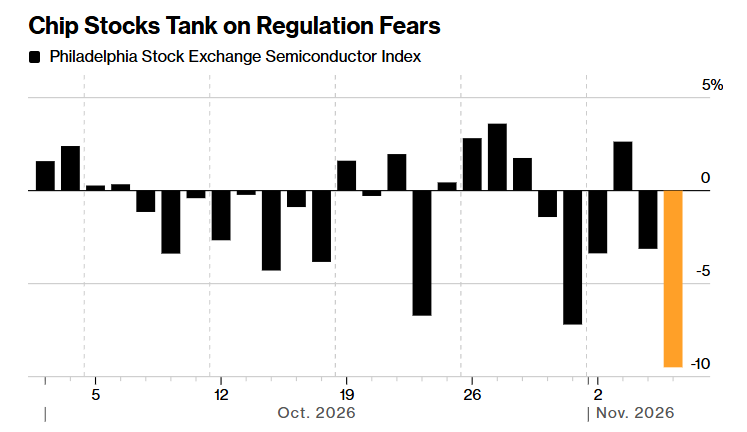
The round of capital, which began in the semiconductor sector, quickly evolved into a full-scale sell-off: the 11 major sectors of the S&P 500 index closed down, leading a sharp decline of 7% in the intraday period; the Nasdaq 100 index, which is dominated by technology stocks, fell 5.9%, and the market value evaporated by more than 2 trillion US dollars; the Philadelphia Semiconductor Index (SOX) fell by more than 10% and is on its way to the worst trading day since the COVID-19 pandemic in March 2020.