
Halozyme Therapeutics (NASDAQ:HALO) surprises with Q3 2026 sales but stock drops

Biopharmaceutical drug delivery company Halozyme Therapeutics (NASDAQ:HALO) announced better-than-expected revenue in Q3 2026, with revenue up 39.2% year on year to $493 million. The company’s full-year revenue guidance of $1.89 billion at the midpoint came in 0.6% above analysts’ consensus estimates. Its non-GAAP profit of $2.39 per share was 1.5% above analysts’ consensus estimates.
For more on Halozyme Therapeutics, read our free full research report.
Halozyme Therapeutics (HALO) Q3 2026 highlights:
- Revenue $493 million vs S&P analysts’ consensus estimates of $486.4 million (39.2% year-on-year growth, 1.3% beat)
- Adjusted EPS $2.39 vs S&P analysts’ consensus estimates of $2.36 (1.5% beat)
- Adjusted EBITDA $336.2 million vs analysts’ consensus estimates of $325.8 million (68.2% margin, 3.2% beat)
- Revenue guidance The company lifted its revenue guidance for the full year to $1.89 billion at the midpoint from $1.87 billion, a 1.1% increase
- Adjusted EPS guidance Management slightly raised its full-year adjusted EPS guidance to $8.90 at the midpoint
- EBITDA guidance $1.27 billion at the midpoint for the full year, above analysts’ consensus estimates of $1.23 billion
- Operating margin 59.8%, down from 61.5% in the same quarter last year
- Market capitalization $14.79 billion
"Halozyme delivered another exceptional quarter, with total revenue increasing 39% and royalty revenue growing 44% year-over-year to record levels," said Dr. Helen Torley, President and Chief Executive Officer. "In and post the quarter, we have achieved multiple milestones that expand our opportunity and diversify our revenue. During the quarter, we expanded our agreements with argenx and Incyte to include additional targets to be evaluated with ENHANZE. In October, we also signed an expanded agreement with Johnson & Johnson for one additional target. Three ENHANZE programs, one each with Pfizer, Incyte and argenx advanced into Phase 1 clinical development, bringing our total products in development to twelve."
Revenue growth
Reviewing a company’s long-term revenue performance reveals insights into its quality. Any business can have short-term success, but a top-tier one grows for years. Halozyme Therapeutics’s 31.2% annualized revenue growth over the last five years was strong. Its growth beat the average healthcare company and shows its offerings resonate with customers.
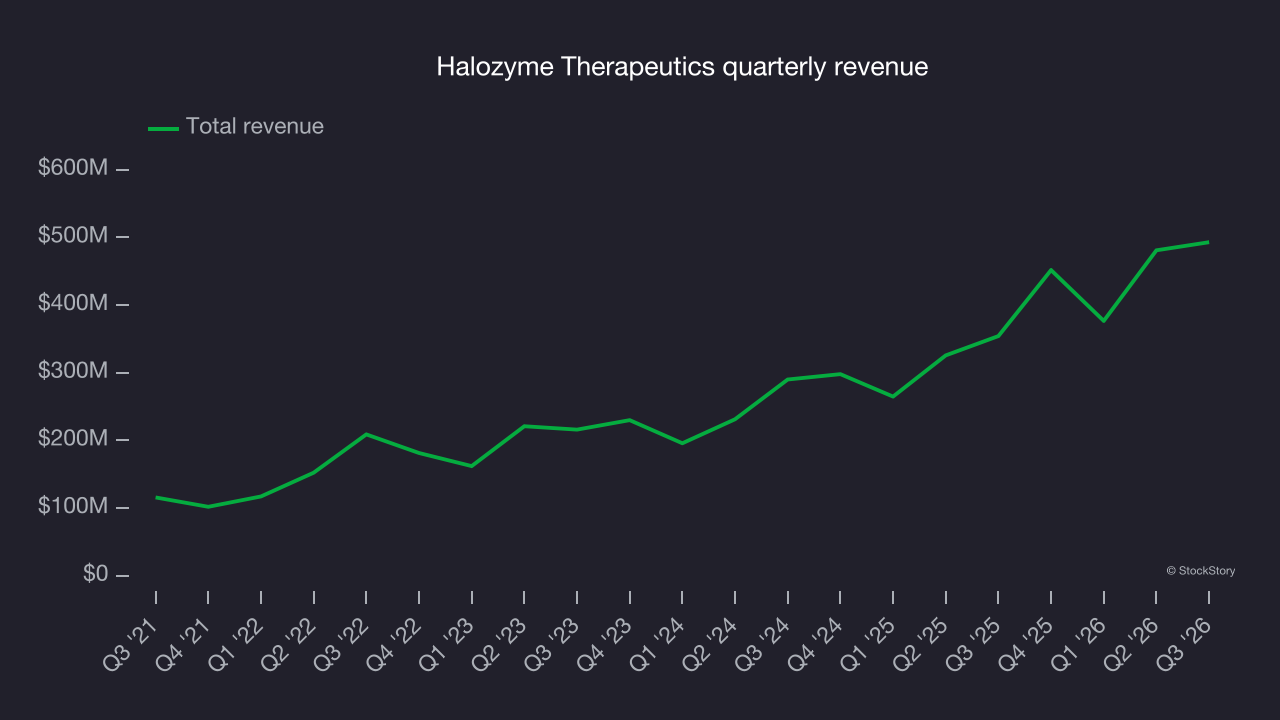
Long-term growth is the most important, but within healthcare, a half-decade historical view may miss new innovations or demand cycles. Halozyme Therapeutics’s annualized revenue growth of 37.9% over the last two years is above its five-year trend, suggesting its demand was strong and recently accelerated. 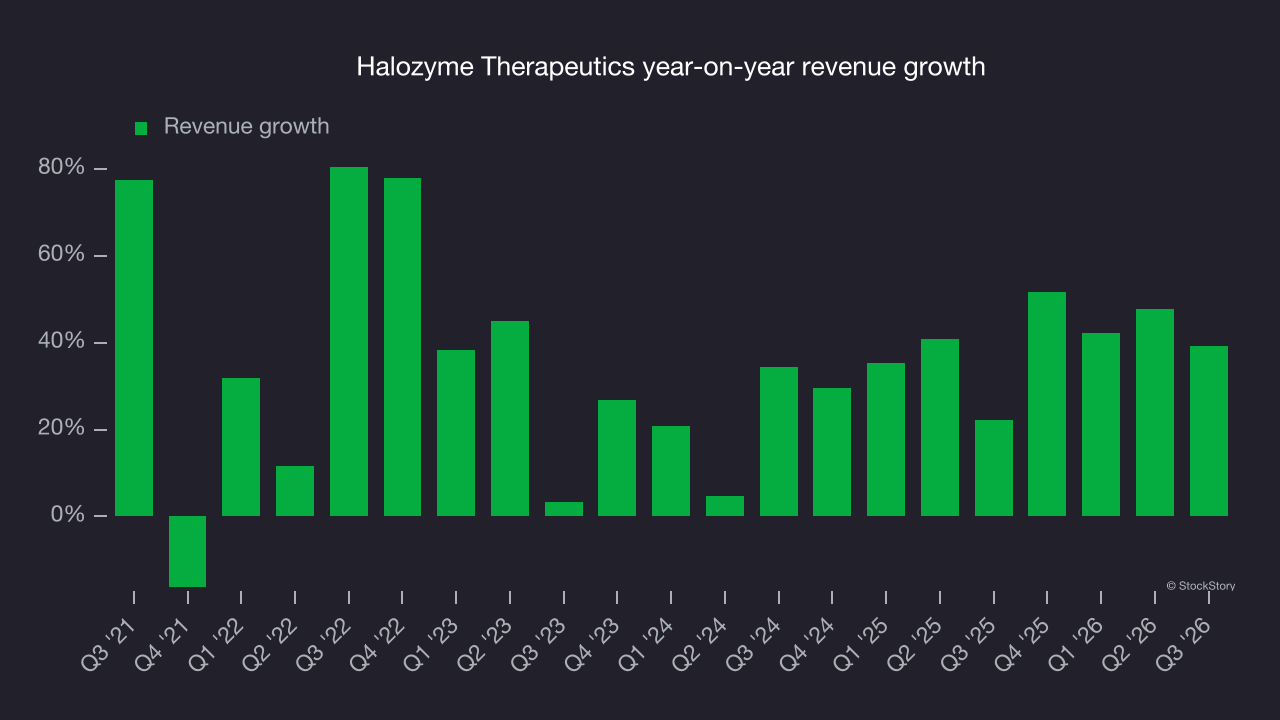
This quarter, Halozyme Therapeutics reported year-on-year revenue growth of 39.2%, and its $493 million of revenue exceeded Wall Street’s consensus estimates by 1.3%.
Looking ahead, sell-side analysts expect revenue to grow 12.7% over the next 12 months, according to S&P, a deceleration versus the last two years. Still, this projection is strong and suggests the market is pricing in success for its products and services.
Adjusted operating margin
Adjusted operating margin is an important measure of profitability as it shows the portion of revenue left after accounting for all core expenses, from the cost of goods sold to advertising and wages. It’s also useful for comparing profitability across companies because it excludes non-recurring expenses, interest on debt and taxes.
Halozyme Therapeutics has performed well over the last five years. It demonstrated high profitability for a healthcare business, with an average adjusted operating margin of 56.7%.
Looking at the trend in its profitability, Halozyme Therapeutics’s adjusted operating margin decreased by 4.9 percentage points over the last five years. This decline was driven by more recent setbacks, as the company’s margin fell by 13.9 percentage points on a two-year basis. These disappointing results show its expenses were rising and it couldn’t pass those costs on to its customers.
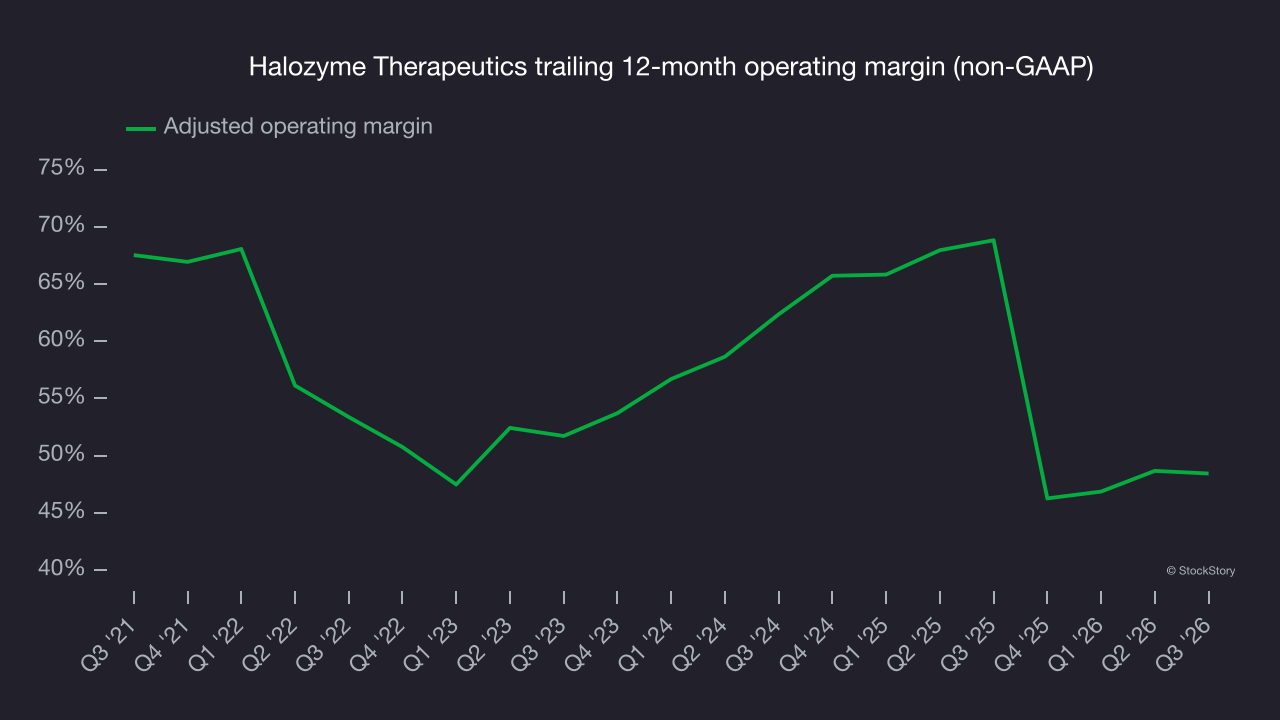
In Q3, Halozyme Therapeutics generated an adjusted operating margin of 63.2%, down 6.9 percentage points year on year. This contraction shows it was less efficient because its expenses grew faster than its revenue.
Earnings per share
We track the long-term change in earnings per share, or EPS, for the same reason as long-term revenue growth. Compared to revenue, however, EPS highlights whether a company’s growth is profitable.
Halozyme Therapeutics’s EPS grew at a strong 23.7% compounded annual growth rate over the last five years. However, this performance trailed its 31.2% annualized revenue growth, indicating that the company became less profitable on a per-share basis as it expanded due to non-fundamental factors such as interest expenses and taxes.
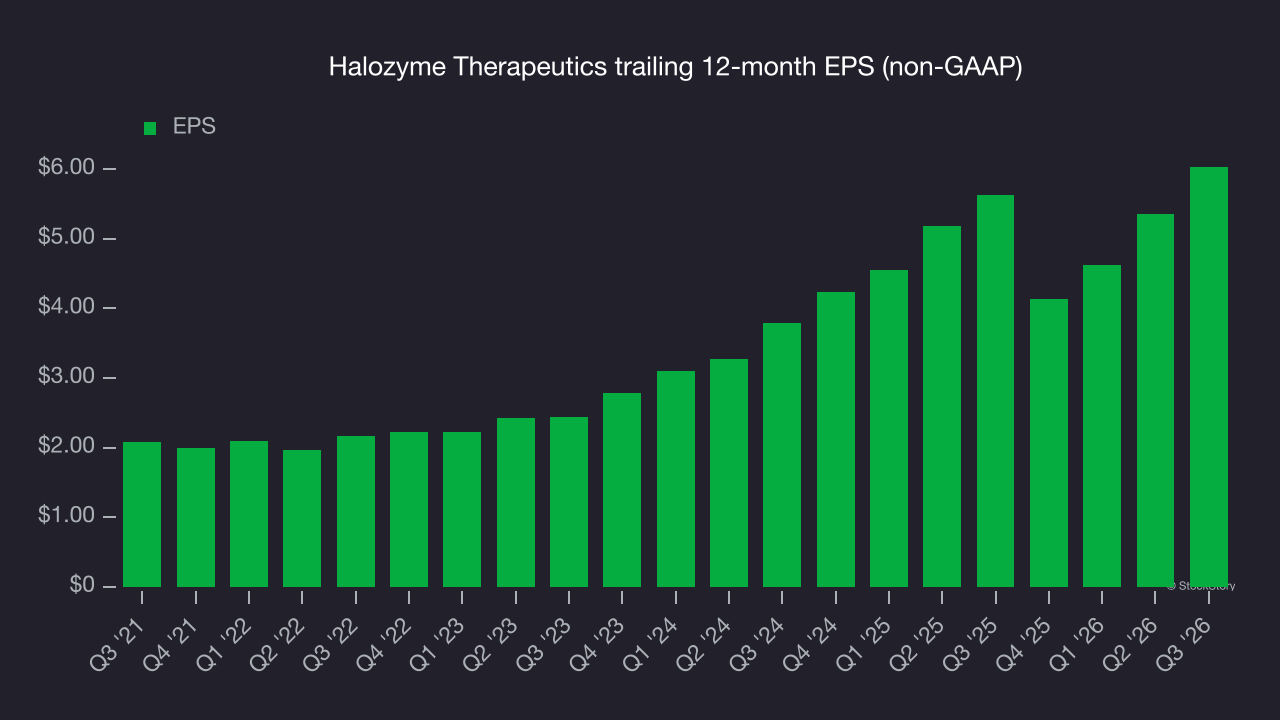
A closer look at Halozyme Therapeutics’s earnings helps explain its performance. As mentioned earlier, Halozyme Therapeutics’s adjusted operating margin declined by 4.9 percentage points over the last five years. This was the most relevant factor (aside from the revenue impact) behind its lower earnings; interest expenses and taxes can also affect EPS but don’t tell us as much about a company’s fundamentals.
In Q3, Halozyme Therapeutics reported adjusted EPS of $2.39, up from $1.72 in the same quarter last year. This result beat analysts’ consensus estimates by 1.5%. Over the next 12 months, Wall Street expects Halozyme Therapeutics’s full-year EPS to grow 72.8% from $6.03 to $10.42, according to S&P.
Key takeaways from Halozyme Therapeutics’s Q3 results
Halozyme Therapeutics delivered some key positives in Q3, with revenue narrowly beating analysts’ consensus estimates and full-year EBITDA guidance coming in above Wall Street’s consensus. But the market seemed to be hoping for more: shares tumbled 5.6% to $116.19 immediately after the results.
To assess whether to buy the stock, consider its valuation, business quality and latest quarterly results. Read the full research report here (it’s free).