
Axon (NASDAQ:AXON) reports sales below analyst estimates in Q3 2026 earnings, stock drops 18.4%

Self-defense company AXON (NASDAQ:AXON) fell short of the market’s revenue expectations in Q3 2026, but revenue rose 27.8% year on year to $908.6 million. Next quarter’s revenue guidance of $1 billion underwhelmed, coming in 6.8% below analysts’ consensus estimates. Its non-GAAP profit of $1.72 per share was 9% below analysts’ consensus estimates.
For more on Axon, read our free full research report.
Axon (AXON) Q3 2026 highlights:
- Revenue $908.6 million vs S&P analysts’ consensus estimates of $935.6 million (27.8% year-on-year growth, 2.9% miss)
- Adjusted EPS $1.72 vs S&P analysts’ consensus estimates of $1.89 (9% miss)
- Adjusted EBITDA $235.7 million vs analysts’ consensus estimates of $227.9 million (25.9% margin, 3.4% beat)
- Revenue guidance $1 billion at the midpoint for Q4 2026, below analysts’ consensus estimates of $1.07 billion
- EBITDA guidance $926.5 million at the midpoint for the full year, below analysts’ consensus estimates of $946.9 million
- Operating margin 4.6%, up from -0.3% in the same quarter last year
- Free cash flow -$18.9 million, down from $36.64 million in the same quarter last year
- Market capitalization $34.46 billion
Revenue growth
Examining a company’s long-term performance can provide clues about its quality. Any business can have short-term success, but a top-tier one grows for years. Over the last five years, Axon grew its revenue at a strong 31.4% compounded annual growth rate. Its growth surpassed the average industrials company and shows its offerings resonate with customers.
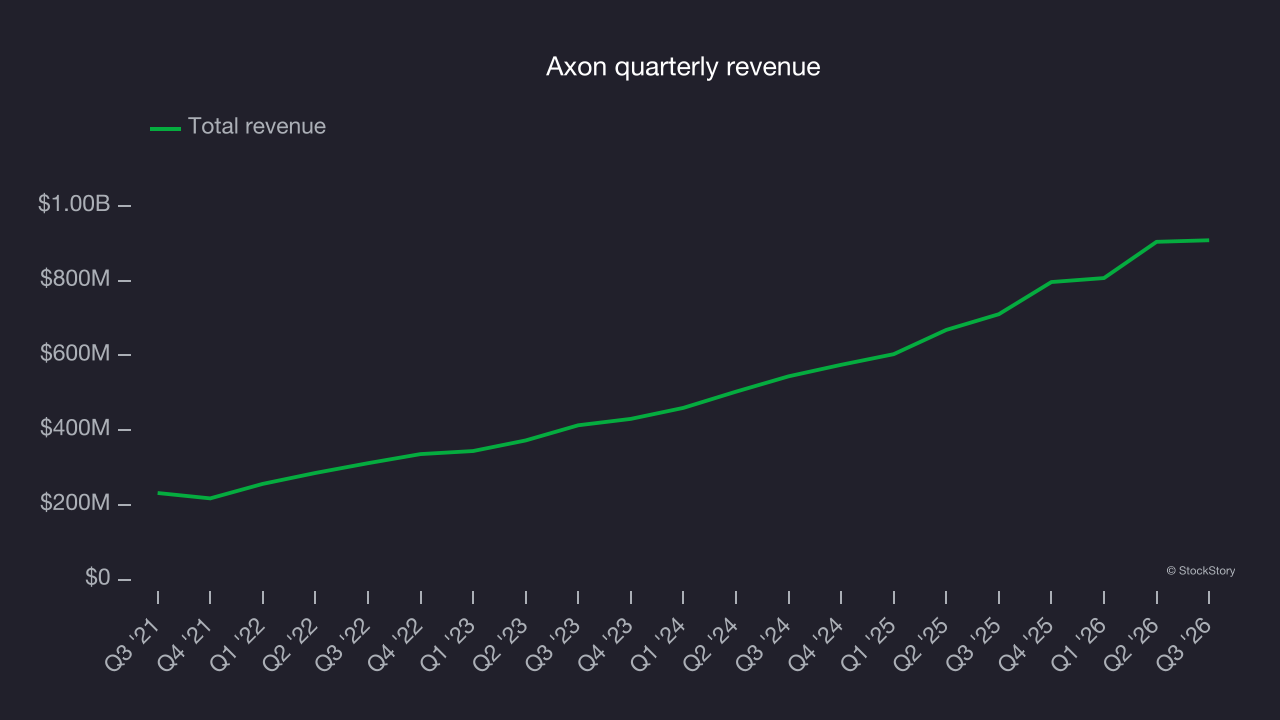
Long-term growth matters most, but within industrials, a half-decade historical view may miss cycles, industry trends or a company capitalizing on catalysts such as a new contract win or a successful product line. Axon’s annualized revenue growth of 32.8% over the last two years is above its five-year trend, suggesting its demand was strong and recently accelerated. 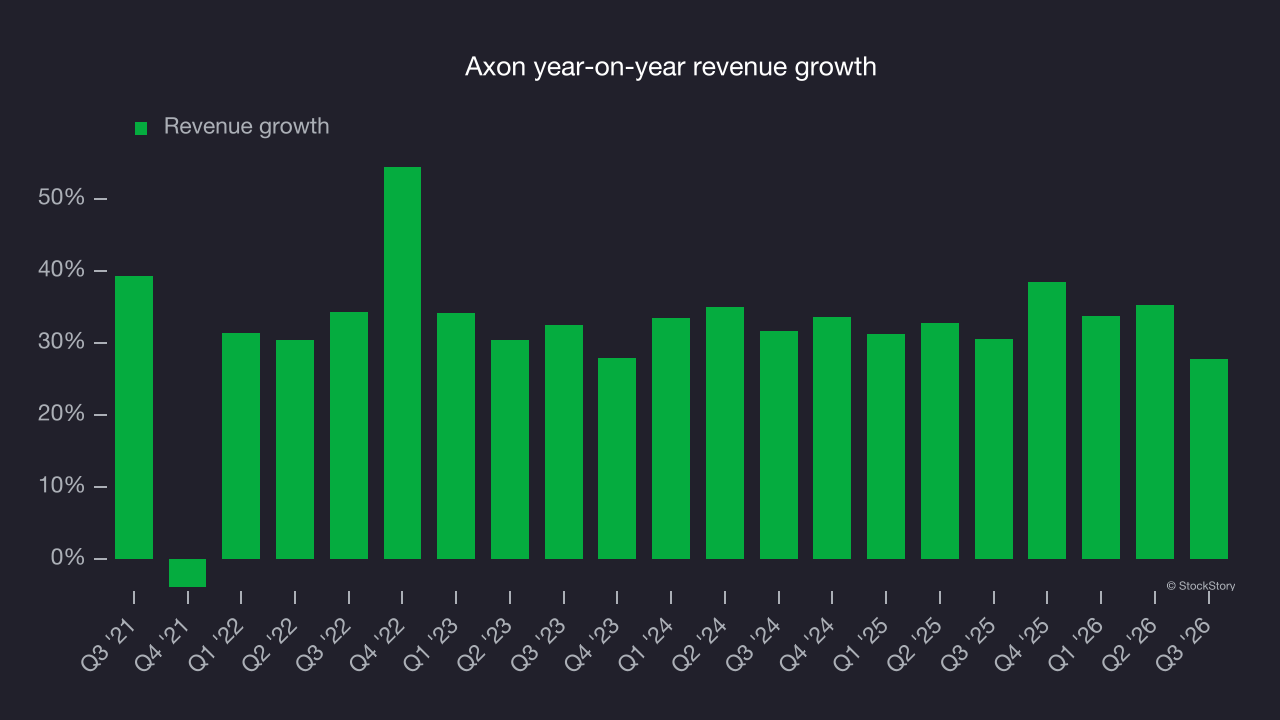
This quarter, Axon delivered strong year-on-year revenue growth of 27.8%, but its $908.6 million of revenue fell short of Wall Street’s high expectations. Management is guiding for a 25.5% year-on-year increase in revenue next quarter.
Looking further ahead, sell-side analysts expect revenue to grow 33% over the next 12 months, according to S&P, similar to its two-year rate. This strong growth projection suggests the market is pricing in success for its products and services.
Operating margin
Axon was profitable over the last five years but held back by its large cost base. Its average operating margin of 3.2% was weak for an industrials business.
Axon’s operating margin decreased by 2.1 percentage points over the last five years. This raises questions about the company’s expense base because its revenue growth should have given it leverage on its fixed costs, resulting in better economies of scale and profitability. Axon’s poor performance shows that costs were rising and it couldn’t pass them on to its customers.
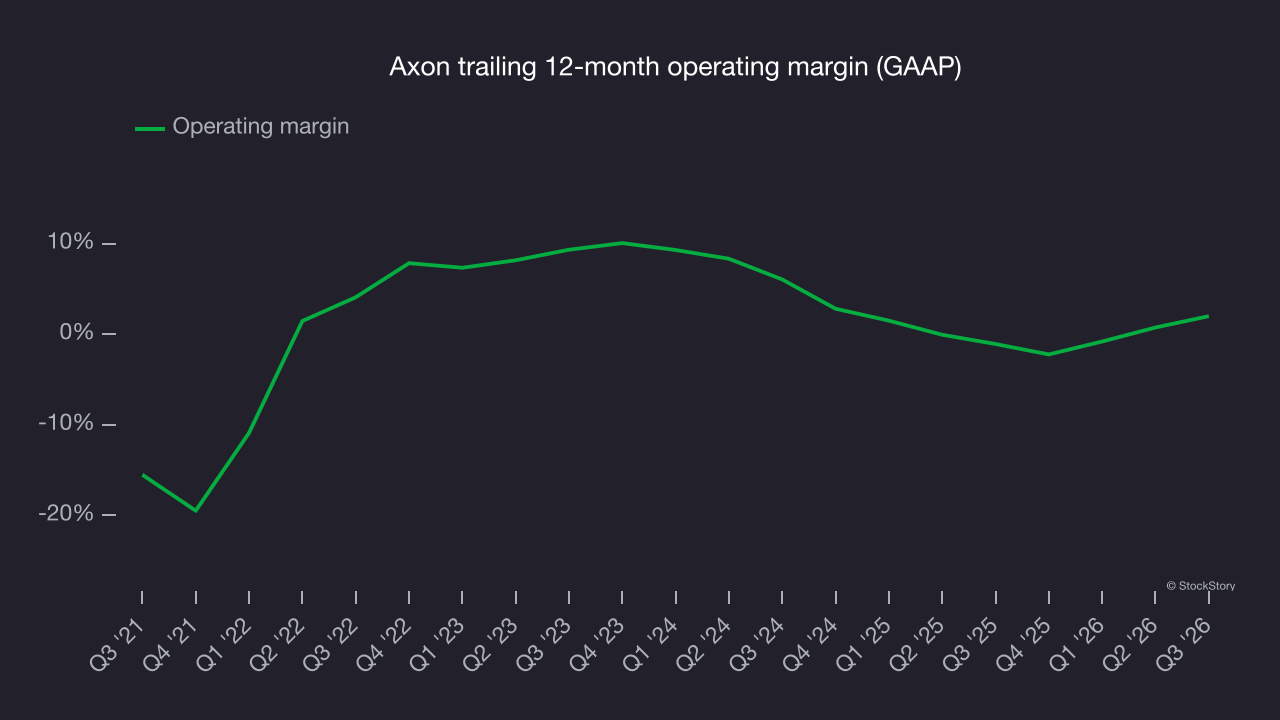
This quarter, Axon generated an operating margin of 4.6%, up 4.9 percentage points year on year. This increase was a welcome development and shows it was more efficient.
Earnings per share
Long-term earnings per share, or EPS, growth matters for the same reason as long-term revenue growth. Compared to revenue, however, EPS highlights whether a company’s growth is profitable.
Axon’s EPS grew at a strong 20.8% compounded annual growth rate over the last five years. Despite its operating margin improvement during that time, this performance trailed its 31.4% annualized revenue growth, indicating that non-fundamental factors such as interest and taxes affected its ultimate earnings.
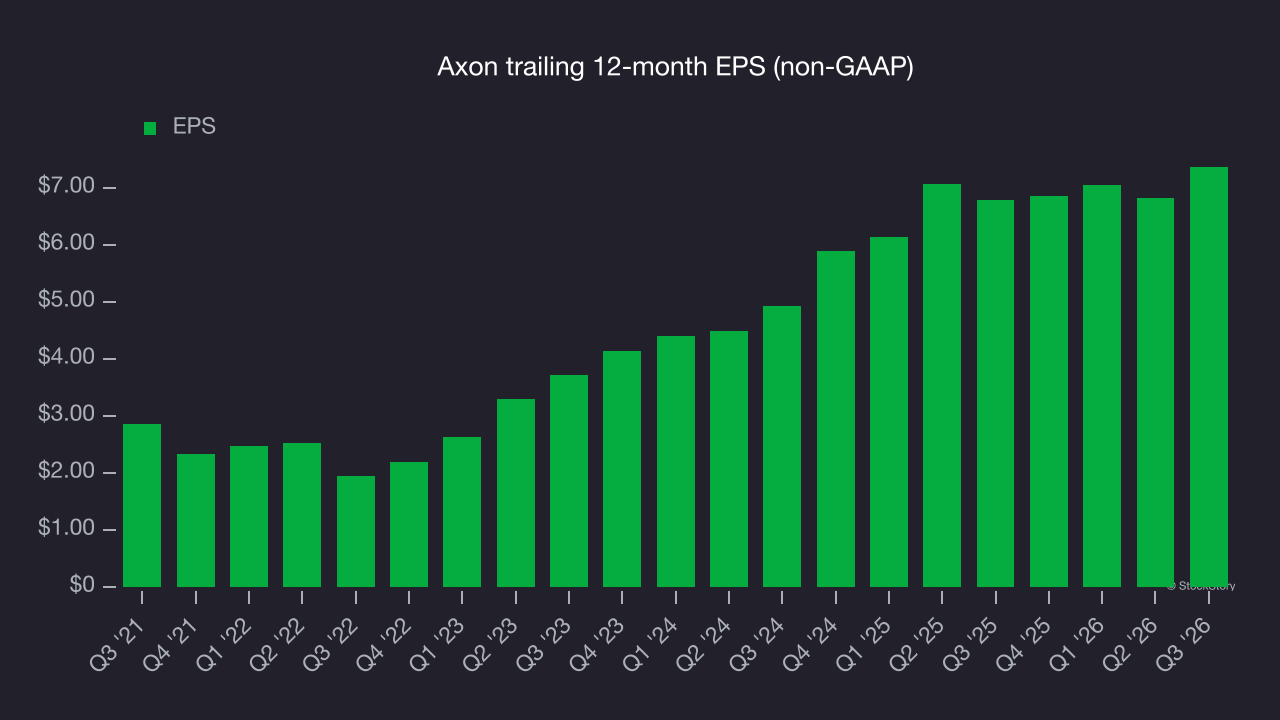
A closer look at Axon’s earnings helps explain the drivers of its performance. As noted earlier, Axon’s operating margin expanded this quarter but declined by 2.1 percentage points over the last five years. Its share count also grew by 15.5%, meaning the company not only became less efficient with its operating expenses but also diluted its shareholders. 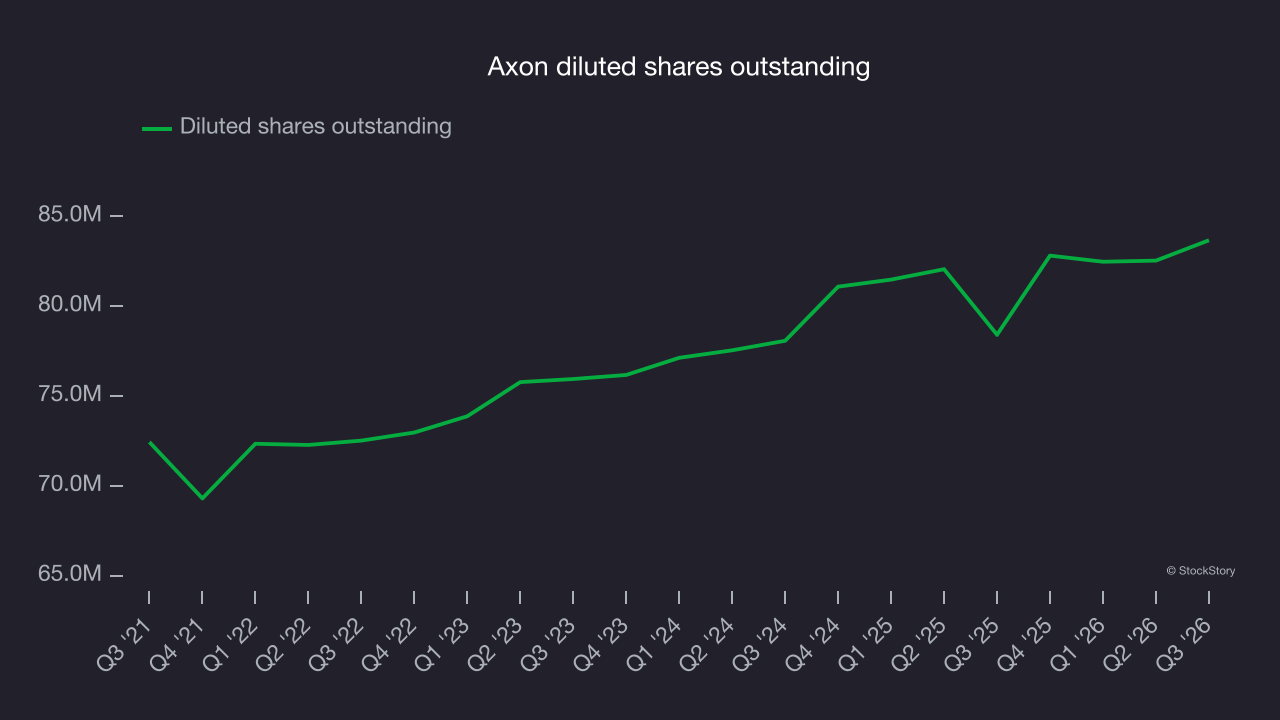
As with revenue, a shorter-term view of EPS can reveal changes in the business.
For Axon, its two-year annual EPS growth of 22.3% was higher than its five-year trend. That acceleration is a positive, particularly given the already high base.
In Q3, Axon reported adjusted EPS of $1.72, up from $1.17 in the same quarter last year. Despite growing year on year, this result missed analysts’ consensus estimates, but long-term adjusted EPS growth matters more than short-term movements. Over the next 12 months, Wall Street expects Axon’s full-year EPS to grow 32.3% from $7.36 to $9.74, according to S&P.
Key takeaways from Axon’s Q3 results
Axon’s EBITDA beat analysts’ consensus estimates, but revenue fell short of Wall Street’s consensus and next-quarter revenue guidance also missed expectations. Those shortfalls made for a quarter that could have been better. Shares plunged 18.4% to $317.59 immediately after the results.
Axon’s earnings report left something to be desired. A closer look can help assess whether this quarter has created an investment opportunity. What happened in the latest quarter matters, but not as much as longer-term business quality and valuation, when deciding whether to invest in the stock. For more on those factors, read our full research report here (it’s free).