
Bear Market Growling? Beat It Back With These 3 ETFs
Another day, another crisis.
As I write this, the major indexes are plunging thanks in large part to the artificial intelligence (AI) trade cooling off (or unraveling, depending on your point of view). That's just one day after Wall Street enthusiastically cheered a Democratic congressional sweep—an event that many market watchers thought would be a selling trigger.
Of course, we've also been kneecapped this year by tariffs and a surprise war with Iran without a bear market (a drop of 20% from a peak) to show for it, so who knows? Maybe we'll only fall into a correction (a 10% drop). Maybe this is just a one-day thing.
I'm not here to pretend I have a crystal ball that will tell the market's fate. I'm here to talk about some of the popular exchange-traded funds you can buy if you think an equity downturn is nigh and you'd like to limit the damage.
Read on as I shine a light on some of the top bear-market ETFs.
Editor's Note: Tabular information presented in this article is up-to-date as of Nov. 5, 2026.
Disclaimer: This article does not constitute individualized investment advice. Individual securities, funds, and/or other investments appear for your consideration and not as personalized investment recommendations. Act at your own discretion.
No Two Bear Markets Are the Same
There's no such thing as a silver-bullet bear-market ETF … because no two bear markets are the same.
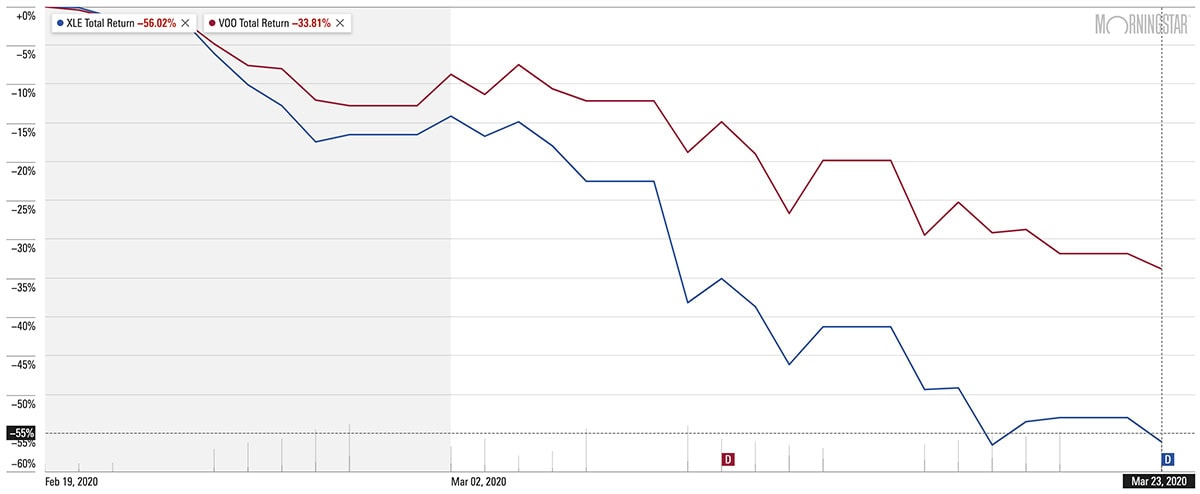
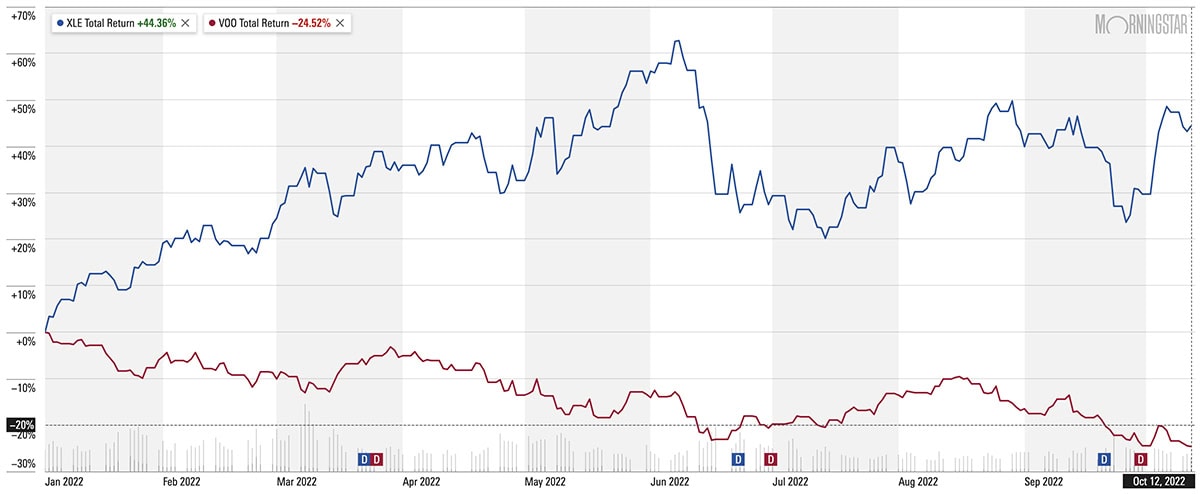
One of the best examples of this lies in the performance of the energy sector during the 2020 and 2022 bear markets.
In 2020, energy commodities crashed amid global travel restrictions, with oil briefly trading at negative prices. Energy stocks—represented here by the Energy Select Sector SPDR Fund (XLE)—lost more than half of their value by the bear market's nadir, reached on March 23, 2020.
However, 2022 was a completely different story altogether. The post-COVID rebound resulted in high levels of inflation that were exacerbated by Russia's invasion of Ukraine, which sent energy prices skyward. That forced the Federal Reserve and other central banks to authorize steep interest-rate hikes, which ultimately sent every market sector but one—energy, propped up by high oil, natural gas and other commodity prices—into the red.
Go further back: The 2007-09 bear market was set off by collapse in the financial markets. The dot-com bear market of 2000-02 was triggered by wild overvaluation and speculation in the tech sector.
You get the picture: Each bear market has its own causes and characteristics, so naturally, which investments will protect you the most will vary from one bear market to the next.
Plus, your goals might vary. You might simply want to limit your risk but still be able to participate in most of the upside in case you incorrectly anticipate a bear market. Or you might be more aggressive and want to actually produce positive returns if stocks circle the drain.
For that reason, it's good to have options—rather than having one go-to fund for a rainy day, it might behoove you to have a handy list of several to meet your needs. Here are a few picks from my larger list of the best bear-market ETFs.
Vanguard U.S. Minimum Volatility ETF
- Style: U.S. minimum-volatility large-cap stock
- Assets under management: $504.7 million
- Dividend yield: 1.6%
- Expense ratio: 0.13%, or $1.30 per year on every $1,000 invested
Investors can easily get confused trying to sort out the difference between low- and minimum-volatility funds. The general goal is roughly the same (reduce volatility), but they go about it in different ways.
Low-vol funds simply hold the lowest-volatility stocks within their selection universe. Min-vol funds try to create the lowest-volatility portfolio possible, even if doing so involves owning some volatile stocks. How would that work? If you own several stocks that are volatile, but whose performances aren't really correlated with one another, they could balance each other out to an extent, creating a portfolio that overall doesn't exhibit much volatility.
The Vanguard U.S. Minimum Volatility ETF (VFMV) aptly expresses it (emphasis mine):
"[The] Fund invests in stocks that together have the potential to generate lower volatility than the broad U.S. equity market."
Related: 8 Low- and Minimum-Volatility ETFs for Peace of Mind
Unlike many low- and min-vol strategies, VFMV isn't index-based, but actively managed. Manager Scott Rodemer tries to achieve minimum volatility by investing across stocks of all sizes, market sectors, and industry groups, while also trying to limit exposure to stocks with relatively low liquidity.
A great illustration of how low- and min-vol strategies take different paths is to look at how the VFMV and Invesco S&P 500 Low Volatility ETF (SPLV) differ from their benchmarks in how they hold stocks in the volatile technology sector.
- VFMV: ~30% tech (vs. ~36% for the Russell 3000)
- SPLV: ~0% tech (vs. ~37% for the S&P 500)
Yes, Vanguard's fund has reduced tech exposure compared to the Russell 3000, but it's hardly low. In fact, not only do technology stocks command the largest portion of VFMV's assets, but they do so by a wide margin over the next closest sector (healthcare, 13%).
Management believes it can achieve lower volatility through a more balanced portfolio. It's not perfectly level, as you'd guess from its tech allocation, but the asset spread is a little better than the Russell 3000. Both funds have three sectors with double-digit exposure, but VFMV has more with higher-single-digit exposure.
VFMV currently has a beta of 0.51—so Vanguard has built a portfolio that's more volatile than SPLV (0.30), but still less wobbly than the broader market by almost half.
Vanguard U.S. Minimum Volatility came to life in 2018, so it doesn't have a long track record. But thus far it has delivered defense in downturns and better upside than SPLV—as well as the larger and more popular iShares MSCI USA Min Vol Factor ETF (USMV)—in up markets.
Related: 5 Best Consumer Staples ETFs You Can Buy
JPMorgan Limited Duration Bond ETF
- Style: Short-term bond
- Assets under management: $4.2 billion
- SEC yield: 4.7%*
- Expense ratio: 0.24%**, or $2.40 per year on every $1,000 invested
Of course, if you're convinced a bear market is coming for stocks, you might want to avoid stocks no matter how defensive they are.
One of the more common defenses against a downturn in equities is the relative safety of bonds. Historically, bonds haven't held a candle to stocks when it comes to their returns across all economic cycles. However, bonds are far more stable, with most of their returns coming in the form of interest income—and those traits begin to look a lot more appealing when stocks are dropping like rocks.
The JPMorgan Limited Duration Bond ETF (JPLD) is one of the best options within the world of bond funds, for several reasons.
For one, short-term bonds are considered safer than longer-dated bonds. That's because the less time a bond has remaining before it matures, the likelier it is that the bond will be repaid. And JPLD's management team—Robert Manning, Sajjad Hussain, and Cary Fitzgerald—have built a 766-bond portfolio with an average life to maturity of a little more than two years. This results in a low duration (a measurement of a bond's risk) of 2.1 years, which effectively implies that for every 1-percentage-point increase in interest rates, JPLD would suffer a short-term loss of just 2.1%.
Invest With CIBC
CIBC Investor's Edge lets you trade U.S. and Canadian stocks and ETFs, options, mutual funds, and bonds through registered accounts like FHSAs, TFSAs, RRSPs, and RESPs, as well as non-registered accounts.
Sign up with CIBC Investor's Edge today and you can make all of your fractional trades commission-free through Oct. 31, 2027.
Second, management isn't limited to any one type of bond—they can hold a variety of different debt products to maximize results in any environment. Right now, JPLD has invested 30% of its assets in Treasuries, 28% in asset-backed securities (ABSes), and another 25% in agency mortgage-backed securities (MBSes). The rest of the portfolio's assets are spread among non-agency MBSes, collateralized loan obligations (CLOs), money market funds, and other credit. And that portfolio generates almost 5% in yield right now despite the short-term nature of its holdings.
The Federal Reserve lowered its benchmark interest rate three times in 2025, but hiked them once in 2026. Additional rate cuts would be good news for JPMorgan's fund, as lower interest rates are generally positive for the price of existing bonds, and the federal funds rate (an overnight lending rate used by rates) is much more likely to have an impact on shorter-term portfolios such as JPLD's. Conversely, rate increases could hinder JPLD's performance.
Lastly, JPMorgan Limited Duration Bond ETF is run by skilled managers. "[Michael] Sais, the lead manager on the strategy since 1995, announced his April 2026 retirement a year in advance, providing time to facilitate a smooth transition to Cary Fitzgerald and securitized specialist Sajjad Hussain," says Paul Olmstead, an analyst at Morningstar, which gives JPLD a Gold Medalist rating. "This pair should be able to get up to speed with the help of Sais and comanager Bob Manning, who's been on the strategy since 2013 and has more than 25 years of industry experience."
JPLD has only traded since 2023, but it was converted from a mutual fund, so it does have a long track record—and a decent one at that, beating its Morningstar category average over every meaningful time frame.
Moreover, it suffered minimal losses during the Great Recession, COVID, and 2022 bear markets, as well as the current downturn. Better still: It actually produced small gains during the near-bear of 2018, did so again between the February 2025 highs and April lows, and suffered only minimal losses during this year's March swoon.
* SEC yield reflects the interest earned across the most recent 30-day period. This is a standard measure for funds holding bonds and preferred stocks.
** 0.30% gross expense ratio is reduced with a 6-basis-point fee waiver until at least June 30, 2027.
Related: The Best Healthcare ETFs: 5 Wholesome Picks
ProShares Short S&P500 ETF

- Style: Inverse stock
- Assets under management: $953.5 million
- Dividend yield: 3.9%
- Expense ratio: 0.89%, or $8.90 per year on every $1,000 invested
All of the aforementioned funds dance around bear markets.
The ProShares Short S&P500 ETF (SH) uses them to its advantage.
The view from 10,000 feet is that when the S&P 500 goes down, SH goes up. How it does that is fairly complex—rather than simply holding stocks, bonds, or physical assets like the aforementioned ETFs, this fund needs to use a series of futures, swaps, and Treasury bills to create the inverse performance of the S&P 500. I normally say that investors should "look under the hood" before they buy an ETF, but in this case, knowing what the ProShares Short S&P500 ETF holds isn't helpful in understanding the fund.
What is helpful is understanding how SH behaves.
SH provides the inverse daily return of the S&P 500. This means if the S&P 500 declines by 1% on Monday, this ETF will gain 1% on Monday (minus expenses, of course). But because this only occurs on a daily basis, that doesn't mean if the S&P 500 declines by 10% in a year, SH will gain 10% in a year. That's because of how returns compound over time. Plus there are SH's fees, which are larger than your average index fund.
Related: 3 Best Utility ETFs You Can Buy Right Now
Not to mention, if the market goes up, you're not participating in any upside whatsoever—SH will lose money.
I'm not arguing against SH. Far from it. I'm simply explaining the risks, which are important to know before you dive into any fund.
But this ETF can do quite well for itself. From Feb. 19 through April 8 of 2025, SH generated a positive 23% total return. It gained 9% during 2026's market decline. In fact, SH not only has a permanent place in my annual best ETFs roundup, but I've owned it before, and I actually owned it for a large part of 2025's downturn (though I have since sold off my position).
While this ProShares ETF might not provide perfect negative-1-for-1 performance, it comes pretty darn close—certainly close enough to make it useful if you're anticipating a significant downturn. It's also a safer hedge than leveraged funds that provide -2x or even -3x the market's performance, which can get out of hand in a hurry. And it's a better alternative than jettisoning stocks you already own, which can not only result in taxable events if done outside of tax-advantaged retirement plans, but (in the event you're selling dividend stocks you've owned for a while) can snuff out attractive yields on cost.
One last important note: SH isn't meant to be held forever. Funds like this are tactical in nature—you hold it for as long as you find it useful, but once you think the tide is going to turn, get out. Leaving it in your portfolio in perpetuity will provide an unnecessary drag as long as stocks go up in the long term.
Related: The 10 Best Fidelity ETFs You Can Buy [Invest Tactically]
Learn More About These and Other Funds With Morningstar Investor
If you're buying a fund you plan on holding for years (if not forever), you want to know you're making the right selection. And Morningstar Investor can help you do that.
Morningstar Investor provides a wealth of information and comparable data points about mutual funds and ETFs—fees, risk, portfolio composition, performance, distributions, and more. Morningstar experts also provide detailed explanations and analysis of many of the funds the site covers.
With Morningstar Investor, you'll enjoy a wealth of features, including Morningstar Portfolio X-Ray®, stock and fund watchlists, news and commentary, screeners, and more. And you can try it before you buy it. Right now, Morningstar Investor is offering a free seven-day trial and a discount on your first year's subscription when you use our exclusive link.
Read More
- 2026 Midterm Elections: 5 Investment Takeaways From the Pros
- 8 Best Closed-End Funds (CEFs) Paying Us Up to 18.8%
- VanEck's WBMO ETF: For Investors Who Want to Own It All