
Radware (RDWR) Could Be 13% Below Fair Value After 7 Year Cloud Deal And Mixed Earnings
Radware (NasdaqGS:RDWR) is back in focus after renewing a major global cloud services provider for a seven year DDoS protection deal, along with releasing fresh quarterly results and new fourth quarter 2026 revenue guidance.
Recent trading has been choppy for Radware, with the share price slipping 11.19% over the past week even after the seven year DDoS contract win and fresh quarterly guidance. The stock is still showing a 30 day share price return of 7.56% and a 1 year total shareholder return of 38.66%, which points to momentum building over a longer horizon.
Scan how other cybersecurity and cloud security players are reacting to similar contract wins and mixed earnings through the curated 53 AI infrastructure stocks.
Bulls point to Radware’s seven year cloud deal and continuing sales growth, while bears focus on softer earnings and the recent pullback. Which side does the current valuation really support next?
Price-to-Earnings of 102.5x: Is It Justified For Radware?
Radware’s share price of $33 sits on a rich earnings multiple, with the stock trading on a P/E of 102.5x that sharply contrasts with many peers in software security.
The P/E ratio compares what investors are paying today for each dollar of trailing earnings. For a cybersecurity vendor like Radware, a lofty multiple often signals that the market is placing a premium on future profit potential rather than current income, especially when the most recent year showed a decline in earnings of 18.7% and current net profit margins of 4.1% sit below last year’s 5.7%.
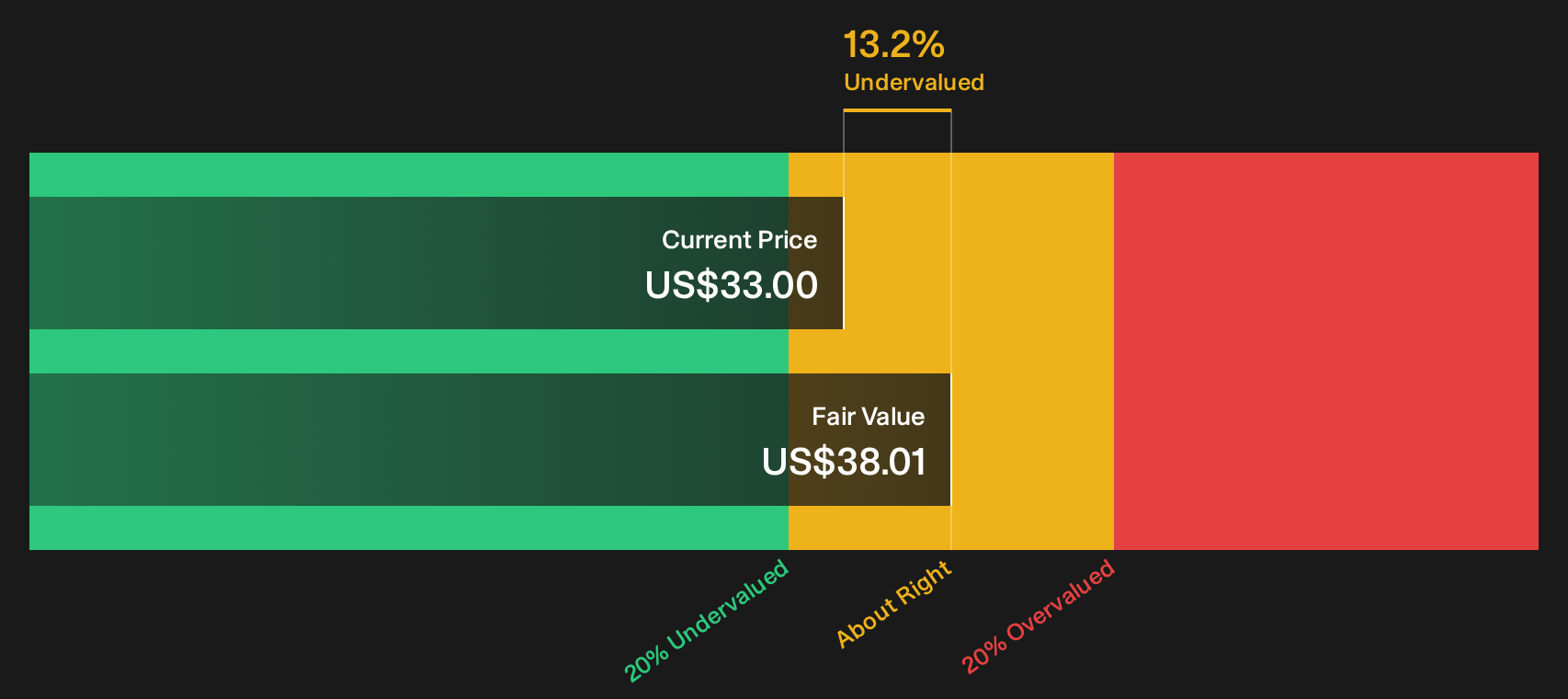
Context matters for that premium. Our DCF model points to a future cash flow value of $38.01 per share, which is 13.2% above the current $33 price and framed by annual revenue growth of 9.8% and a five year earnings growth rate of 26.2% per year. At the same time, a 3.8% return on equity is described as low, one off gains of $4.7m complicate the quality of recent profits, and earnings are forecast to expand slower than the broader US market with limited analyst coverage reducing confidence in forward estimates.
The comparison to peers is stark. Radware’s P/E of 102.5x is described as expensive versus the US Software industry average of 29.9x and also expensive against its closer peer group on 31.6x. That gap suggests the market is assigning Radware a valuation that is materially higher than both sector and peer benchmarks even as revenue is forecast to grow slower than the US market and recent earnings have declined.
See what the numbers say about this price — find out in our valuation breakdown.
Result: Price-to-Earnings of 102.5x (OVERVALUED)
Still, Radware’s premium P/E could reset quickly if revenue growth near 9.8% slows further or if the 4.1% net margin comes under pressure.
Find out about the key risks to this Radware narrative.
Another View: What The SWS DCF Model Says About Radware
The rich 102.5x P/E hints at a stock priced for perfection, yet the SWS DCF model paints a milder picture for Radware. On that cash flow view, an estimated value of $38.01 per share sits about 13.2% above the current $33 price, which points to a modest gap rather than a large mispricing.
That difference matters. If earnings stay patchy and revenue is expected to grow around 9.8% per year, a P/E north of 100x leaves little room for disappointment, while the DCF outcome centers on cash generation instead of headline multiples. Which signal do you want to trust more when expectations are this high?
Look into how the SWS DCF model arrives at its fair value.
Simply Wall St performs a discounted cash flow (DCF) on every stock in the world every day (check out Radware for example). We show the entire calculation in full. You can track the result in your watchlist or portfolio and be alerted when this changes, or use our stock screener to discover 35 high quality undervalued stocks. If you save a screener we even alert you when new companies match - so you never miss a potential opportunity.
Next Steps
Mixed signals around Radware do not have to leave you on the fence. Move quickly through the key figures, stress test the narrative against your own expectations, then weigh the 1 key reward and 2 important warning signs.
Looking for more investment ideas beyond Radware?
After weighing Radware’s valuation, you may want to broaden your watchlist with a few focused stock ideas that match different risk levels and income goals using the Simply Wall St Screener.
- Target resilient performers that prioritise capital preservation by running a filter focused on 31 resilient stocks with low risk scores.
- Explore potential mispriced opportunities by scanning a curated 19 high quality undiscovered gems that many investors might still be ignoring.
- Build a portfolio with staying power by focusing on strong finances through a list of solid balance sheet and fundamentals (24 results).
Have feedback on this article? Concerned about the content? Get in touch with us directly. Alternatively, email editorial-team@simplywallst.com