
Unusual Options Activity in Airline Stocks Shows Optimism Building: Go Deeper into the Trades
The markets spoke volumes yesterday as all three major U.S. indices rose significantly: Dow Jones Industrial Average (+3.03%), S&P 500 (+1.58%), and the Nasdaq Composite (+1.44%). Investors were pleased with the midterm election results and the resulting lower oil prices.
The hope is that the midterms will force President Trump to end the Iran war and possibly take more seriously reaching a trade deal with Canada. I’m skeptical about both issues.
But for now, investors are heavily risk-on.
In yesterday’s unusual options activity, airline stocks were popular. Both Delta Air Lines (DAL) and United Airlines Holdings (UAL) had Vol/OI (volume-to-open-interest) ratios above 50, making them the 6th-highest and 12th-highest, at 104.81 and 67.36, respectively.
In fact, the top 10 publicly traded U.S. airline stocks by market cap had 12 unusually active options, including the two mentioned above and two others above 20.
It’s not hard to see why. Lower fuel prices mean higher profits. More importantly, an end to hostilities would stabilize fuel prices, vital to airline growth plans.
Based on the 12 unusually active options, I'm considering three bets from yesterday’s trading.
The Airline Options in Question
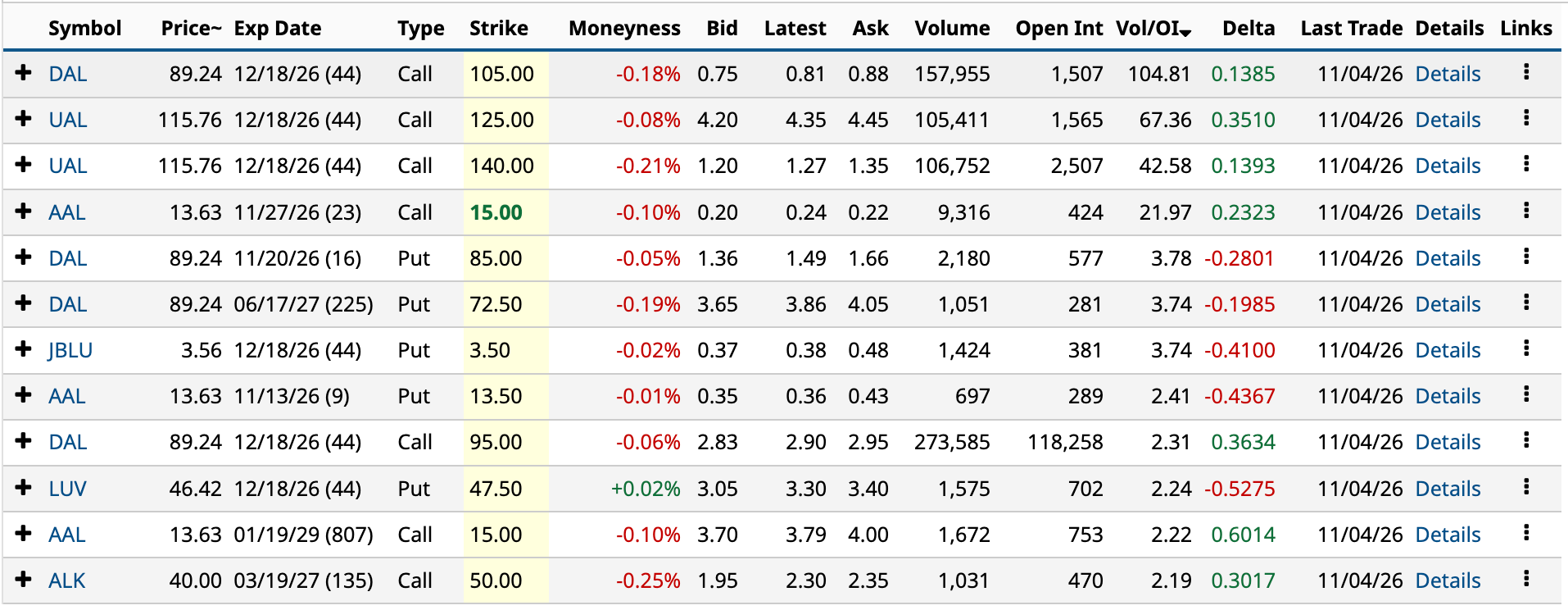
First, four of the 12 options had volume over 100,000: two were for Delta and two for United. Second, all four options were calls expiring in 44 days, on Dec. 18. Third, six of the 10 airlines had at least one call represented in yesterday’s trading.
Early Christmas and Thanksgiving presents, perhaps? For now, let’s focus on the four calls with 100,000 or more contracts traded.
Delta’s 30-day average options volume is 74,564. Yesterday, both the Dec. 18 $105 call and Dec. 18 $95 call were higher than that. The combined volume of 431.540 was 70% of Delta’s total options volume for the day. More importantly, the volume for the two calls alone was the second-highest daily volume over the past two years.
In case there’s any doubt about the extremely bullish nature of these trades, the Put/Call Volume ratio was 0.02. You can only get one basis point lower.
As for the United calls, their combined volume of 212,163 was 51% of the day’s total, which was 8.1 times higher than the 30-day average of 50,909.
The Delta Options Strategy

The institution that made these four trades yesterday at 15:13:53 ET was likely part of one big multi-leg trade, broken down into two pieces, rolling up a profitable existing Bull Call Spread.
The first piece involved closing out the 115,141 Dec. 18 $87.50 calls by selling them for $5.60 in premium income and then buying back 115,141 Dec. 18 $95 calls for $2.62, for a net credit of $2.98 or $34.3 million [$2.98 net credit per share * 115,141 contracts * 100].
The second piece involved opening a new bull call spread by buying 157,536 Dec. 18 $95 calls for $2.62 per share and selling 147,214 Dec. 18 $105 calls for $0.76 per share in premium and 10,322 Dec. 18 $105 calls for $0.75 per share for a net debit of nearly $1.86, or $29.3 million [$1.86 net debit per share * 157,536 contracts * 100].
Most importantly, the new rolled-up bull call spread makes money at expiration in December if Delta’s share price is above the breakeven of $96.86. The maximum profit is $8.14 per share [$105 strike price - $95 strike price - $1.86 net debit], or $128.2 million [$8.14 per share * 157,536 contracts * 100].
The two trades together generated the institution a net credit of $5.0 million [$34.3 million net credit - $29.3 million net debit], or $0.32 per share [$5.0 million / 157,536 contracts / 100], boosted the number of contracts in play by 42,395 (37%), and widened the strike width from $7.50 [$87.50/$95] to $10 [$95/$105].
The United Options Strategy

United’s two unusually active calls -- Dec. 18 $125 and Dec. 18 $140 -- had volume of 105,411 and 106,752, respectively. The two trades shown above accounted for almost all of the volume for the two calls. It’s a Bull Call Spread that was OTM (out of the money).
The institution bought 105,024 Dec. 18 $125 calls for $4.45 per share and sold 105,024 Dec. 18 $140 calls for $1.28 per share in premium, and a net debit of $3.17 per share or $33.3 million [$3.17 net debit per share * 105,042 contracts * 100].
Here’s how the profit/loss chart looks late Thursday morning, with UAL stock down more than 5% on the day.
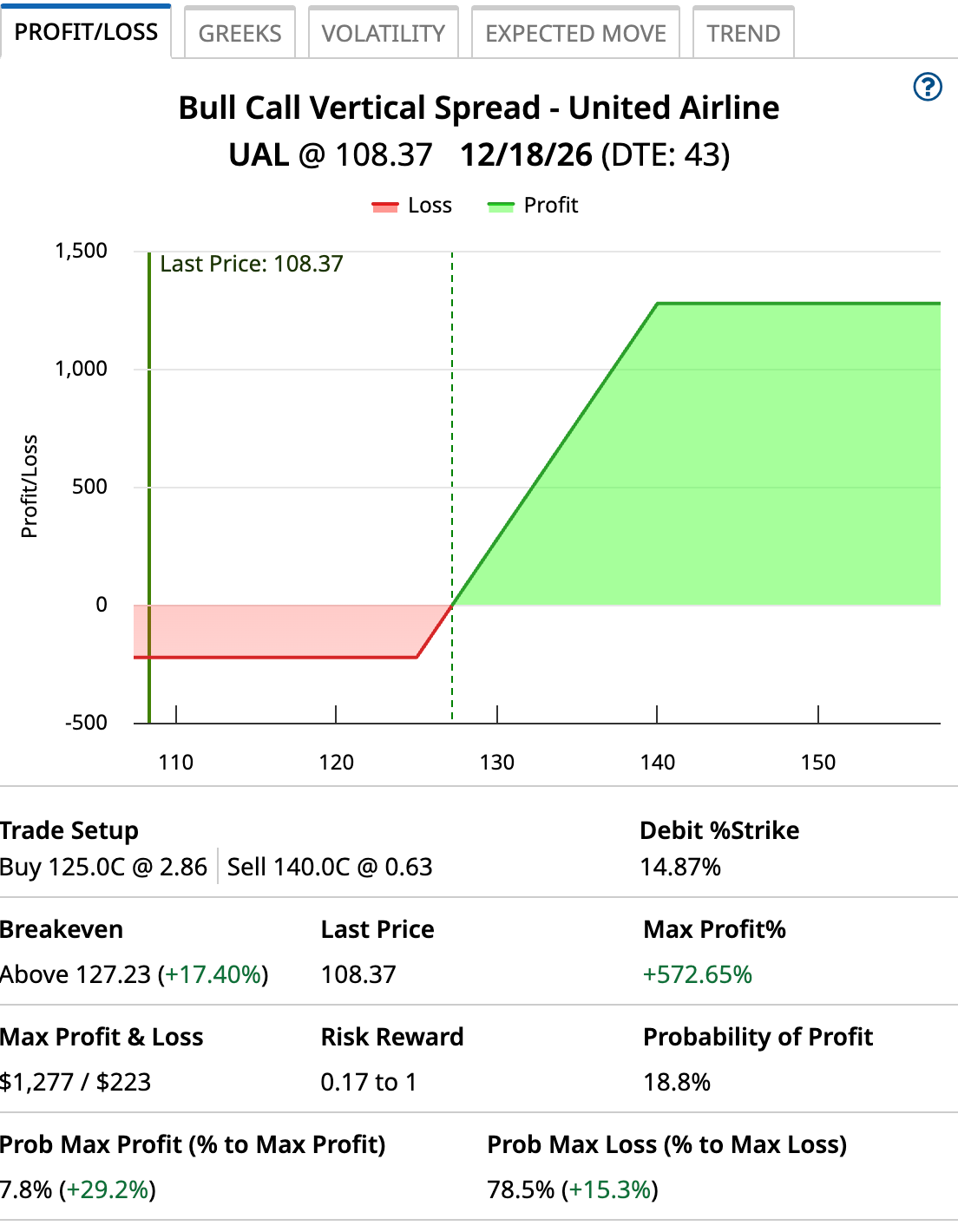
The net debit in this example is $2.23 per share, 94 cents (30%) lower than yesterday's trade. It is 14.87% of the difference between the $125 and $140 strike prices. Yesterday's trade was considerably higher at 21.1%.
Let’s assume that UAL is trading at $140 on Dec. 18. Based on the trade from yesterday, the institution’s maximum profit would be $11.83 per share [$140 strike price - $125 strike price - $3.17 net debit per share] or $124.2 million [$11.83 net debit per share * 105,024 contracts * 100].
The odds, while low, were tempting for one institution.
The Best of the Rest

The three unusually active American Airlines Group (AAL) options from Wednesday interest me because one DTE (days to expiration) is 9 days, another is 23 days, and the third is a LEAPS (Long-Term Equity Anticipation Securities) option, expiring in 807 days, or more than two years. They’re on both ends of the spectrum.
Looking at the volume for the three, the largest trade for the Nov. 13 $13.50 put was 83 contracts. That’s not enough.

The Nov. 27 $15 call shown above had three large trades of 2,000 contracts yesterday morning within 41 seconds of each other. They accounted for 64% of the call’s overall volume. All at the same trade price of $0.12. All were at the bid. All three were likely Covered Calls, generating income for the seller.
Here’s how the $15 strike covered call looks today.

If the institution(s) that made the trade(s) bought AAL in March at or near the 52-week low of $10.08, it’s easy to see why covered calls would be an attractive bet. Even if shares were bought today simultaneously with selling 6,000 calls, the 16.7% potential return [$15 strike price + $0.08 bid price - $12.93 share price / $12.93 share price - $0.08 bid price] isn’t awful.
Finally, let’s consider the Jan. 19/2029 $15 call, which had 1,672 contracts traded yesterday. All but 103 contracts were in the trade shown below.

The buy-to-open trade was $3.95 per share, right at the ask price, for a $619,700 outlay, 28.7% of the share price. Yesterday, the likelihood of the share price being at the $18.95 per share breakeven [$15 strike price + $3.95 per share call cost] in 807 days was around 40%. With the share price down nearly 8% today, the likelihood has dropped to around 33.5%. The expected move is about 47%.
Of the three options, I’m most enthusiastic about the Nov. 27 $15 covered call strategy.
On the date of publication, Will Ashworth did not directly have a position in any of the securities mentioned in this article. All information and data in this article is solely for informational purposes. For more information please view the Barchart Disclosure Policy here.