
How to Play DIS Stock as Disney Eyes 20% Cost Cuts and Thousands of Layoffs
Layoffs have increasingly become a go-to strategy for companies looking to rein in costs and streamline operations. But with artificial intelligence (AI) accelerating the pace of corporate restructuring, workforce reductions are becoming an even more common part of the equation. Now, Disney (DIS) appears to be the latest entertainment giant considering a sweeping round of job cuts. Disney is reportedly moving toward thousands of potential job eliminations, with managers being asked to identify ways to achieve 20% in annual cost savings.
The target could be met through a combination of workforce reductions and broader expense cuts, according to Bloomberg News. The potential restructuring comes at a challenging time for CEO Josh D’Amaro, who is navigating several headwinds, from the growing adoption of AI and declining box office revenue to intensifying competition from streaming rivals and slowing attendance at international theme parks. And this would hardly be Disney’s first attempt to trim its workforce this year.
The company has already carried out several rounds of layoffs, eliminating hundreds of positions in July and September across human resources, IT, Pixar, ESPN, and other divisions. Earlier, in April, Disney cut approximately 1,000 jobs as part of a broader marketing overhaul led by Chief Marketing and Brand Officer Asad Ayaz. With thousands of additional job cuts potentially on the horizon, Disney’s cost-cutting drive raises an important question for investors. Could a leaner cost structure strengthen the company’s financial outlook, or do its mounting operational challenges warrant greater caution toward DIS stock?
About Walt Disney Stock
Founded in 1923 by brothers Walt and Roy O. Disney, The Walt Disney Company has grown from a small animation studio into one of the world's largest entertainment and media conglomerates. Headquartered in Burbank, California, the company operates across three major business segments: Disney Entertainment, ESPN, and Disney Experiences. Its extensive portfolio spans blockbuster movies and television productions, streaming platforms such as Disney+ and Hulu, sports broadcasting, and iconic franchises through studios such as Pixar, Marvel, and Lucasfilm.
Beyond the screen, Disney also generates revenue through its global theme parks and resorts, cruise lines, vacation experiences, and consumer products ranging from toys and apparel to books and merchandise. With a market capitalization of approximately $197.15 billion, Walt Disney’s performance on Wall Street has remained largely subdued, as intensifying competition, rising AI adoption, and declining box office revenue weigh on sentiment.
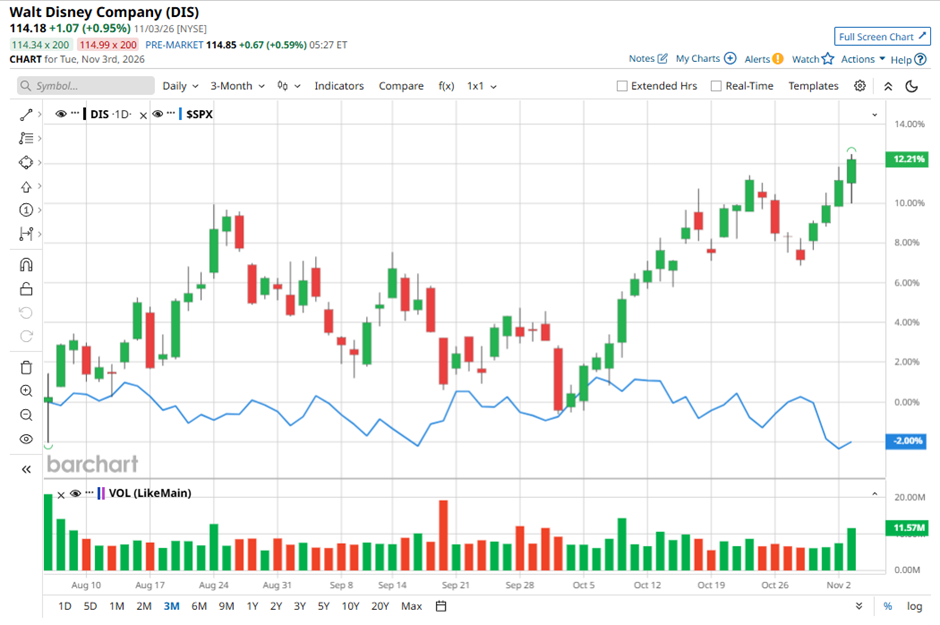
However, compared with several other leading U.S. media companies, the House of Mouse has demonstrated relative resilience. Over the past year, DIS stock has gained just 1.8%, with shares posting only marginal gains so far in 2026. That said, its recent performance paints a more encouraging picture. Disney shares have rallied 16.3% over the past three months and climbed 11.7% in just the past month. In contrast, the broader S&P 500 Index ($SPX) has edged lower over both periods.
Walt Disney’s Q3 Earnings Snapshot
The Walt Disney Company’s fiscal third-quarter earnings report, released in August, delivered a strong bottom-line beat, putting the spotlight on its streaming and Experiences businesses. Disney reported adjusted earnings per share (EPS) of $2.06, up 28% year over year and comfortably ahead of Wall Street’s consensus estimate of $1.88.
The impressive earnings growth highlighted the company’s operational resilience amid an evolving media landscape and broader macroeconomic uncertainty. On the revenue front, Disney generated $25.25 billion, marking nearly 7% growth from the year-ago quarter. Although revenue came in slightly below analysts’ expectations of $25.48 billion, the stronger-than-expected profit performance more than helped offset the modest top-line miss.
Disney’s Experiences division, which includes its global theme parks, cruise lines, and consumer products businesses, continued to serve as a major growth engine. The segment generated nearly $9.97 billion in revenue, up 10% year-over-year. This expansion was particularly notable given mounting macroeconomic uncertainty among consumers, which also appears to be weighing on other companies in the theme park industry.
Meanwhile, the Entertainment segment, spanning streaming, traditional television, and theatrical releases, reported a 6% revenue increase to $11.35 billion. The theatrical success of Toy Story 5 provided an additional boost, with the animated film surpassing $1 billion at the global box office. Disney’s Sports division, primarily comprising ESPN, also delivered growth, with revenue climbing 4% to $4.5 billion. Higher subscription and affiliate fees, alongside advertising revenue, helped drive the increase.
Looking ahead, Disney expects fiscal 2026 adjusted EPS to grow approximately 16%, while projecting fourth-quarter total segment operating income of around $4.9 billion. The company has also raised its fiscal 2026 share repurchase target to at least $9 billion, underscoring its focus on earnings growth and shareholder returns.
How Do Analysts View Walt Disney Stock?
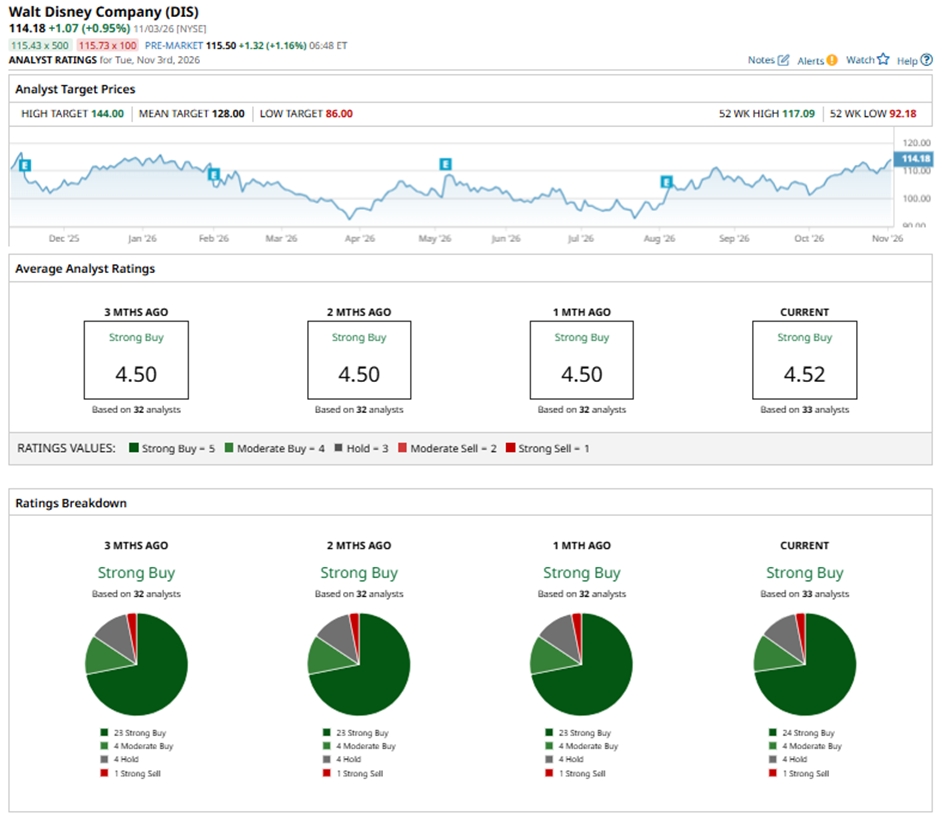
Wall Street remains firmly bullish on Walt Disney, with the stock carrying a consensus “Strong Buy” rating. Of the 33 analysts covering the company, 24 recommend a “Strong Buy,” four favor a “Moderate Buy,” four maintain a “Hold,” and just one issues a “Strong Sell.” The average price target of $128 points to an upside potential of approximately 12.1%, while the Street-high target of $144 suggests DIS could rally as much as 26.1% from current levels.
On the date of publication, Anushka Mukherji did not directly have a position in any of the securities mentioned in this article. All information and data in this article is solely for informational purposes. For more information please view the Barchart Disclosure Policy here.