
Apple Shares Fell Despite a Double Beat in Q4. Don’t Let Anyone Tell You the Results Weren’t Great.
John Ternus's first quarterly earnings presentation as CEO of Apple (AAPL) may evoke mixed feelings for him. Q4 2026 saw Apple report a beat on both revenue and earnings while clocking record revenue. Yet, shares of the iPhone maker ended almost 2% lower in Tuesday's trading session as the Street was disappointed with the guidance on lower margins in Q1 2027 and the slowest growth in the high-margin Services segment in three years.
Notably, with Ternus at the helm and the speed with which his tenure has started with new products and a first-ever touchscreen MacBook, it seems that for the former hardware chief of the company, the focus area is clear: make Apple solely known for products that the world will talk about. Ternus's path has found takers early on, and Apple is now the most valuable company in the world again, with a market cap of $4.9 trillion.
However, will this come at the expense of compromising its finances, which are as robust as they can be? What do the Q4 2026 results suggest? Let's find out.
Q4 Was Great, Don't Let Anyone Tell You Otherwise
In Q4 2026, Apple saw growth in all revenue segments, except iPad and Wearables, and across all geographic segments, except Japan, where a weaker yen and not really a slowdown in demand was the culprit. For iPad and Wearables, again, demand remained solid as Apple attributed the fall in revenues to supply constraints and a strong product launch cadence in the same period a year ago, including the A16-powered iPad, Apple Watch SE 3, and AirPods Pro 3. Encouragingly, management indicated that for iPad and the Wearables, the installed base was at an all-time high.
Overall, total net sales for the quarter were at $114.48 billion, up 11.7% from the previous year and ahead of consensus estimates by more than a billion dollars. iPhone, the biggest product segment of the company, had sales of $57.58 billion in the quarter. This marked a YoY growth of 17.4% and exceeded Street expectations of $57.18 billion. Powered by the new MacBook Neo, Mac sales rose 23.7% YoY to $10.79 billion, while the Services segment rose 9.8% YoY to $31.57 billion. Although this was the slowest pace of growth for the latter segment in years, it also surpassed the Wall Street consensus of $31.50 billion.
In terms of geography, the two largest regions, the Americas and Europe, reported sales of $48.68 billion and $32 billion, showing YoY growth rates of 10.2% and 11.5%, respectively. The contentious China market, which once made up about 20% of the company's sales, grew by 21% on a YoY basis to $17.54 billion. Finally, India, the fastest-growing market for the company, saw record revenues in the September quarter.
Apple expects revenue to grow by 7%-10% in the December 2026 quarter, with operating expenditure poised to grow by 11%-13%, with most of it geared towards AI. Yet, the call held scant details about how Siri AI would be improved and whether its agentic capabilities will be enhanced to compete effectively with the likes of Meta’s (META) Muse.
Meanwhile, earnings for the quarter were at $2.10 per share (including a positive impact of $0.05 per share for tariff refunds), marking a YoY rise of 13.5%. Furthermore, this was the 10th consecutive quarter of earnings beats from the company, a testament to its earnings power. Gross margins improved slightly to 47.9% from 47.2% in the year-ago period. However, management revealed that 1% of the 47.9% should be attributed to tariff refunds. And for Q1 2027, Apple expects gross margins to compress to 45%-46% due to higher memory costs, with additional costs to be incurred from ramping up Siri AI infrastructure. Here, some good news can be derived from this report, which expects DRAM prices to rise more slowly. That said, in the earnings call, it was revealed that the company's manufacturing purchase obligations increased by $33 billion in the September quarter, implying that any benefit from possibly lower DRAM price growth may be realized in Q2 2027 or subsequent quarters.
Shifting attention to cash flows, fiscal 2026 was another year of solid operating cash flow generation from the company. Cash generated from operating activities for the year was $145.1 billion, up 30.1% from 2025. Overall, Apple closed the quarter with a cash balance of $36.31 billion, much higher than its short-term debt levels of $11.9 billion.
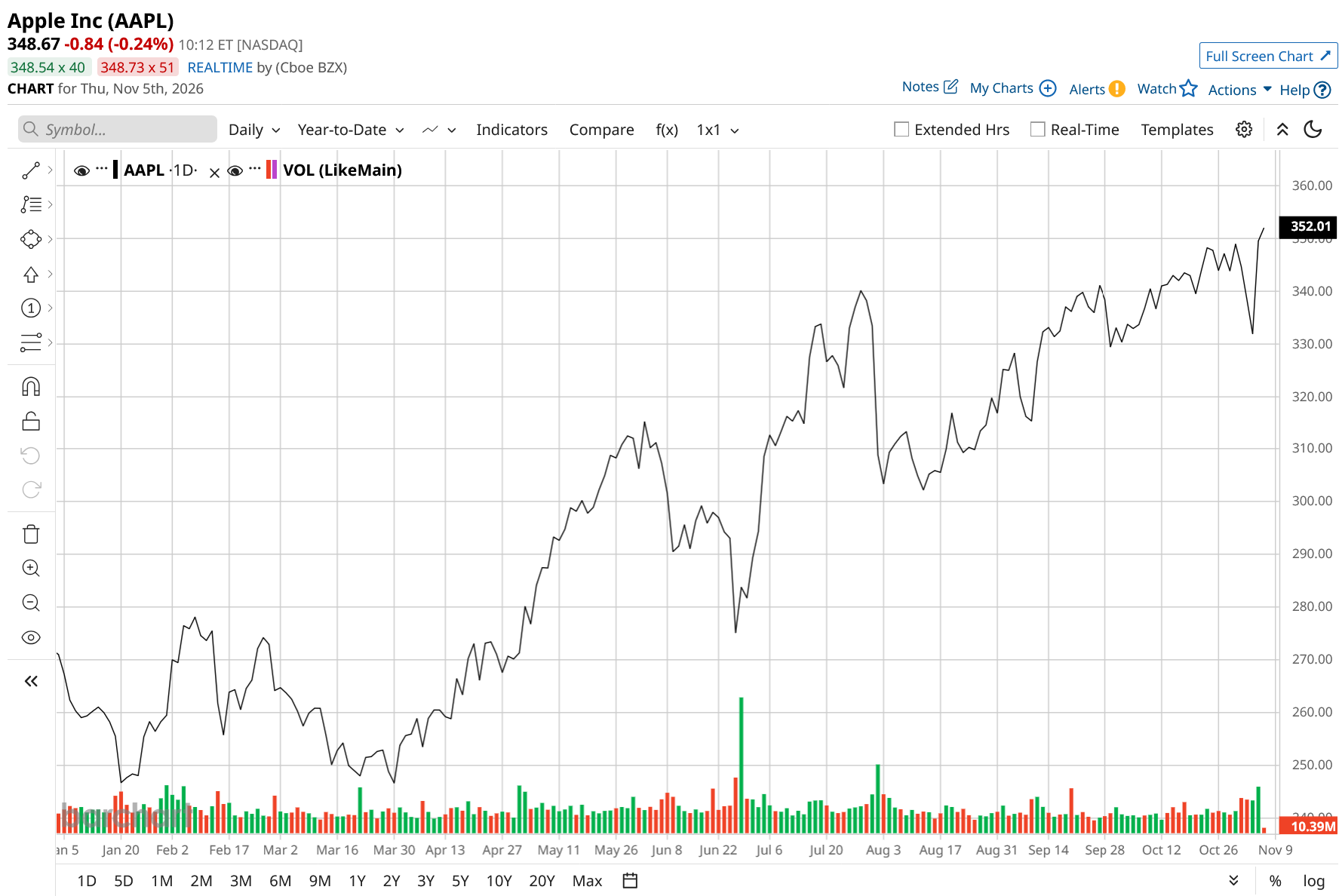
However, AAPL stock is trading at expensive valuations when compared to the industry. The forward P/E, P/S, and P/CF of 35.10, 9.23, and 29.91 are all above the sector medians of 21.21, 3.31, and 18.97, respectively. Apple shares are up 22.1% on a YTD basis.
Analyst Opinion on AAPL Stock
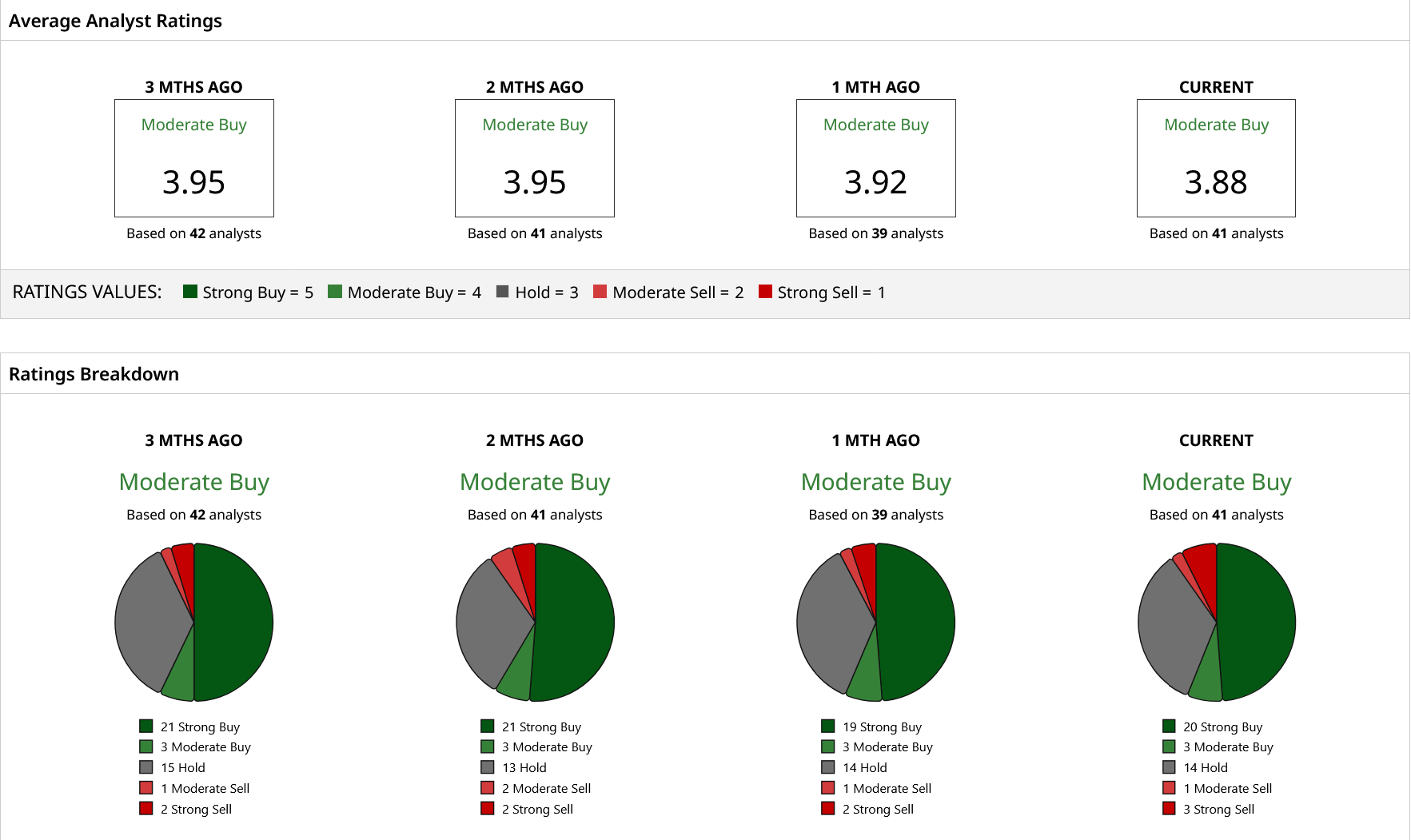
Overall, analysts deemed AAPL stock to be a “Moderate Buy.” The mean target price has already been surpassed, while the high target price of $400 denotes a potential upside of 14% from current levels. Out of the 40 analysts covering the stock, 19 have a “Strong Buy” rating, three have a “Moderate Buy” rating, 15 have a “Hold” rating, one has a “Moderate Sell” rating, and two have a “Strong Sell” rating.
On the date of publication, Pathikrit Bose did not directly have a position in any of the securities mentioned in this article. All information and data in this article is solely for informational purposes. For more information please view the Barchart Disclosure Policy here.