
What Harley Davidson (HOG)'s Earnings Drop Means For Shareholders
- Harley-Davidson reported third quarter 2026 net income of US$42.76 million and basic EPS of US$0.41, with nine month net income of US$147.34 million and basic EPS of US$1.39, all lower than the prior year period.
- The sharp year over year drop in profitability raises questions about how Harley-Davidson’s Back to the Bricks cost program and product mix shift are tracking against earlier expectations.
- Next comes a look at how this weaker Harley-Davidson earnings run rate could reshape the broader investment narrative that investors have been using.
Compare Harley-Davidson's weaker earnings with other potential turnaround stories by reviewing a curated list of 35 high quality undervalued stocks that may offer stronger fundamentals.
Harley-Davidson Investment Narrative Recap
To own Harley-Davidson, you need to believe the Back to the Bricks cost program and the shift to more affordable bikes can still restore consistent earnings power. The latest quarter tests that belief. Net income of US$42.76 million and EPS of US$0.41 for Q3 2026, much lower than a year ago, point to an earnings base under pressure.
The key short term catalyst remains execution on cost savings and mix, so the weaker run rate matters for confidence in that plan. The biggest near term risk is that tariffs, softer pricing and a lower margin product tilt keep compressing margins, which would limit cash available for reinvestment and shareholder returns.
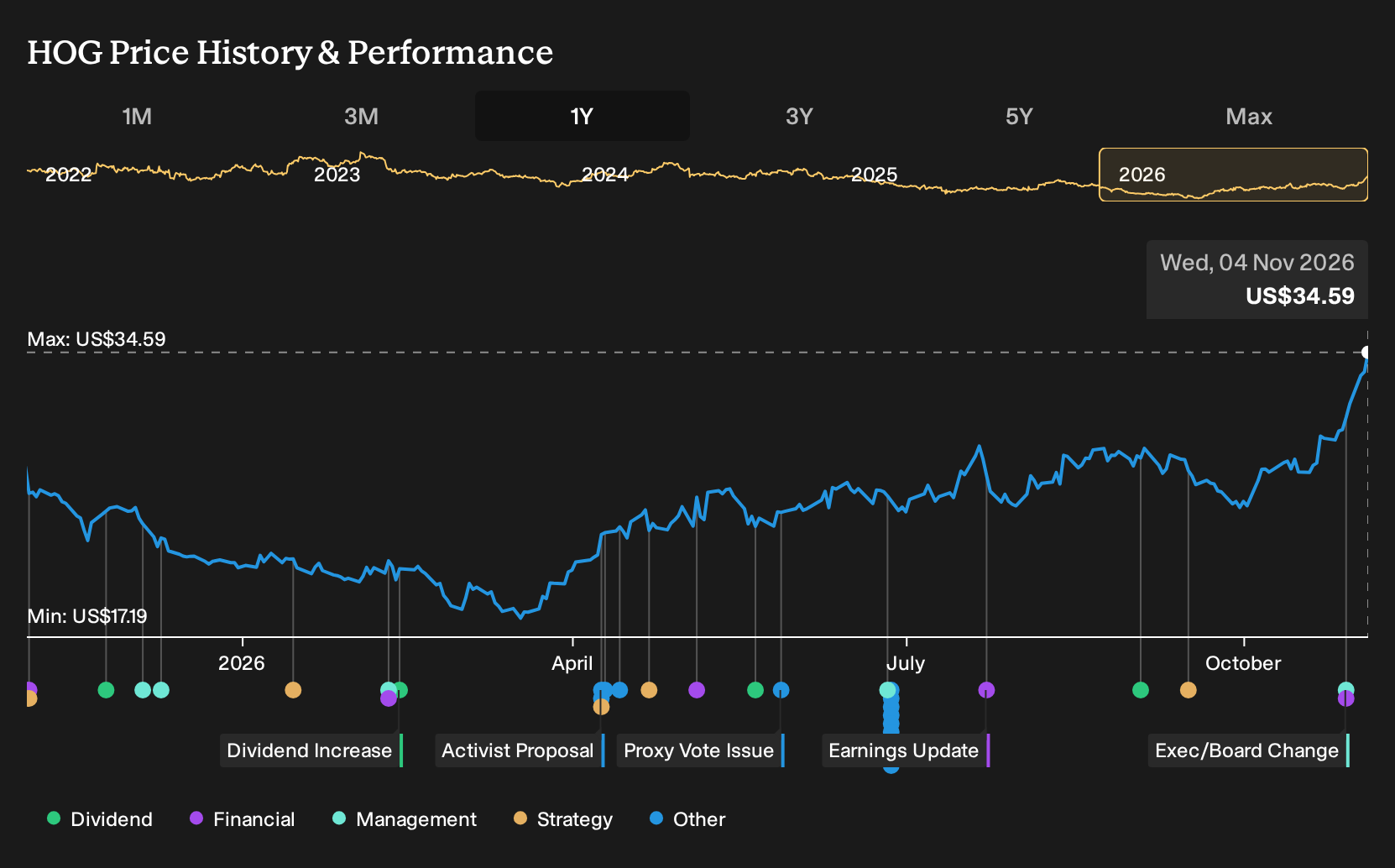
Board changes announced on 28 October 2026 are highly relevant in this context. Harley-Davidson added two independent directors: Anthony Fassino, with a long career at Caterpillar, and Bryan Slone, with deep tax, audit and governance experience. This refresh comes while profitability is strained and the turnaround agenda is execution heavy.
For investors watching catalysts, extra operational expertise and financial oversight on the board feed directly into how well Back to the Bricks, capital allocation and tariff responses are overseen. It does not change the earnings picture today, but it can influence how effectively management tackles cost inflation, product profitability and Harley-Davidson Financial Services capital light ambitions over the next few years.
What The Harley-Davidson Forecasts Are Really Asking You To Believe
Analysts sketch a Harley-Davidson story that keeps revenue roughly steady while trying to repair profitability. The assumptions are clear. Forecasts point to earnings moving from a loss of US$132.0 million today to a profit of US$264.4 million by 2029, with profit margins shifting from 3.3% in the red to 6.6% in the black over roughly three years.
This is a swing of about US$396.4 million in earnings, which is roughly a 3x improvement from the current loss position. Forecast revenue in that 2029 year is pegged at US$4.0 billion, which aligns with the comment that analysts see top line performance remaining broadly flat rather than accelerating.
The consensus view effectively asks you to underwrite three things. First, that Back to the Bricks and related cost actions do enough to lift margins into that mid single digit zone. Second, that Harley-Davidson can sustain roughly stable sales while tilting toward more affordable models. Third, that the market is comfortable paying a P/E of 13.4x those projected 2029 earnings, compared with a negative multiple today that reflects loss making conditions.
Those same forecasts also bake in a 7.0% yearly decline in the share count over the next three years. That implies a meaningful contribution from buybacks to per share earnings, even if overall profit just tracks toward the US$264.4 million target. For investors, it means any shortfall in margin repair would need to be weighed against the mechanical lift to EPS from a shrinking equity base.
Harley-Davidson's narrative points to revenue of US$4.0 billion and earnings of US$264.4 million by 2029, with analysts assuming revenue stays broadly flat over the next few years and earnings shifting from a loss of US$132.0 million today to that profit level, which is an increase of about US$396.4 million.
Uncover why Harley-Davidson's fair value indicates a 14% potential downside to its current price, leaving little room for error.
Exploring Other Perspectives
One optimistic twist on Harley-Davidson focuses on dealer health rather than cost cuts. The most bullish analysts framed the story around inventory discipline and higher dealer profitability, expecting revenue of about US$4.3b and earnings of US$344.0 million by 2029. After a sharp Q3 profit drop, those upbeat forecasts are likely to be revisited, so treat them as starting points and compare several viewpoints before deciding what makes sense to you.
Explore 3 other Harley-Davidson fair value estimates, including one that suggests it could be worth as much as $33.00.
Decide For Yourself
Don't just follow the ticker; dig into the data and build a conviction that's truly your own.
- A great starting point for your Harley-Davidson research is our analysis highlighting 1 key reward and 1 important warning sign that could impact your investment decision.
- See our latest analysis for Harley-Davidson. The report includes a comprehensive fundamental analysis summarized in a single visual, the Snowflake, making it easy to evaluate Harley-Davidson's overall financial health at a glance.
Looking For More Ideas Beyond Harley-Davidson?
If Harley-Davidson has you rethinking your watchlist, use the broader market as a comparison set. A well chosen basket of companies with different balance sheet strength, income profiles and risk levels can give better context to Harley-Davidson's story and help you decide where it fits.
- For investors who want potential upside but still care about quality, scan a curated group of 19 high quality undiscovered gems that pair solid fundamentals with lower visibility.
- If capital preservation sits high on your priority list, weigh Harley-Davidson against a 31 resilient stocks with low risk scores to see which businesses score better on stability and downside protection.
- Income focused readers can round out the picture by comparing Harley-Davidson to a set of 5 dividend fortresses that combine higher yields with thorough fundamental checks.
Have feedback on this article? Concerned about the content? Get in touch with us directly. Alternatively, email editorial-team@simplywallst.com