
Whirlpool (WHR) Stock May Be A Bargain After Guidance Was Cut
Whirlpool has had a rough stretch over the past few years, and after a sharp year to date decline followed by a recent bounce, the key issue is whether the current share price lines up with what its sales can realistically support. For an investor trying to make sense of the move, the question is whether this stock’s valuation now reflects the scale and quality of the revenue the appliance maker is actually generating.
- Whirlpool’s share price has fallen about 81.2% over 5 years, which puts the focus squarely on whether the business performance implied by that drop matches the sales it produces today.
- Recent earnings weakness, including lower North American volumes and higher input costs, can affect how confidently investors treat Whirlpool’s revenue base and its ability to convert those sales into sustainable cash generation.
- Your read on Whirlpool is one view; the desks covering it have another. See what analysts think Whirlpool's shares could be worth.
The stock’s next move may depend on whether today’s market value can be explained by Whirlpool’s sales when set against a Fair Ratio benchmark.
If Whirlpool’s slump has you rethinking where to focus your research, a targeted stock list built around resilient income payouts can be a useful second starting point, including the 5 dividend fortresses.
Does Whirlpool Look Undervalued on Sales?
P/S fits Whirlpool because revenue is still positive even while profits move around. It anchors the valuation in what the business actually sells rather than what it earns in a tough year.
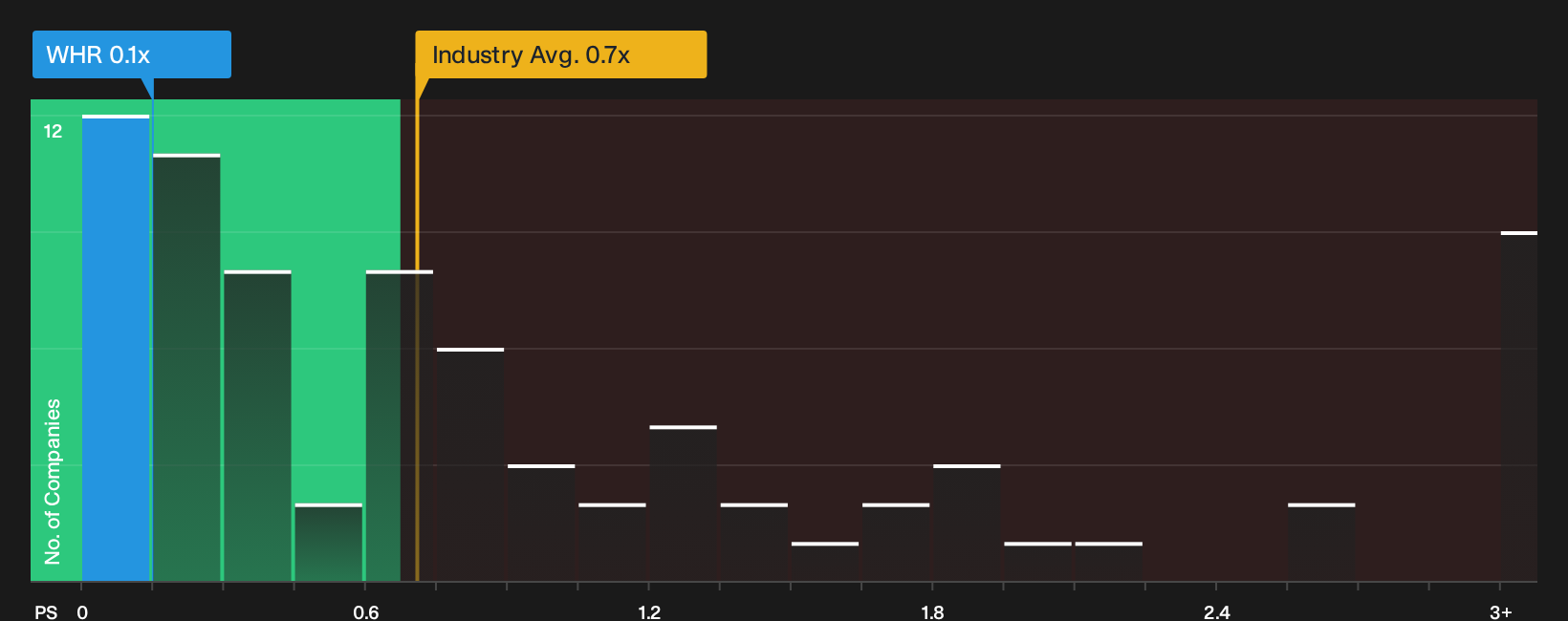
On this lens, Whirlpool trades on a P/S of 0.1x, which sits well below the Consumer Durables sector average of 0.7x and the peer group around 1.2x. The Fair Ratio, which estimates what a stock might trade on given its own mix of growth profile, margins, size and risk, points to a higher P/S than where the shares change hands today, so the current tag screens as undervalued on this measure. Because Q3 guidance cuts and weaker North American demand have weighed on sentiment, that low revenue multiple suggests investors are treating the recent earnings hit as heavily as the underlying sales base. Explore the numbers behind Whirlpool's P/S valuation.
The Whirlpool Narrative: What Would Justify Today's Price?
Simply Wall St Narratives pick up where Whirlpool's P/S puzzle leaves off by spelling out which combinations of future growth, margins and earnings would need to play out for the stock to be worth materially more or less than it is today, and they sit on the Community page. Instead of giving a single valuation point and stopping there, they unpack the future business conditions that number assumes so you can watch, over time, whether Whirlpool's reality tracks that path or drifts away from it.
Whirlpool’s community is split between investors who see a cost reset and liquidity as underappreciated and others who think weak appliance demand is already biting hard.
Bull case: 11% undervalued
“Ongoing factory consolidation, automation investments and logistics footprint changes in North and Latin America are expected to deliver at least $150 million of 2026 cost savings…”
Discover why this Narrative puts Whirlpool at 11% undervalued.
Bear case: 48% overvalued
“Despite a detailed program targeting about US$150 million of cost takeout in 2026, the company is still reporting very low ongoing EBIT margins and has already consumed more than US$2.0b of free cash flow in the first half of 2026…”
Explore why this Narrative puts Whirlpool at 48% overvalued.
One more Whirlpool check that belongs beside the price tag
Before moving on to the next idea, it is worth asking who is steering Whirlpool and how their pay packets line up with the outcomes shareholders care about most. See who runs Whirlpool and how they are paid.
Have feedback on this article? Concerned about the content? Get in touch with us directly. Alternatively, email editorial-team@simplywallst.com