
External AI agents compete for traffic entry, and internal AI models erode search and monetization! Alphabet's (GOOGL.US) forward price-earnings ratio has dropped 18 times. Is it time to bottom out?
The Zhitong Finance App notes that since the beginning of the artificial intelligence boom, investors have been worried about whether Google's dominant position in the Internet search field can be maintained in the AI world.
The financial report released by parent company Alphabet (GOOGL.US) last week showed that search revenue was lower than expected, indicating that these concerns did not come out of nowhere. Ironically, at least part of the threat comes from within, as Google's expanding AI presence is eroding one of its strengths.
Stash Graham, chief investment officer of Wealth Management at Graham Capital, which holds Alphabet shares, said, “If the goose that lays the golden egg is no longer the goose that lays the golden egg, then there is reason to worry.”
Alphabet shares rose on Wednesday amid post-election optimism that boosted most of the big tech stocks. But that doesn't cover up the historic sell-off that followed the company's earnings report last week. Not only did search revenue fall short of expectations, but the company also said that the popularity of its “AI model” search was one of the reasons, and the monetization rate of this model was lower than traditional search.
The search business may be weakening, which is the latest alert for investors. Search accounts for more than half of Alphabet's revenue in 2025, and investors have previously been hit by soaring capital expenditure, concerns that it is falling behind on cutting-edge AI models, and negative free cash flow last quarter. This marks a shift from its image as a historically reliable free cash flow machine.
Alphabet's stock price struggled this year, and after surging 65% in 2025, it turned down. The sell-off has accelerated since spring, and the stock fell 19% in the second half of the year, becoming the second biggest drag on the S&P 500 index during the same period. In October alone, it fell nearly 19%, the worst monthly performance in history, and the market value evaporated by $758 billion.
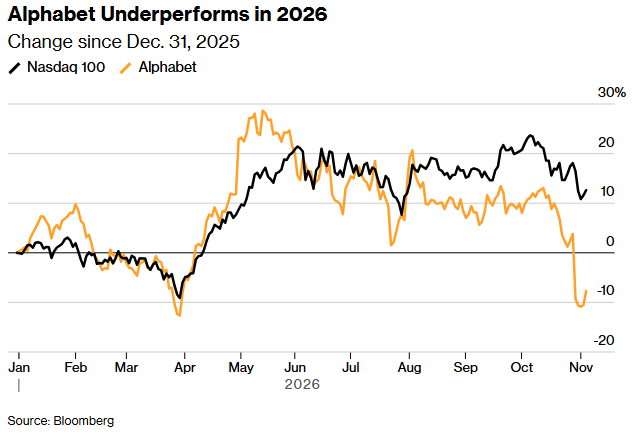
Alphabet's 2026 results are underperforming
On the other hand, this round of decline also made the stock relatively cheap. Currently, its transaction price is about 18 times the expected profit for the next 12 months, 29 times lower than February, and lower than the ten-year average of about 21 times. Graham said that the shift to high capital expenditure and negative cash flow provided reasons for undervaluation. Still, he was surprised by the slowdown in search growth, which made the stock more difficult to value.
He said, “If the search weakness is temporary (which I think is true), then the current valuation multiples are quite reasonable. But if there is a prolonged deterioration, then it should fall even lower.”
Considering that Google is almost synonymous with internet search, the importance of this business to Alphabet's shareholders cannot be overemphasized. The stock also experienced a search-related sell-off in 2023, 2024, and 2025. However, concerns seem to be more acute this time around, especially when Meta Platforms' (META.US) Muse AI smart products are causing a huge stir.
Citizens analyst Andrew Boone downgraded Alphabet's rating from “outperforming the market” to “on par with the big market” in an October 29 report. He wrote, “As competition from intelligence intensifies, we believe that intelligence is the future gateway to the Internet (which will replace browsers or search), and Google faces significant execution risks in the search monetization transformation process.”
Dan Ives, a well-known bullish analyst at Yorkville Ives, wrote in an October 30 report: “This is the first quarter where the 'AI crushes search' bearish argument holds true.”
Over the past week, analysts have lowered Alphabet's 2026 earnings per share forecast by 4.5%. In addition to search issues, Wall Street is also concerned about the company's huge investments in building AI infrastructure and when these investments will yield significant returns.
Having said that, bulls can still take comfort from the accelerated growth of Alphabet's cloud business and the stock's relatively low valuation.
Ed O'Gorman, CEO of River Wealth Advisors, who holds Alphabet shares, said: “The aura has faded, but the stock price is gradually becoming cheaper.”
He said, “There are still questions about what the final revenue model for intelligent search will be, but Alphabet also has other sources of revenue that have grown quite well. The cloud business is the number one example. When such a drastic conditional reflex sell-off occurs, there may be an opportunity to step in. I think the sell-off is probably a bit excessive because how things unfold is still very early.”
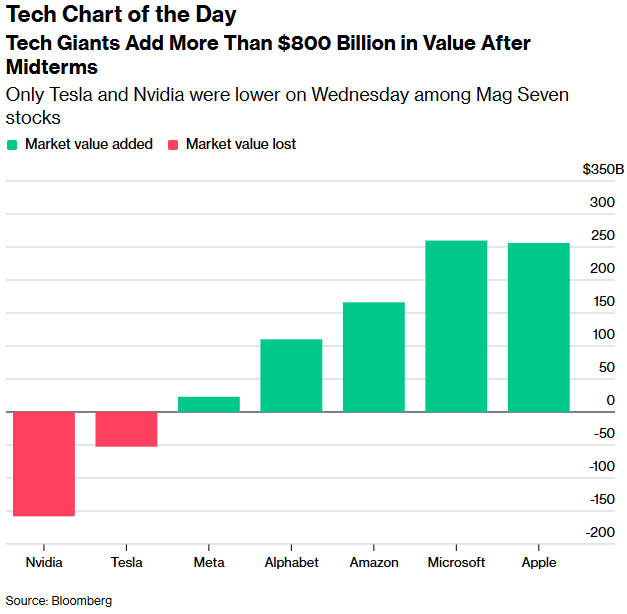
Tech giants increased their market capitalization by more than $800 billion after the midterm elections