
What PVH Holders Got Right
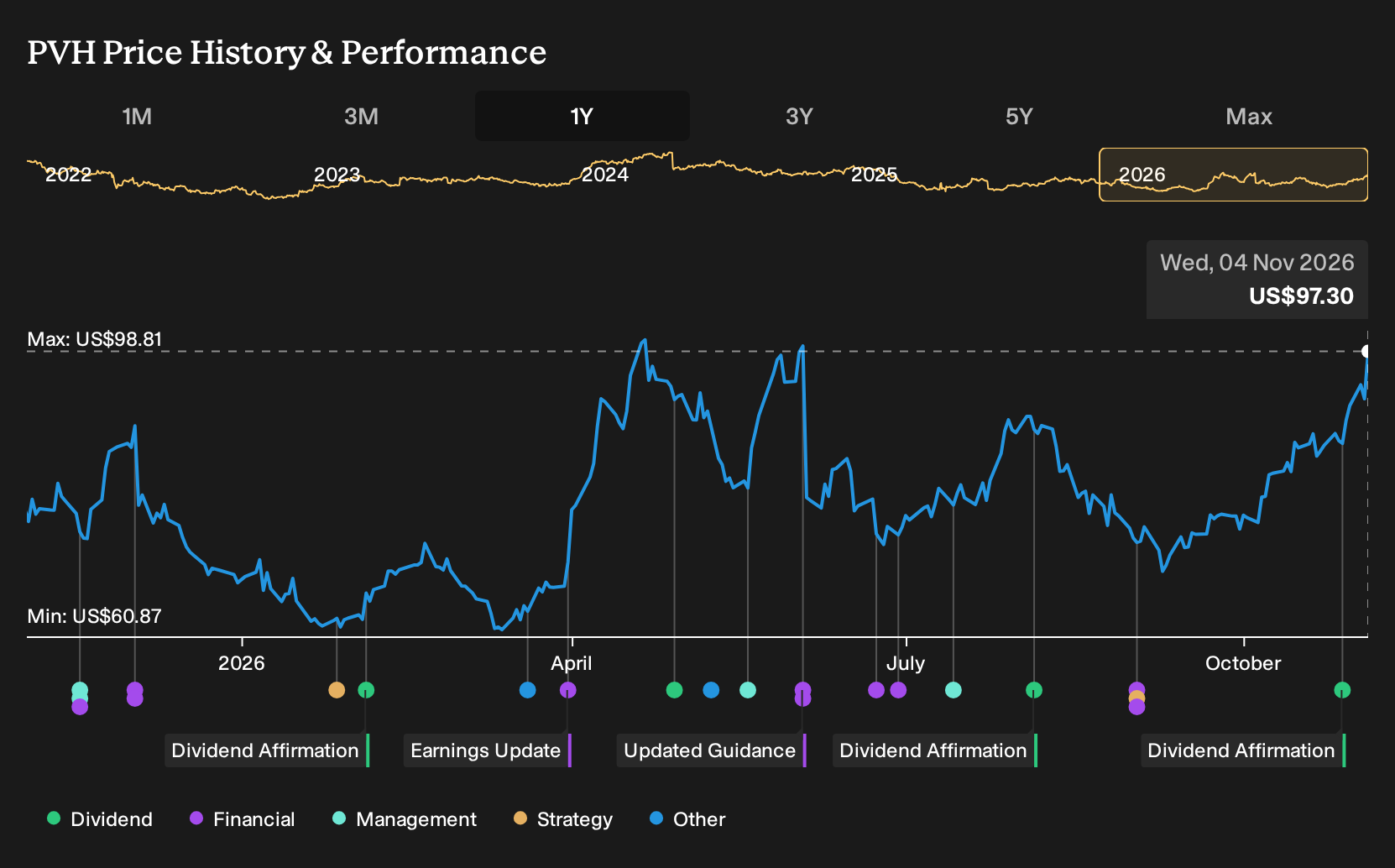
If you followed PVH through a year of tariff headlines, geopolitical flare ups and internal brand reshuffles, the final score might surprise you. For PVH shareholders, the return over the past year was 25.1%, including dividends. If you had been weighing a purchase back on 2025-11-04, you would have faced clashing analyst views on Asia Pacific growth, digital execution and tariff risk. Which of those early debates really mattered for that outcome?
Narratives are how investors here put a case on the record, with explicit assumptions about revenue, margins and the multiple. Those assumptions imply an estimated Fair Value.
The easy part of this move is behind PVH. Zero in on 35 high quality undervalued stocks for companies trading below our estimates.
The Argument PVH Investors Were Actually Having
The shares cost US$75.03 at the start of the period. For anyone looking at PVH then, the real work was choosing which story about the future felt more realistic.
The bullish Narrative put Fair Value at US$96.79, based on PVH lifting revenue by 2.3% a year and taking profit margin to 7.5% within three years. That case leaned on expansion in Asia Pacific and Europe plus a push into direct digital sales.
The bearish script anchored Fair Value at US$64 and focused on tariff escalation and digital rivals. In that version, analysts still assumed margin could reach 7.5% but expected revenue to decline 1.0% a year and saw pressure from online native competitors as the central risk.
What The Results Changed For The PVH Argument
The most telling data point for PVH came from Q2 2027, when revenue slipped to US$2.10b from US$2.17b a year earlier and net income swung from a US$224.2m profit to a loss of US$102.9m. Net margin moved from 10.3% to a loss of 4.9%. That shift challenged the bullish profitability path and leaned toward the cautious case.
For another company, you would stress test any upbeat margin story in the same way. Track whether net income and net margin actually move toward the level baked into the original thesis or drift away from it.
What PVH’s One Year, Up 25%, Price Now Assumes
PVH now trades at US$97.3, while this cautious Narrative’s Fair Value sits below the current price based on its own earnings and risk assumptions.
The Narrative leans on tariff costs, EMEA softness and high marketing spend as potential caps on earnings even with healthier direct sales and cost discipline. Anyone paying today’s price is effectively assuming those direct and e-commerce gains can offset EMEA volatility and tariff pressure, so how do those risks interact with that reliance on margin stability?
"Key Takeaways: Bearish analysts expect PVH to face prolonged earnings pressure as high EMEA exposure, soft European demand and marketing and tariff costs limit the benefit from higher-margin direct channels. The main thing that has to go right is that PVH converts growing D2C and e-commerce traffic, higher AURs and cost-discipline efforts into sustained gross margin and EBIT stability, despite EMEA volatility and goodwill impairment signals."
That disagreement has a full argument behind it. → Uncover the lower Fair Value this Narrative argues for
Go Straight To The Source
The story behind this run has already been told. The next one could be taking shape somewhere else. Where could you start looking before it becomes the headline?
- Company 1 - 33% below our estimate - balances a long-life reserve base against higher cost operations and political risk.
- Company 2 - 25% below our estimate - embeds AI assistants into productivity, coding and security tools already wired into office workflows.
- Company 3 - 40% below our estimate - converts faster subsea project timelines into more iEPCI awards and longer service contracts.
That is three of the list. See all 24 companies with the balance sheet to back it up →
Have feedback on this article? Concerned about the content? Get in touch with us directly. Alternatively, email editorial-team@simplywallst.com