
How Riyadh Metro Contract Win At Parsons (PSN) Has Changed Its Investment Story
- Parsons reported that its Riyadh Metro Transit Consultants joint venture was selected in March 2026 to provide multi year project and construction management services for the 8.4 km Riyadh Metro Red Line Extension between King Saud University and Diriyah South, adding five new stations to the network.
- This new PMCM mandate deepens Parsons' long running role in Riyadh's transport build out and adds another complex, international infrastructure contract to a portfolio that already leans heavily on large, multi year programs.
- We will look at how Parsons' investment narrative is affected by the Riyadh Metro Red Line Extension contract win and project scope.
Scan how Parsons compares with a hand picked group of infrastructure contractors on valuation, balance sheet strength and contract pipelines using our 35 high quality undervalued stocks as a starting point.
Parsons Investment Narrative Recap
To own Parsons, you need to be comfortable with a contractor that relies on long duration government and infrastructure programs and is still working through some messy legacy issues. The Riyadh Metro Red Line Extension fits the long term program thesis, but it does not change the near term picture that includes lower net margins, Q2 charges and a Q3 earnings step down.
The key short term swing factor remains execution on existing awards while limiting fresh write downs from older contracts and joint ventures. The new Riyadh work looks additive rather than transformational on that front. The biggest risk is still further project specific hits to earnings or cash flow that keep reported profitability from catching up with expectations.
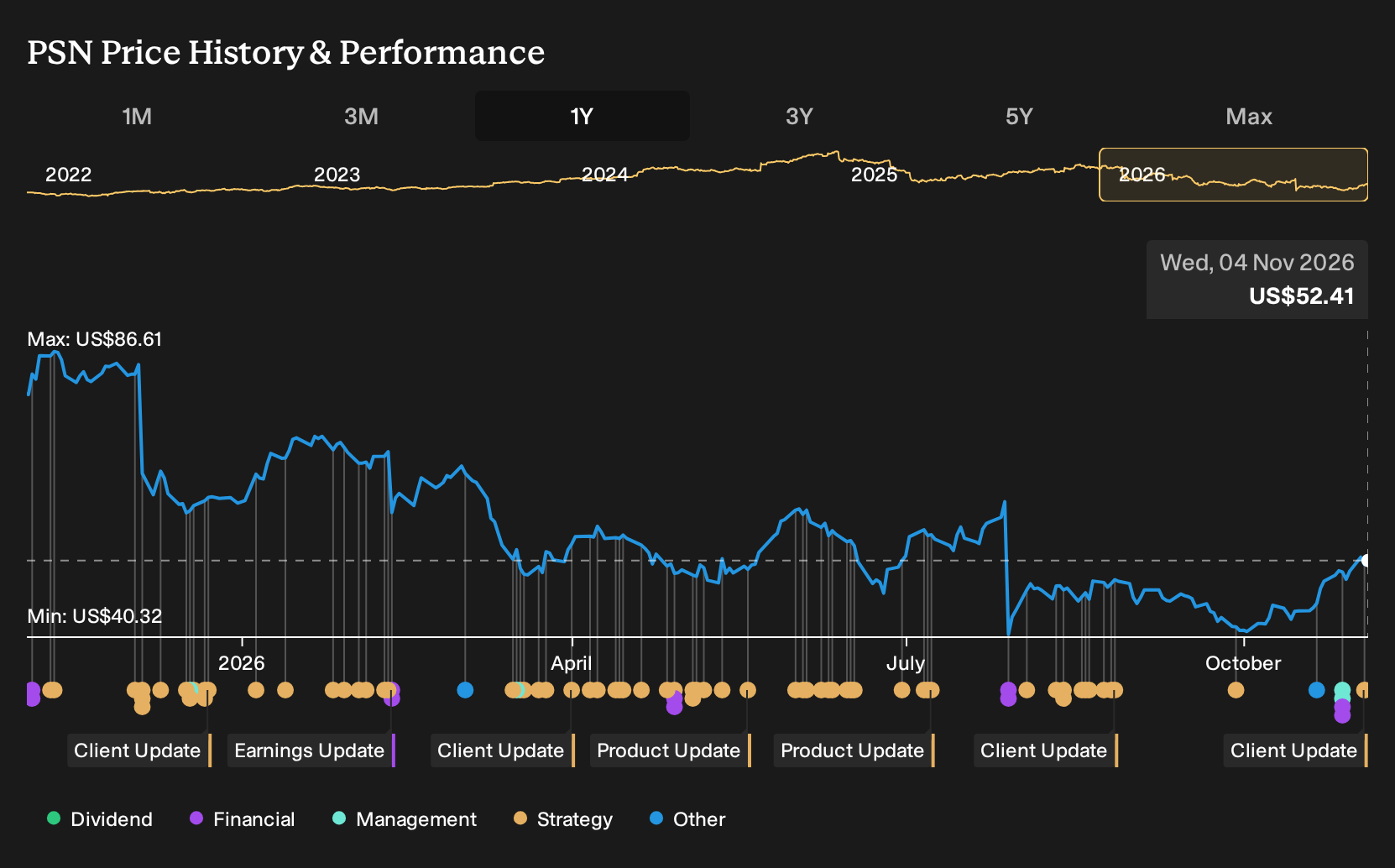
The most relevant recent update alongside the Riyadh award is the Q3 2026 report, which showed US$1,650.55 million of sales and US$54.15 million of net income, with earnings per share at US$0.51. Those figures compare to higher profit a year earlier, which keeps the focus on how efficiently Parsons converts its sizeable backlog into cleaner earnings.
Management also reiterated the midpoint of full year 2026 revenue guidance at US$6.25 billion to US$6.45 billion after earlier timing related pressure. For investors, that pairs the Riyadh win with a reminder that backlog alone is not the catalyst. The near term story lies in execution quality, mix shift toward higher margin work and avoiding further surprises from legacy contracts.
Parsons' current analyst narrative points to forecast revenues of US$7.2b and earnings of US$407.1 million by 2029, based on assumed annual top line growth of 4.6% and an earnings increase of roughly US$249.7 million from US$157.4 million today.
Uncover how Parsons' fair value indicates a 14% potential upside to its current price before traders fully price in Parsons' contract momentum.
Exploring Other Perspectives
One alternate view around Parsons focuses on cash flow risk rather than contract wins. The most bearish analysts were only penciling in about US$7.1b of revenue and US$337.7 million of earnings by 2029 before this Riyadh contract was public. That is a much tougher stance. Use it as a reminder that forecasts can shift sharply as new information lands, and explore multiple viewpoints before deciding how today's news fits your own thesis.
Explore 3 other Parsons fair value estimates, including one that suggests it could be worth just $59.64.
Form Your Own Verdict
Don't just follow the ticker; dig into the data and build a conviction that's truly your own.
- A great starting point for your Parsons research is our analysis highlighting 2 key rewards and 1 important warning sign that could impact your investment decision.
- See our latest analysis for Parsons. The report includes a comprehensive fundamental analysis summarized in a single visual, the Snowflake, making it easy to evaluate Parsons' overall financial health at a glance.
Looking For More Investment Ideas Beyond Parsons?
Once you have a handle on Parsons and its Riyadh exposure, it can be useful to line it up against other opportunities that fit different risk and income profiles. The Simply Wall St Screener offers several curated sets of stocks that you can use as a jumping off point.
- If capital preservation sits high on your list, start with companies that have stronger balance sheets and robust fundamentals through the list of solid balance sheet and fundamentals (24 results).
- If you prefer to get paid while you wait, income focused investors can scan for higher yielding, resilient payers through the 5 dividend fortresses.
- If you are hunting for under followed ideas with healthier financial quality, use the 19 high quality undiscovered gems as a way to surface potential outliers that might deserve a closer look.
Have feedback on this article? Concerned about the content? Get in touch with us directly. Alternatively, email editorial-team@simplywallst.com