
From “founder driven” to “professional collaboration”, Weilong (09985) is an ability puzzle oriented towards long-term principles
On the evening of November 3, Weilong Meishui (09985)'s personnel announcement attracted a lot of attention on the consumer circuit and capital market.
Liu Fuping, the founder of the company, resigned as CEO and became co-vice chairman; Yu Feng, 35, was promoted from CFO to CEO and co-vice chairman; Chen Yang, who has 18 years of experience as CFO of Nestle and Xu Fu Ji, took over as CFO.
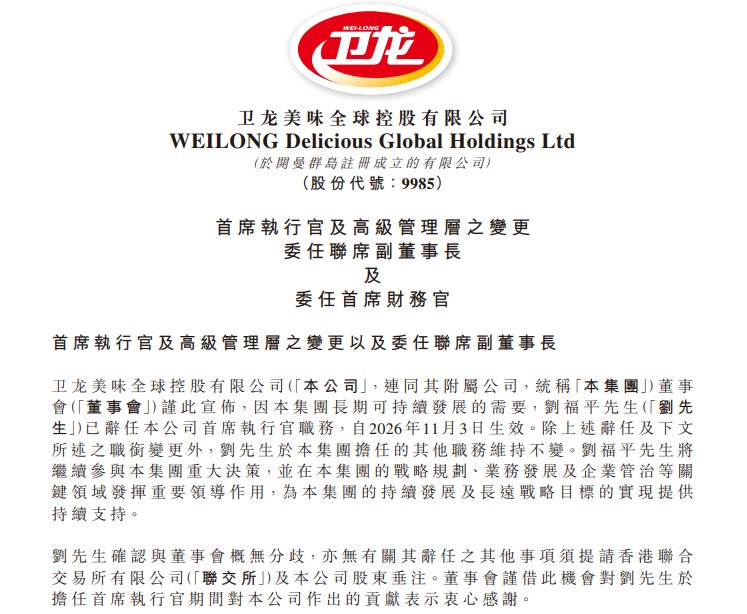
If you just look at the announcement itself, this is just an ordinary executive change. However, if we move forward the timeline, we will see another picture: in 2022, Weilong's Shanghai Second Center was established, and the company's Luohe manufacturing headquarters and the Shanghai Brand Research and Development Center took shape; in February 2026, Wei Zhe became a non-executive director to supplement the board's strategic vision at the consumer circuit and capital level; in November 2026, the CEO and CFO iterated simultaneously to further strengthen Weilong's operation and management capabilities.
The three steps are four years apart, and the pace is steady, pointing in the same direction — this is not an isolated personnel change, but Weilong's ability puzzle oriented towards long-term principles. As a result, the management mechanism shifts from “founding team driven” to “diversified and specialized management team collaboration.”
Endogenous+extrinsic, spell out 1+1+1>3
Most people's imagination of the founder's shift is a zero-sum game of “retreat” and “advance.” Weilong's structure this time gave another answer.
Liu Fuping stepped down as CEO, but was transferred to the position of co-vice chairman and remained at the management level. The founding team did not leave the field; what was cut off was the path dependence of daily operations on personal experience; what was preserved was the cultural anchor for long-term strategies. Liu Weiping, chairman of Weilong's board of directors, made a very restrained statement in the announcement — “Optimizing management team allocation and improving decision-making and execution efficiency.” Behind the restraint is a clear judgment: the founder stepped back behind the scenes but still held back, providing full authorization and room for trial and error for the professional management team.
The successor, Yu Feng, can be called a model of Weilong's “endogenous cultivation” model. He started as an assistant designer in 2011 and served as R&D engineer, R&D manager, e-commerce center general manager, media center leader, marketing center vice president and human resources manager. He was promoted to senior vice president in 2024, became CFO in September 2025, and took over as CEO in November 2026.
This kind of “full link rotation” gave Yu Feng a deep understanding of Weilong's structure. He has personally experienced all stages of category expansion, channel construction, and Hong Kong stock listing. It is a key hub connecting the founding team with the first-tier business. A key person familiar with the company's internal logic is in charge of Shuai Yin, which can guarantee the smooth implementation of existing business strategies to the greatest extent possible, reduce business turbulence caused by management changes, and maintain the basic domestic market.
The addition of new CFO Chen Yang is another key step in Weilong's “external recruitment and internal education” talent strategy. He has 18 years of financial management experience at Nestle and 2 years of financial management experience at Xu Fu Ji. His career gradually moved from the Chinese business line finance to the Swiss global headquarters, where he is responsible for financial management and planning analysis in Asia, Africa, and Greater China. The key words in this resume are not summed up in the three words “internationalization,” but rather extend financial management to pre-allocation of accounting after carrying out financial management in a complex structure of multiple categories, multiple channels, and multiple markets.
The core mission of the CFO during the expansion period is not to simply save money, but to make every investment have clear goals and return expectations. In 2026, Weilong carried out the three fronts of brand investment, channel regulation, and overseas cultivation, and capital requirements continued to be released. The biggest risk at this stage was not that the pace of investment was slow, but that capital investment lacked a closed loop of quantifiable results tracking and feedback. Chen Yang's joining just happened to meet this strategic demand.
This is also the most intuitive way to upgrade Weilong's management mechanism from “founding team driven” to “diversified and specialized management team collaboration”.
The management complexity faced by Weilong today has far exceeded the range of experience of a large single product company. Product development and innovation management, manufacturing and supply chain, channel construction and marketing, finance and cost control, internal audit risk control and compliance, every line requires systematic professional ability, rather than being sewn together by the intuition of the founder or any “all-rounder”. In 2025, Weilong's key positions have brought together professional managers with backgrounds in Unilever, McKinsey, Kraft, and Mars to form an echelon with local backbone that has grown internally. To now, Chen Yang's joining has filled the last piece of the specialized puzzle in finance, the “central nerve of management decisions.”
It can be seen from this that Weilong's current executive adjustments are not simply an alternation between old and new management, but rather that talents with different backgrounds and different professional abilities complement each other. The founding team, internal talent training, and international professional managers have formed a “1+1+1>3” synergy, which not only ensures strategic stability, but also injects innovative vitality.
Triple profit, creating a bottom card for long-term growth
Of course, from a deeper perspective, Weilong's current management upgrade is also a key part of its long-term layout. The aim is to build an organizational, product, and channel system that can continuously produce compound benefits.
First, organize compound interest and build a talent flywheel based on external recruitment and internal education.
Wei Long is building a management team with both an international perspective and local insight through “introducing domestic education from outside”. In recent years, Weilong's key positions have brought together senior professional managers from internationally renowned companies such as Unilever, McKinsey, Kraft, and Mars. At the same time, talents such as Yu Feng, who were trained internally, entered core decision-making positions. This combination of “endogenous training+external procurement” forms a complementary combination of talents with different backgrounds and professional abilities, and supports the long-term development of the enterprise. Once the talent flywheel rotates, the compound benefits it generates will last far longer than any explosive product.
Second, product compounding to build a delicious+healthy product matrix through research and development.
At present, Weilong has built dual R&D centers in Shanghai and Luohe, and has obtained more than 200 authorized patents, iterating over 10 flavors for konjac refreshing products alone. As consumers' demand for health continues to rise, the core task of the future team is to continue to dig deeper into the value of superfoods such as konjac, continue to enrich the product matrix, reduce dependency on a single category, and open up the category ceiling with new products. Only when the organization fills the boundaries of ability can the business open the boundaries of growth.
Third, channel compounding, consolidating the basic local market, and speeding up the expansion of brands overseas.
In the domestic market, Weilong continues to cultivate global channels such as online e-commerce, offline distribution, mass sales of snacks, and member stores, optimizing inventory turnover and terminal sales efficiency, and building a solid domestic revenue ballast. In terms of overseas business, Weilong completed the US online channel layout in July 2026 and landed on the three major e-commerce platforms TikTok Shop, Amazon, and TEMU, marking a move from an early stage of product testing to deep systematic development. The ultimate goal of going overseas is not to simply sell goods overseas, but to enable brands to go overseas. This places extremely high demands on cross-regional financial risk control and local operation capabilities. It is also the core purpose of introducing a CFO with an international background.
Judging from the operating results, with the gradual implementation of the trifecta of organizational, product, and channel benefits, Weilong's systematic management upgrade has begun to transform into visible positive feedback effects.
Throughout 2025, Weilong achieved revenue of 7.224 billion yuan, an increase of 15.3% year on year; net profit of 1,427 billion yuan, a sharp increase of 33.6% year on year. Both indicators reached record highs. Entering the first half of 2026, the company continued to grow in revenue of 37.15 billion yuan and net profit of 766 million yuan. Highlights in terms of profit quality are also prominent. The overall gross profit margin for the first half of 2026 was 47.8%, an increase of 0.6 percentage points over the same period in 2025, while the management expenses ratio was controlled at 6.0%. These figures show that systematic management is already having an effect on the profit side.
However, it should be noted that upgrading the management mechanism is a necessary condition for long-term benefits, but it is not a sufficient condition for performance to explode, and Weilong is still facing many challenges along the way.
For example, in terms of domestic market growth, how can the company find new growth points in the context of the spicy snack food market becoming saturated; in terms of category innovation, where is the next super item after konjac is fresh; in terms of overseas business, how will Weilong increase its share of overseas markets to achieve strategic goals of globalization, etc. These questions require a new management team to answer with execution and synergy.
Long term doctrine has always been easily described as “holding on.” However, Wei Long's governance upgrade curve shows that the true long-term principle is to place the right organizational ability in the right structural position at the right time. As can be seen, even though the company is currently facing many challenges, with a forward-looking and efficient strategic layout, Weilong will have strong momentum to enjoy multiple benefits from organizations, products and channels.
Summarize
In summary, Weilong's current executive adjustments are a future-oriented strategic layout. It optimizes the knowledge structure of the management team through a combination of “endogenous training+external procurement”, and injects key management capabilities and professional experience into long-term strategies such as globalization, category upgrading, and channel deepening.
From an investment perspective, a company's long-term value depends largely on the ability of its management team to turn strategy into continuous cash flow and competitive advantage. Currently, Weilong's new management team is holding the three major engines of category innovation, brand upgrading, and globalization. Their execution and synergy will be the key to determining whether Weilong can truly grow from a “leading spicy snack food company in China” to a “leading global spicy snack food company.”
As Weilong stated in the announcement, this adjustment will help “provide strong support for the Group's continued, steady and long-term development.” Therefore, for this company that started in Luohe and has grown into a leading Hong Kong snack food company, this organizational iteration is an important step in its journey to transcend the single-product era and move towards long-term growth goals.