
How Investors Are Reacting To Brink's (BCO) Higher Sales Lower Profit
- Brink's reported third quarter 2026 results with sales of US$1,374.6 million and net income of US$14.5 million, alongside lower earnings per share versus the prior year.
- The mix of higher sales but reduced profitability, including lower basic and diluted EPS across both the quarter and nine month period, points to rising cost or margin pressure inside Brink's operations.
- The next step is to consider how Brink's investment narrative compares with this combination of revenue growth and weaker earnings performance.
See how Brink's earnings pressure compares with other companies facing similar profitability questions by reviewing our hand picked list of 35 high quality undervalued stocks.
Brink's Investment Narrative Recap
To own Brink's, you need to be comfortable with a story built on cash handling, ATM managed services and digital retail cash solutions remaining relevant, while the NCR Atleos deal and higher debt are managed carefully. The latest quarter shows sales of US$1,374.6 million but net income of US$14.5 million and weaker EPS, so profitability is the near term pressure point.
The key short term swing factor is whether Brink's can stabilise margins as costs, integration work and interest expenses meet softer earnings. The biggest risk is that interest payments, already flagged as not well covered by earnings, stay tight while Atleos integration and cash usage trends weigh on results.
With no fresh corporate announcements beyond these results, the most relevant reference point remains the previously outlined NCR Atleos acquisition. That deal is expected to roughly double Brink's scale to about US$10b of revenue and US$2b of adjusted EBITDA, with management targeting US$200 million of cost synergies and a larger ATM managed services footprint.
Set against the current quarter, the Atleos plan raises the execution bar. Investors need Brink's to improve free cash flow enough to reduce leverage from an expected 3.4x and to support interest costs that are already flagged as a risk. The weaker EPS now makes progress on integration, cost discipline and AMS and DRS growth even more important to the thesis.
What Brink's Analyst Assumptions Really Implies
Analysts frame Brink's longer term story around steadier growth than the recent EPS pressure might suggest. The consensus model has revenue rising at 4.1% a year over the next three years, with profit margins moving from 3.3% today to 10.7% on their 2029 view. That step up in profitability sits at the center of the earnings bridge rather than any aggressive top line expansion.
On those figures, earnings today of US$181.2 million are projected to reach US$664.6 million by 2029, which implies an increase of about US$483 million over the period. The same forecast set points to earnings per share of US$15.91 by that year, supported in part by an assumed 0.86% annual decline in the share count. Analysts are not unanimous, since the more optimistic group see earnings as high as US$820.1 million, but the bulk of estimates cluster around the US$664.6 million mark.
Brink's narrative projects US$6.2b revenue and US$664.6 million earnings by 2029. This assumes 4.1% yearly revenue growth and an earnings increase of about US$483 million from current earnings of US$181.2 million.
Valuation work then ties those operating assumptions back to what investors are paying today. The analyst framework uses a discount rate around 8.4% to bring the future cash flows into present terms and tests whether the implied P/E on 2029 earnings is realistic. On their numbers, Brink's would be trading on roughly 11.3x those 2029 earnings, compared with about 23.3x today and an industry multiple quoted at 18.2x for US Commercial Services stocks.
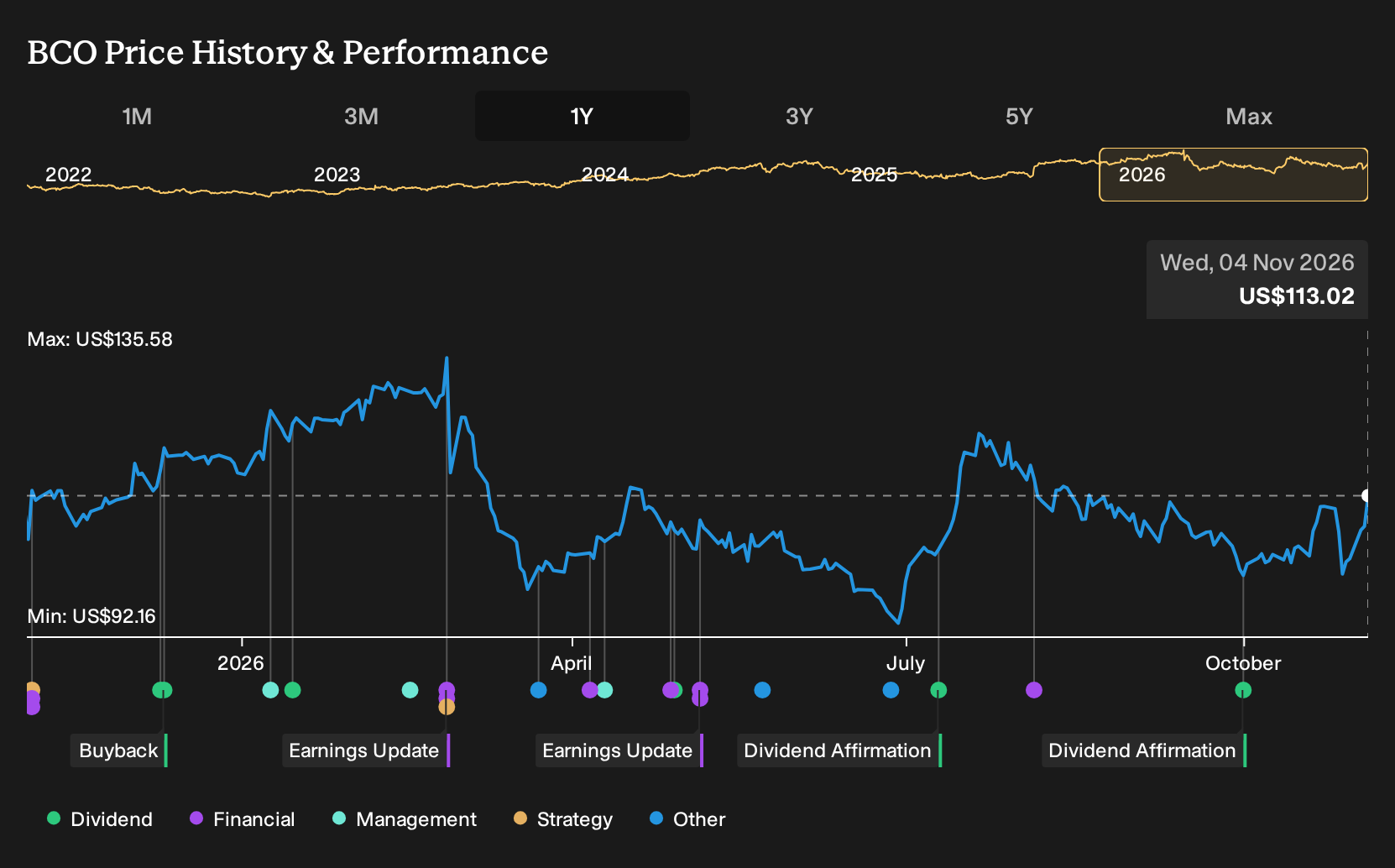
For readers, that spread in multiples matters more than the precise target price. The research group has a consensus fair value estimate of US$146.33 per share, with the most cautious at US$138.00 and the most optimistic at US$163.00. Set against a current share price of US$102.36, the target range embeds the view that the market is not fully reflecting the projected revenue of US$6.2b and earnings of US$664.6 million by 2029, or the shift to higher margin ATM managed services and digital retail cash solutions.
Any personal view on Brink's needs to stress test the building blocks inside those forecasts rather than focus only on the headline upside. The key questions are whether a 4.1% annual revenue lift feels reasonable for a business anchored in cash logistics, whether the jump from a 3.3% margin to 10.7% is achievable given current cost pressure, and how comfortable you are with a future P/E multiple of 11.3x on 2029 earnings. Your own answers to those points will matter more than the exact consensus target on the page.
Discover why Brink's fair value indicates a 29% potential upside to its current price, a discount that could close sooner than you expect.
Exploring Other Perspectives
The Simply Wall St Community contributes 2 fair value estimates for Brink's, stretching from about US$87.71 to US$146.33, so private investors already frame the stock through very different lenses. Those views sit beside fresh earnings pressure, which may push you to weigh leverage, Atleos execution and long term cash usage more carefully.
Explore another Brink's fair value estimate, including one that suggests there could be as much as 29% upside from the current price!
The Verdict Is Yours
Disagree with existing narratives? Extraordinary investment returns rarely come from following the herd, so go with your instincts.
- A great starting point for your Brink's research is our analysis highlighting 2 key rewards and 1 important warning sign that could impact your investment decision.
- See our latest analysis for Brink's. The report includes a comprehensive fundamental analysis summarized in a single visual, the Snowflake, making it easy to evaluate Brink's overall financial health at a glance.
Looking For More Investment Ideas Beyond Brink's?
If the Brink's story has sharpened your thinking on risk, cash flow and valuation, use that same framework to scout other opportunities on the Simply Wall St Screener. The tools let you filter for the mix of quality, balance sheet strength and income that best fits your own approach.
- For investors who want resilient businesses with fewer red flags, start by scanning a 31 resilient stocks with low risk scores that already clear a tougher risk hurdle.
- If balance sheet strength is the first box you tick, focus on our list of solid balance sheet and fundamentals (24 results) to see companies where debt and liquidity metrics are already in better shape.
- Income seekers who care about consistency as much as yield can review a curated set of 5 dividend fortresses that pair higher payouts with more robust fundamentals.
Have feedback on this article? Concerned about the content? Get in touch with us directly. Alternatively, email editorial-team@simplywallst.com