
United Natural Foods (UNFI) Recall Raises Fresh Questions, Is The Stock Fully Valued?
United Natural Foods (UNFI) is back in focus after a recall of Brad's Plant Based Crunchy Kale and Brad's Veggie Chips Kale related to possible thallium contamination in products it distributed nationwide.
The recall lands at a time when United Natural Foods’ 1-day share price return of 7.07% and 30-day share price return of 8.44% suggest short term momentum is building, while the 44.49% year to date share price return and 216.03% three year total shareholder return point to a longer running re rating driven by shifting views on both growth prospects and risk.
Scan how investors are pricing food distributors after United Natural Foods’ recall by reviewing our hand picked list of solid balance sheet and fundamentals (24 results) for comparison.
After a recall linked to products it distributes and a share price near $48, the debate around United Natural Foods now centers on valuation. Has most of the rerating already played out, or is there still meaningful upside left?
Most Popular Narrative: 9% Undervalued
On the most followed narrative, United Natural Foods screens below an estimated fair value of $53, even after closing at $48.29. That gap sets up a story that leans on efficiency gains and category mix more than rapid top line expansion.
The company's disciplined approach to customer segmentation and contract profitability, exiting unprofitable relationships and optimizing its distribution network, is unlocking operational leverage, concentrating throughput into higher-return assets, and supporting free cash flow growth and deleveraging.
Strategic investments in technology (such as warehouse management systems and data-driven inventory management) and ongoing focus on supply chain transparency and traceability align with rising retailer and consumer expectations, reinforcing UNFI's relevance and competitive edge, which underpins both long-term revenue resiliency and gross margin stability.
See why 8 investors see United Natural Foods as 9% undervalued.
Result: Fair Value of $53 (UNDERVALUED)
Still, the recall spotlight and prior cybersecurity breach leave United Natural Foods exposed to reputational damage and contract risk, which could quickly challenge the efficiency led upside story.
Find out about the key risks to this United Natural Foods narrative.
Another View On United Natural Foods’ Valuation
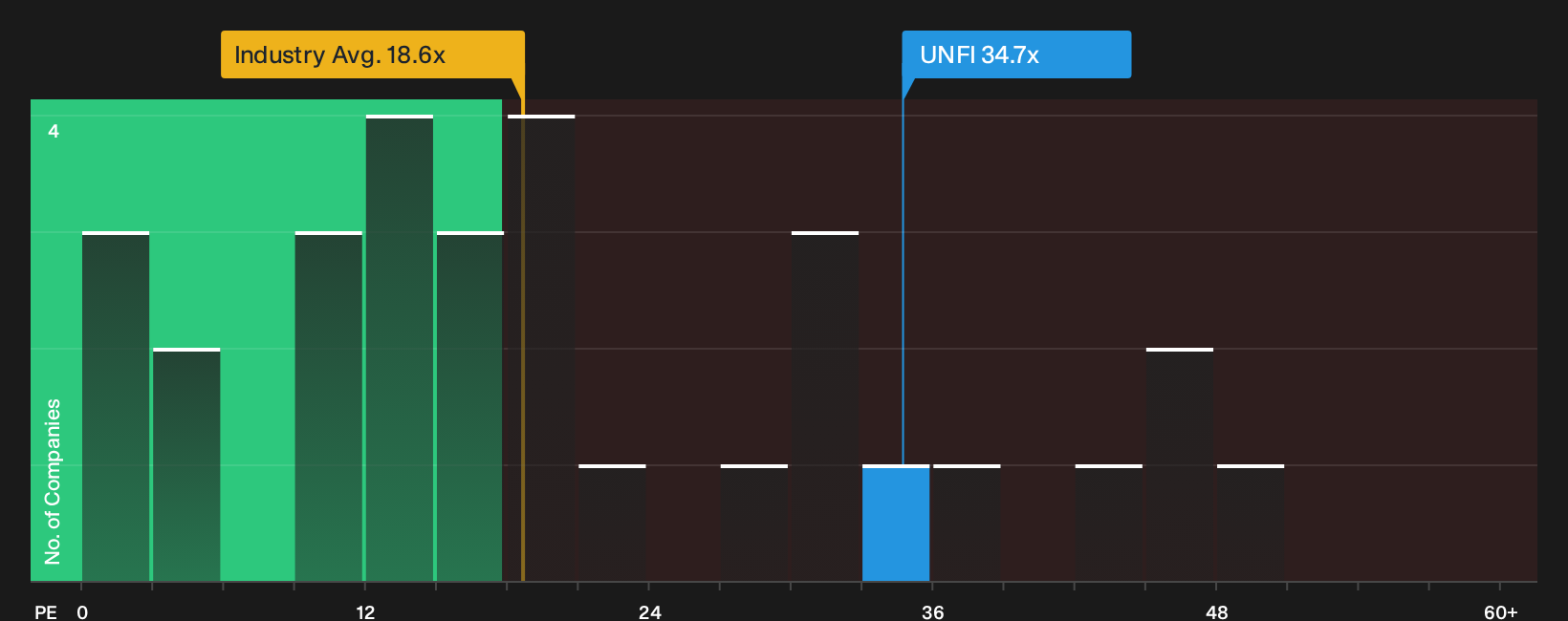
On simple P/E terms, United Natural Foods appears considerably more expensive. The shares trade on 34.7x earnings, compared with 17.7x for the US Consumer Retailing group and a fair ratio of 24.4x. That premium can suggest optimism already reflected in the price, or it may indicate that investors are expecting more than the base case.
See what the numbers indicate about this price in our valuation breakdown by reviewing the See what the numbers say about this price — find out in our valuation breakdown..
For a visual comparison of how United Natural Foods lines up against peers on this metric, take a look at the
Next Steps
Mixed signals around United Natural Foods can feel messy, which is exactly why checking the underlying data yourself matters. The recall, prior cybersecurity incident, and shifting valuation views have created both worry and optimism, so move quickly, review the detail, and weigh the 3 key rewards and 2 important warning signs.
Looking for more investment ideas beyond United Natural Foods?
If United Natural Foods has you thinking more critically about price, risk, and quality, broaden your watchlist now so you do not miss better aligned opportunities.
- Target stronger quality at a reasonable price by scanning our curated set of 35 high quality undervalued stocks that pair solid fundamentals with more grounded expectations.
- Secure more dependable income streams by reviewing a focused 5 dividend fortresses that screens for higher yields backed by resilient balance sheets and cash flows.
- Prioritise capital preservation by running through a 31 resilient stocks with low risk scores designed to surface businesses with sturdier financial profiles and lower overall risk scores.
Have feedback on this article? Concerned about the content? Get in touch with us directly. Alternatively, email editorial-team@simplywallst.com