
Is Icahn Enterprises (IEP) Undervalued As Q3 Losses Clash With Higher Net Asset Value?
Icahn Enterprises (IEP) just released a mixed Q3 update, reporting a net loss, a sizeable increase in net asset value tied to CVR Energy, and the completion of the Pep Boys sale.
Icahn Enterprises now trades at US$5.34, with the share price down 19.94% over the past month and 30.01% over 90 days, while the one year total shareholder return has fallen 21.94%. That slide has coincided with the Q3 loss, the sharp refining hedge hit, the CVR Energy refinery acquisition and the ongoing distribution. Together, these factors have shifted attention toward balance sheet strength and how much of the partnership’s value investors are willing to ascribe to asset gains rather than near term earnings.
Scan beyond Icahn Enterprises and stress test your income ideas against other high-yield payouts by reviewing our hand-picked 5 dividend fortresses that also carry elevated risk signals.
Bulls point to Icahn Enterprises’ higher net asset value and liquidity, while bears focus on ongoing losses and payout risk. Which story do the current price and numbers lean toward as you weigh valuation next?
Preferred Price-to-Sales of 0.3x for Icahn Enterprises: Is it justified?
On simple sales-based metrics, Icahn Enterprises screens as cheap. The partnership trades on a P/S of 0.3x, compared with 0.7x for the wider global Industrials group and 2.4x for its closer peer set, even as the unit price sits at $5.34 and the SWS model flags a 45.9% discount to its estimate of fair value.
A P/S ratio compares the market value of the equity to the revenue the business generates, so it is especially useful for groups like Icahn Enterprises where earnings are currently negative. In effect, you are asking how many dollars investors are willing to pay today for each dollar of annual sales across its investment, energy, automotive, and other operating segments.
With Icahn Enterprises unprofitable and reporting a net loss of $1,016.0m over the past year, a low P/S can reflect both the mix of cyclical businesses and investor concern over the quality and volatility of those earnings. The same data shows shareholders were diluted in the past year, returns have declined 45.9% over three years and 74.4% over five years, and a 37.45% cash distribution is not covered by earnings or free cash flow. This helps explain why the market may be assigning a low multiple even if the SWS DCF model points to a higher future cash flow value of $9.88 per unit.
Compared with the 0.7x average for the global Industrials industry, Icahn Enterprises trades at a materially lower sales multiple. Against the 2.4x peer average, the gap is even wider. This suggests investors are pricing in higher risk around leverage, a funding mix that is 100% higher risk borrowing, and the fact that profits have declined 7.8% per year over the past five years, rather than paying up in line with the sector.
See what the numbers say about this price — find out in our valuation breakdown.
Result: Price-to-Sales of 0.3x (UNDERVALUED)
Still, the story can change quickly if Icahn Enterprises continues to report sizable losses or if funding that relies on higher risk borrowing becomes harder to sustain.
Find out about the key risks to this Icahn Enterprises narrative.
Another View: Icahn Enterprises Through The SWS DCF Lens
The low 0.3x P/S ratio paints Icahn Enterprises as cheap on sales. The SWS DCF model points in the same direction, with an estimated future cash flow value of $9.88 per unit versus a current price of $5.34, which suggests the units screen as undervalued. The real question is whether you trust the cash flow assumptions more than the market’s skepticism around losses and funding risk.
Look into how the SWS DCF model arrives at its fair value.
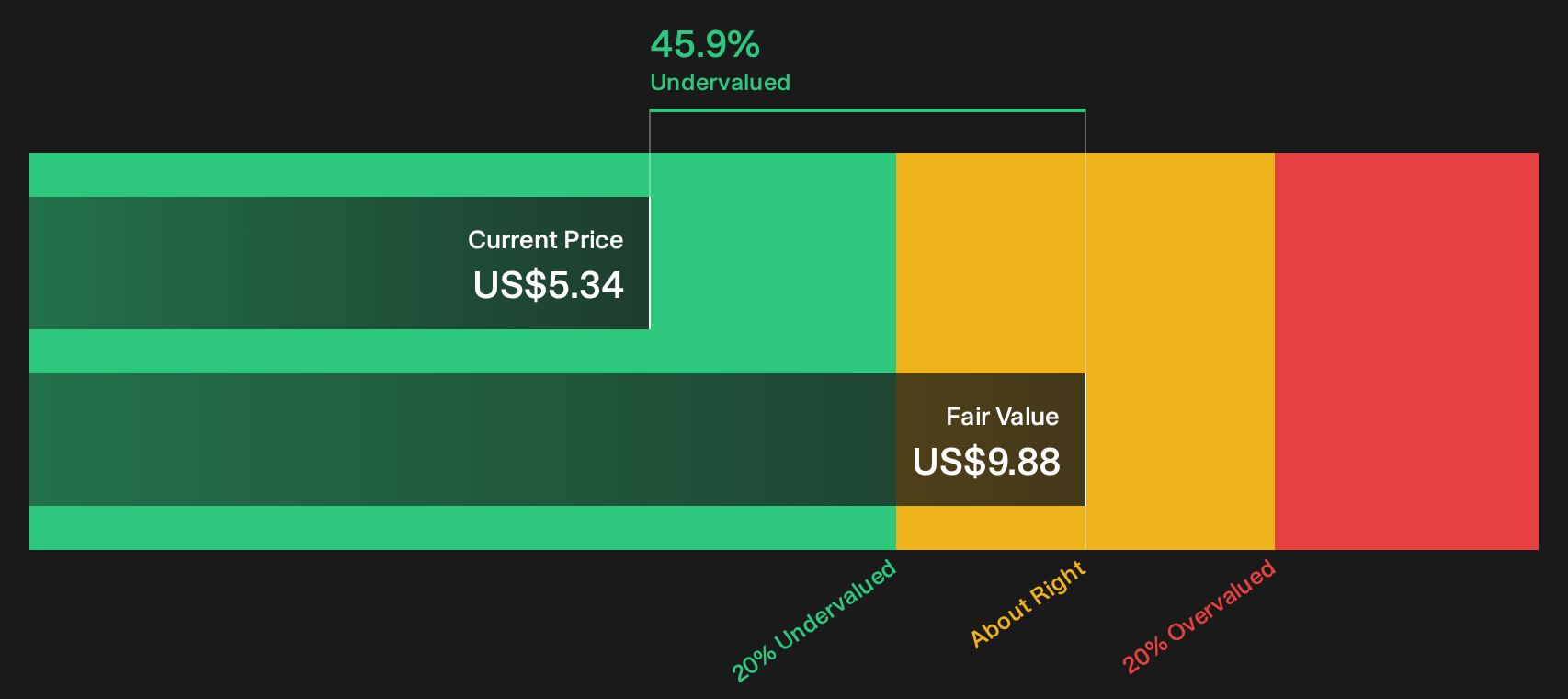
Simply Wall St performs a discounted cash flow (DCF) on every stock in the world every day (check out Icahn Enterprises for example). We show the entire calculation in full. You can track the result in your watchlist or portfolio and be alerted when this changes, or use our stock screener to discover 35 high quality undervalued stocks. If you save a screener we even alert you when new companies match - so you never miss a potential opportunity.
Next Steps
Mixed signals on Icahn Enterprises can be confusing, so move quickly from headline impressions to the underlying numbers and weigh both the risks and the potential upside by using the 1 key reward and 3 important warning signs.
Looking for more investment ideas beyond Icahn Enterprises?
If Icahn Enterprises has raised more questions than answers for your portfolio, you may want to broaden your opportunity set with focused screeners that surface very different risk and reward profiles.
- Target stronger balance sheets by scanning a curated list of solid balance sheet and fundamentals (24 results) that can help you pressure test Icahn Enterprises against sturdier financial foundations.
- Hunt for mispriced quality using the 35 high quality undervalued stocks to spot companies where fundamentals and current pricing tell a very different story.
- Contrast IEP’s income profile with a high-yield shortlist through the 5 dividend fortresses and evaluate which payouts appear more sustainable in comparison.
Have feedback on this article? Concerned about the content? Get in touch with us directly. Alternatively, email editorial-team@simplywallst.com