
Standard Chartered (LSE:STAN) Could Be 13% Undervalued After Raising Guidance
Standard Chartered (LSE:STAN) has just paired a raised 2026 earnings outlook with higher net income and earnings per share for the first nine months of the year. This gives investors fresh numbers to reassess the stock.
Standard Chartered sits at £21.34 after a 3.95% 1-day share price return and a 3.19% gain over the past week. These moves line up closely with the upgraded 2026 guidance and recent earnings update, even though the 30-day share price return is down 4.99% and the 90-day share price return is down 2.78%.
Set against that short term wobble, the year-to-date share price return of 15.73% and a 5-year total shareholder return of 437.32% indicate that the story has been evolving over time as dividends and reinvestment effects compound.
Recent corporate news has stayed focused on execution rather than headline-grabbing deals. Raised income guidance on 28 October and the appointment of a new Managing Director for North American fund finance on 30 October point to management prioritising growth areas while investors reassess the risk and reward balance.
Scan banks reacting to upgraded guidance and stronger earnings, such as Standard Chartered, by checking the hand picked list of solid balance sheet and fundamentals (10 results) in this corner of the market.
Standard Chartered now has stronger guidance and higher earnings on the table, yet the share price has only inched up. Is this a genuine business reset, or simply a brief burst of optimism before valuation work begins?
Most Popular Narrative: 13% Undervalued
Standard Chartered is priced at £21.34 against a widely followed fair value view of about £24.51, so the current guidance upgrade lands against a market that has not fully closed that gap.
The main thing that has to go right is continued delivery on wealth inflows, productivity programmes and credit quality improvements, while the bank allocates more capital to higher return businesses and manages Basel 3.1 effects.
The current valuation implies the share price does not fully reflect progress on earnings growth, capital efficiency and cost reduction. This narrative views that as consistent with Standard Chartered being undervalued and positioned for a bullish outcome.
See why 48 investors see Standard Chartered as 13% undervalued.
Result: Fair Value of £24.51 (UNDERVALUED)
Still, the Standard Chartered narrative can weaken if affluent wealth inflows slow, or if buybacks and capital returns fall short of analyst expectations.
Find out about the key risks to this Standard Chartered narrative.
Another View: What Standard Chartered's P/E Is Telling You
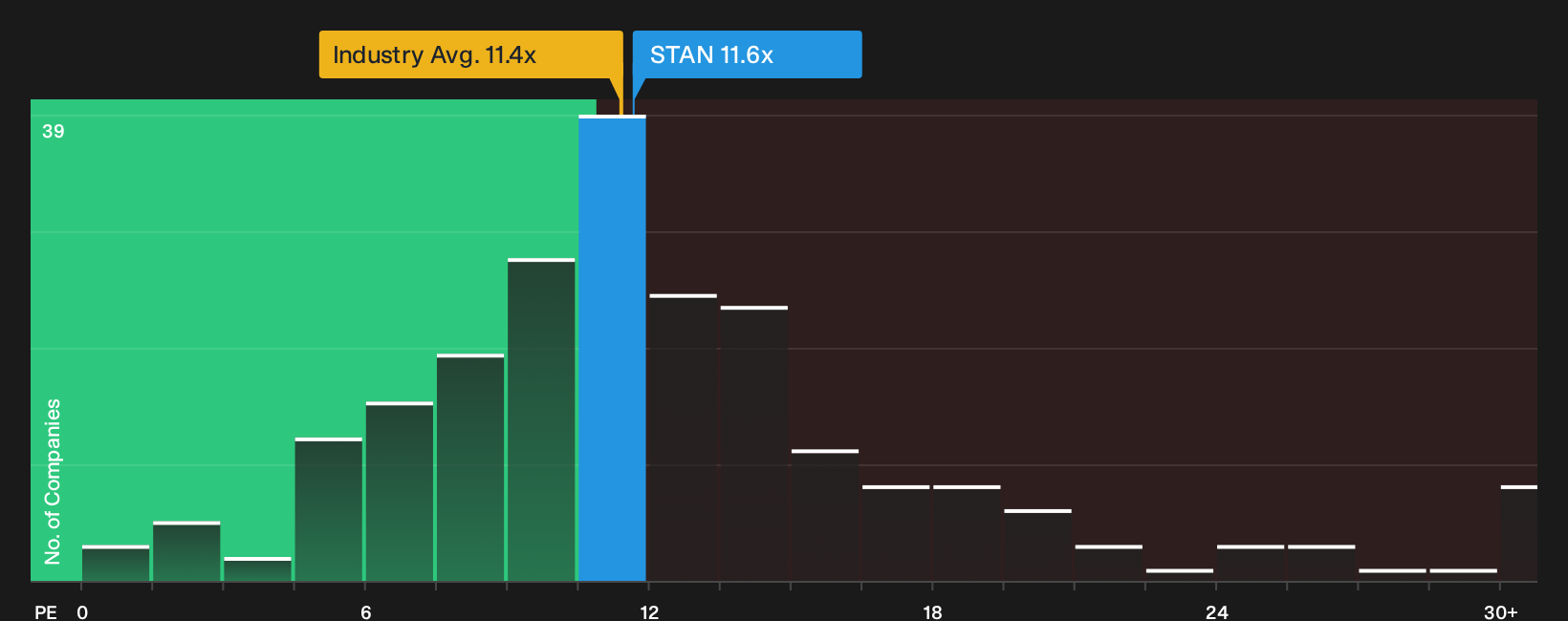
The story looks different when you step away from fair value models and just look at what people are paying today. On a P/E of 11.6x, Standard Chartered trades above both its peer average of 9.4x and the wider European banks group at 11.4x, while also sitting well ahead of its own fair ratio of 8.6x.
That gap means the market already prices in a healthier future than the regression based fair ratio implies. As a result, anyone leaning on the undervalued narrative is taking on the risk that expectations stay lofty. If sentiment cools and the P/E drifts toward 8.6x or closer to peers, how much of the perceived upside would still feel comfortable?
For a closer look at how this earnings multiple stacks up against fair value and sector norms, See what the numbers say about this price — find out in our valuation breakdown.
Next Steps
Mixed messages in the Standard Chartered story so far. If you want to move faster than the crowd and decide where you stand, take time to weigh up the 3 key rewards and 1 important warning sign.
Looking for more investment ideas beyond Standard Chartered?
If you stop with Standard Chartered, you miss the wider opportunity set. Use the screener to compare this bank with other focused ideas tailored to your style.
- Target income resilience by reviewing a curated group of 3 dividend fortresses that prioritise yield with support from underlying fundamentals.
- Hunt for mispriced quality by scanning a concise set of 14 high quality undervalued stocks where cash flows and balance sheets do more of the talking.
- Protect the downside first by checking a basket of 5 resilient stocks with low risk scores that score well on financial strength and risk controls.
Have feedback on this article? Concerned about the content? Get in touch with us directly. Alternatively, email editorial-team@simplywallst.com