
Shopify (SHOP) Earnings Reset Keeps Undervalued Narrative In Focus
Shopify (SHOP) kicked off November trading with a sharp reaction to its third quarter 2026 earnings, as investors weighed 32% revenue growth against softer gross merchandise volume and subscription trends.
The latest drop came on top of a wider pullback, with the 7 day share price return down 14.02% and the year to date share price return down 9.31%, even though the 3 year total shareholder return is 131.11%. This indicates strong longer term momentum that contrasts with the recent reset in expectations after the earnings miss and shelf registration filing.
Scan how other software and ecommerce plays are reacting to earnings shocks and guidance resets by reviewing the hand picked 19 high quality undiscovered gems that may be flying under the radar beside Shopify.
For Shopify, a 32% revenue gain alongside a sharp share price drop puts two stories in front of you. Is this reset about the business itself, or mostly about sentiment and what investors are now willing to pay?
Most Popular Narrative: 32% Undervalued
The latest community narrative pegs Shopify's fair value at $210.47, well above the last close at $142.57. This frames the recent pullback as a valuation reset rather than a collapse in the underlying business case.
I’ve owned Shopify for many years, and my conviction originally came from seeing the product work in the real world.
While working at an agency, one of our clients migrated their business to Shopify. What stood out wasn’t simply how easy it was to build the store. It was how seamlessly the business could grow afterwards.
See why 6 investors see Shopify as 32% undervalued.
According to QuanD, the thesis around Shopify hinges on the platform acting as infrastructure rather than just another software subscription. The narrative points out that roughly 78% of revenue comes from Merchant Solutions tied directly to merchant activity, which means Shopify participates in the sales flowing through its ecosystem instead of relying solely on monthly fees.
This framing helps explain why some investors still see value despite a premium headline valuation and a P/E ratio that screens as expensive against the broader US IT sector. The focus of that narrative is on Shopify's role as an operating system for independent commerce, the compounding effect of merchants scaling on the platform, and the idea that tools like AI could lower the barrier to starting new businesses while still requiring Shopify's payments, security, and infrastructure rails.
Result: Fair Value of $210.47 (UNDERVALUED)
Still, the Shopify story could be challenged if merchant activity slows significantly or if investors become less willing to support a high P/E valuation.
Find out about the key risks to this Shopify narrative.
Another View: Shopify Through The Lens Of Earnings Multiples
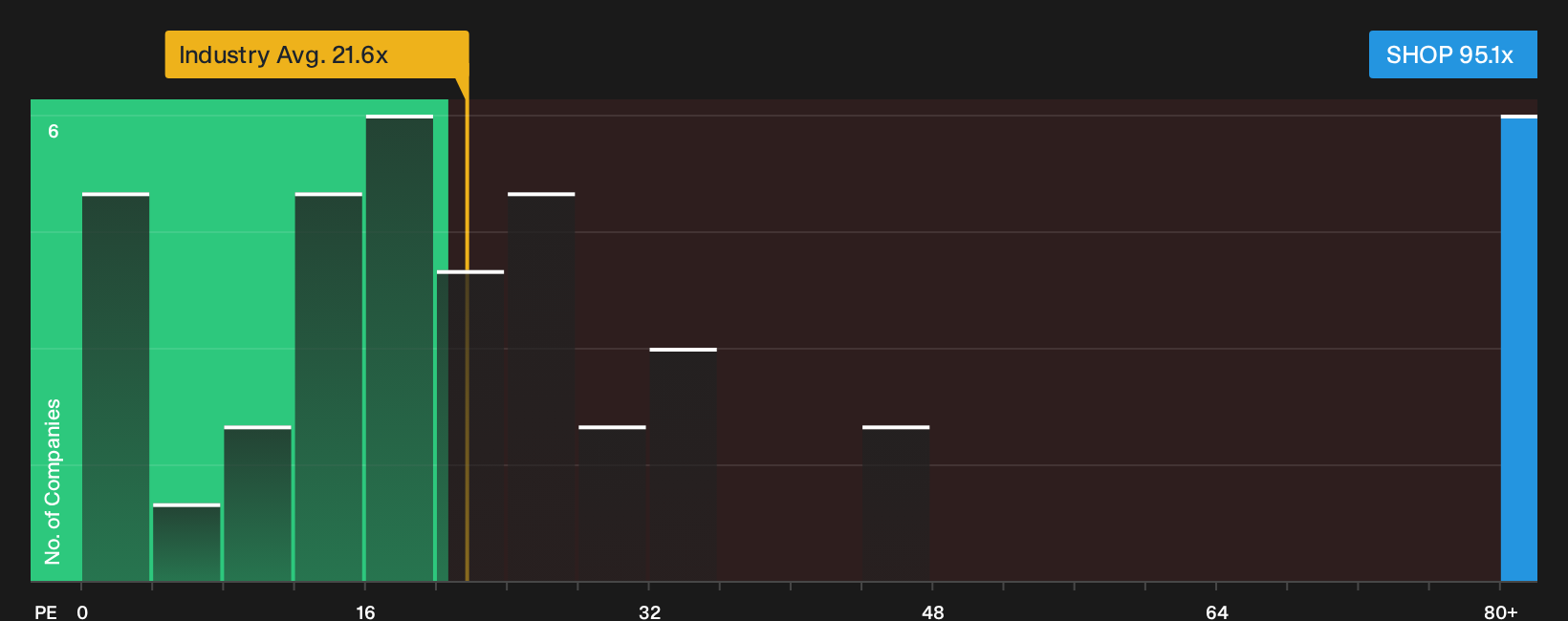
The community narrative leans on a $210.47 fair value, yet the current P/E of 95.1x tells a different story. That earnings multiple is far higher than the US IT sector at 21.6x, the peer group at 46.4x, and the fair ratio estimate of 55.1x that the market could move toward over time.
If sentiment cools, a move closer to that 55.1x fair ratio would mean a meaningful reset in what investors are willing to pay for each dollar of Shopify earnings. The question for you is whether future profit growth justifies staying at the top of that range or invites a closer look at valuation risk from here.
See what the numbers say about this price — find out in our valuation breakdown.
Next Steps
Sentiment around Shopify is clearly mixed, with strong long term returns set against valuation questions and pockets of concern in the latest quarter. Act promptly, review the underlying numbers and recent filings for yourself, then weigh the 2 key rewards and 2 important warning signs carefully before making any decisions.
Looking for more investment ideas beyond Shopify?
If Shopify has you rethinking your approach, do not stop there. Broaden your opportunity set with other focused stock ideas built from concrete fundamentals and clear data.
- Target potential mispricings by scanning a curated pool of quality companies that look out of favor using the 35 high quality undervalued stocks.
- Strengthen your income stream by searching for reliable payers and higher yields through the 4 dividend fortresses.
- Reduce downside surprises by filtering for companies with resilient finances with the 30 resilient stocks with low risk scores.
Have feedback on this article? Concerned about the content? Get in touch with us directly. Alternatively, email editorial-team@simplywallst.com