
Jensen Huang Defends Nvidia After Spy Investigation Report. Why I’d Buy the Dip.
Megaspeed, a cloud company in Singapore, buys Nvidia's (NVDA) chips. The New York Times reported that U.S. authorities are investigating a former Megaspeed executive. She's suspected of passing information to China and helping get around U.S. rules on chip sales. The investigation has been running since late 2024 and has now been handed to the Justice Department. On Oct. 29, Huang told Bloomberg that Nvidia's dealings with Megaspeed were “normal and not unusual.” He said that Nvidia has checked every one of its chips at Megaspeed and found that none of them had been sent to China illegally. He further noted that the executive doesn't even work there anymore. The very next day, NVDA stock fell about 4%, but that probably had more to do with a wider selloff in AI stocks.
Investors might wonder if any of this could hurt Nvidia's business. In my opinion, I don't think it will. As of this writing, Nvidia is among the two most valuable companies in the world, and its business continues to look stronger every quarter. In its last quarter, it made $96.2 billion in revenue, more than double what it made a year earlier. Most of that came from data centers, which made up $89 billion in revenue, up 117% year-over-year (YoY). For the current quarter, Nvidia expects about $108 billion in revenue, comfortably over the $104 billion analysts expected.
And here's the main reason I believe the investigation shouldn't hurt Nvidia's business. As I pointed out after its August report, Nvidia's $108 billion forecast doesn't even assume any data center compute revenue from China. So the business is already growing fast without selling its AI chips to China. That's why I think the dip may be a buying opportunity for long-term investors.
About Nvidia Stock
Nvidia makes the chips behind most of the world's AI. Its data center GPUs, networking gear, and software power the biggest AI systems out there. Its chips are so powerful that the U.S. limits their sale to China. This is why an investigation into a customer like Megaspeed draws so much attention. Founded in 1993, the company is headquartered in Santa Clara, California, and is led by co-founder and CEO Jensen Huang.
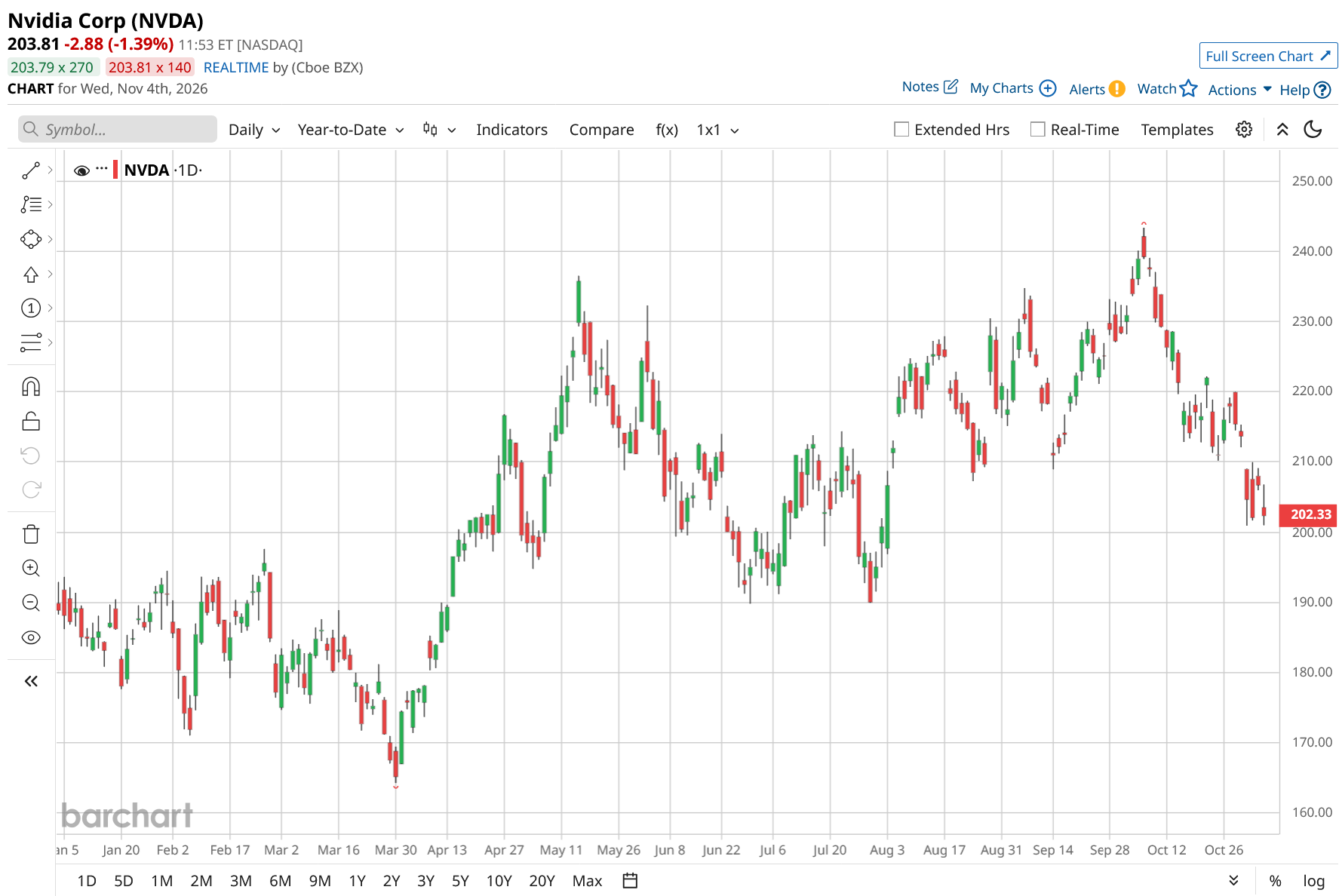
Nvidia's stock is up about 9% this year, a bit behind the S&P 500's ($SPX) 12% gain during the same period. In early October, it reached an all-time high of $243.37 but has dropped roughly 17% since. Part of that drop was due to worries about Big Tech's AI spending, and the Megaspeed investigation has added to the pressure.
Nvidia's stock already looked cheap this year compared to its historical norms, and the discount looks even bigger after the recent drop. Its forward price-to-earnings (P/E) of 21.70x sits about 48% below its 5-year average of 41.67x. Its forward price-to-sales (P/S) ratio of 11.85x is also about 39% below its average of 19.53x. That's a steep discount, especially for a company whose earnings are still growing fast. Analysts expect EPS to jump 95% this fiscal year and another 71% next year. At that pace, the P/E falls to just 12.70x by fiscal 2028. The balance sheet is a genuine strength as well. Nvidia holds $62.47 billion in cash against $38.86 billion in debt. Overall, I think the recent selloff in AI stocks and the investigation fears have pushed NVDA stock lower than the business deserves.
A Strong Quarter, a Stronger Outlook
In its second quarter of fiscal 2027, Nvidia delivered another strong report, beating analysts' consensus on both key metrics. Revenue beat estimates by about $4 billion, while adjusted EPS of $2.22 also surpassed the $2.10 analysts expected. Gross margins held at a healthy 75%, and Nvidia handed back about $26 billion to shareholders through buybacks and dividends.
Management expects even stronger growth ahead. CFO Colette Kress said revenue should grow about 70% next fiscal year, well above the roughly 45% analysts had expected. And that's with Nvidia still unable to make enough chips to meet demand.
What Do Analysts Expect for NVDA Stock?
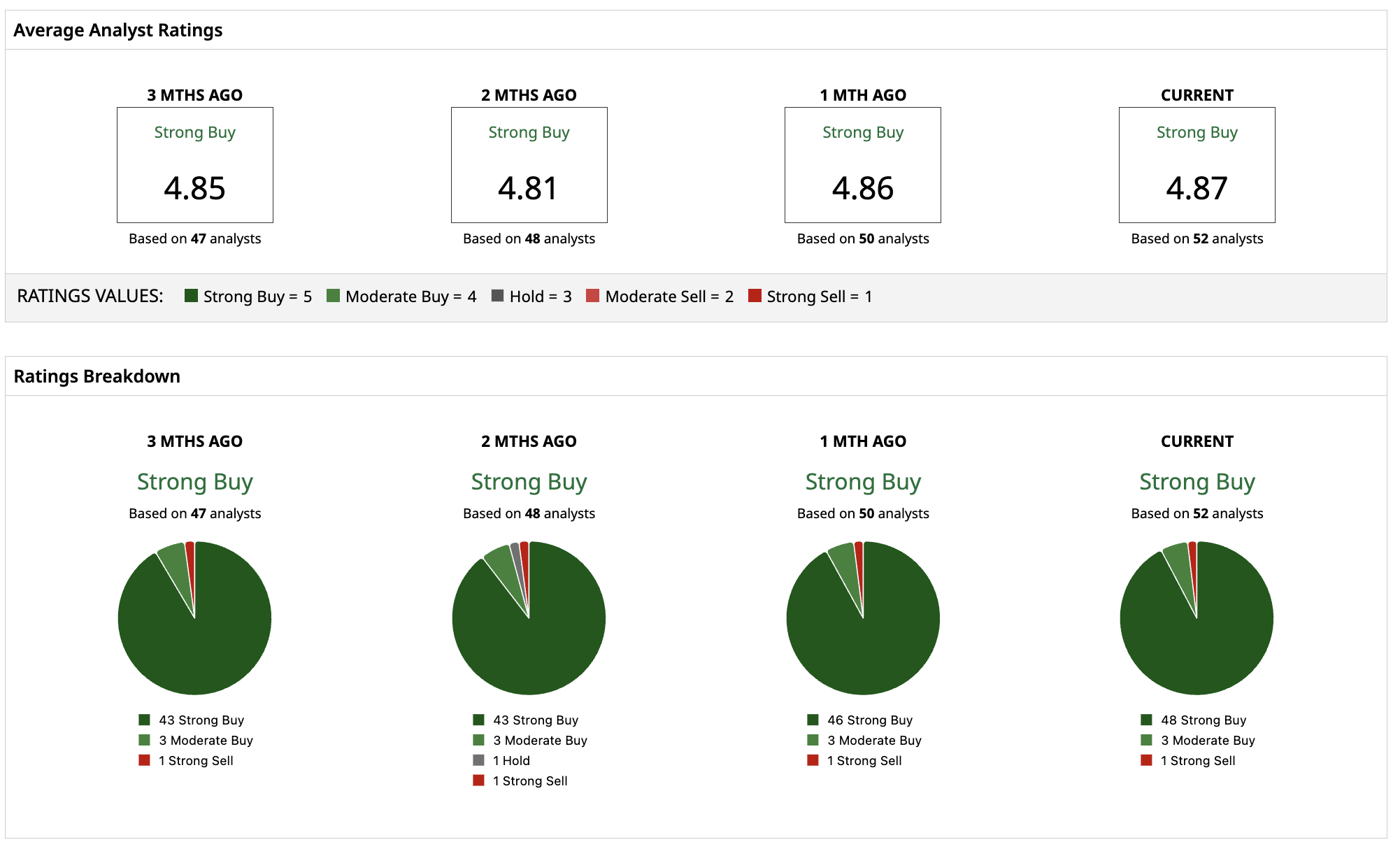
Based on 52 Wall Street analysts, NVDA stock holds a consensus “Strong Buy” rating with a mean price target of $326.65, indicating a healthy 62% upside. So, after the stock has dipped more than 15% while the business is still booming, analysts also largely see this as a buying opportunity for investors.
On the date of publication, Jabran Kundi did not directly have a position in any of the securities mentioned in this article. All information and data in this article is solely for informational purposes. For more information please view the Barchart Disclosure Policy here.