
The US trade deficit narrowed to 105 billion US dollars in September, and imports reached a record high
The Zhitong Finance App learned that the US Department of Commerce's Census Bureau and the Bureau of Economic Analysis jointly released a report showing that the US goods and services trade deficit in September was 105 billion US dollars, which was 700 million US dollars narrower than the 105.7 billion US dollars revised in August, down 0.7% from the previous month. The deficit in August was slightly revised up from the initial report of US$105.6 billion.
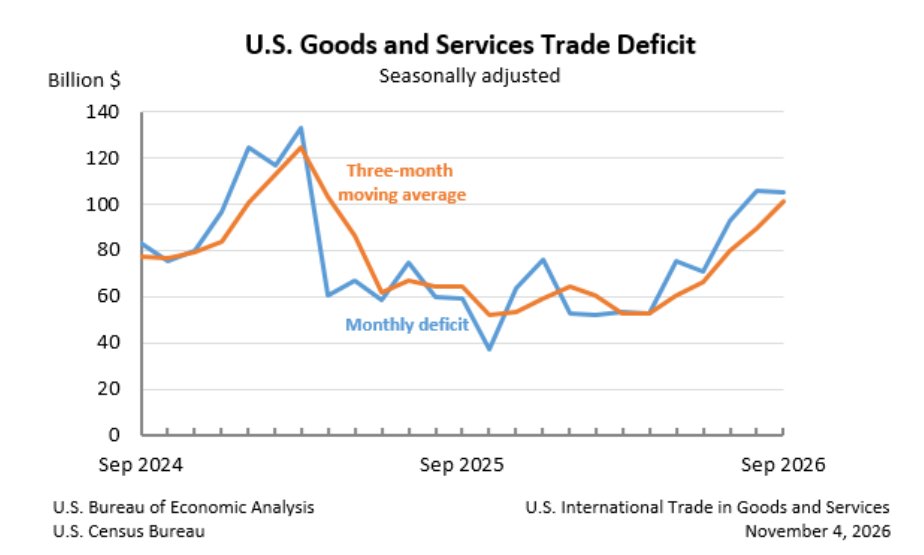
Exports in the same month were US$321.5 billion, up 1.9% month-on-month, the highest since May; imports amounted to US$426.6 billion, up 1.2% month-on-month, the highest since the series began to be compiled in 1992. The commodity deficit decreased by 700 million US dollars to 135.9 billion US dollars, and the service surplus decreased by less than 100 million US dollars to 30.9 billion US dollars.
The import side is dominated by capital goods. According to the report, imports of capital goods increased by 11.6 billion US dollars in September, including 7.6 billion US dollars for computers, 5.7 billion US dollars for computer accessories, and 1.2 billion US dollars for semiconductors; imports of consumer goods increased by 2.4 billion US dollars, pharmaceutical preparations increased by 2.9 billion US dollars; imports of industrial goods decreased by 3.7 billion US dollars, non-monetary gold decreased by 2.7 billion US dollars, and crude oil decreased by 1.3 billion US dollars. Export-side capital goods increased by 3.8 billion US dollars, food, feed and beverages increased by 1.9 billion US dollars, of which soybeans increased by 1.3 billion US dollars.
By country and region, the deficit with Taiwan Province of China increased by 3.6 billion US dollars to 21.9 billion US dollars, and imports increased by 4.2 billion US dollars; the deficit with the European Union increased by 3.2 billion US dollars to 14.2 billion US dollars; and the deficit with Canada narrowed by 2.7 billion US dollars to 4.4 billion US dollars.
The two sets of caliber are going in opposite directions. According to the Census Bureau's nominal scale, the commodity deficit widened 2.2% month-on-month in September, which is inconsistent with the direction of narrowing of the balance of payments. The difference is mainly due to adjustments in the balance of payments to non-monetary gold imports. At constant prices in 2017, the real commodity deficit widened by US$3.5 billion to US$119.5 billion, an increase of 3.0%; actual commodity exports increased by only 0.1%, while nominal commodity exports of the same caliber increased by 2.5%. The difference between the two mainly reflects price factors.
Although the deficit narrowed month-on-month, it was still the second highest since March 2025, only lower than August. On a year-on-year basis, the deficit in September was 76.9% larger than the 59.4 billion US dollars in the same period last year, exports increased 10.0% year on year, and imports increased 21.3% year on year; the cumulative deficit for the first nine months narrowed by 12.2% year on year.
The widening real commodity deficit means that net exports continued to be a drag in GDP accounting for the third quarter.