
Investors are hoping for a rebound at the end of the year, but Barclays warned that the midterm elections will not clear up the haze in the stock market; AI revenue and financing are the two mountains that are at the top
The Zhitong Finance App learned that investors who expect the US midterm elections to clear the obstacles to the stock market rebound at the end of the year may be disappointed. The biggest force currently suppressing the stock market — questions about the return of artificial intelligence (AI) and the cost of financing its construction — will not be solved by this election.
After experiencing a difficult October pullback, Wall Street increasingly sees Election Day as a potential catalyst for a rebound. But Alex Altmann (Alex Altmann), head of global equity tactical strategy at Barclays, believes this election is unlikely to change the fundamental issues driving recent market fluctuations.
“Nasdaq's decline of 10% was not due to midterm election risks,” Altman said in an interview. This round of correction was more driven by concerns about AI financing and revenue trajectory. While election uncertainty was a factor, it played only a minor role.
Initial reactions from investors have been positive. After the Democratic Party won a landslide victory in Congress and Trump said he would accept the election results, US stock index futures erased the decline and turned upward. The easing of uncertainty prompted investors to buy on dips.
“The market almost universally expects that the midterm elections will be an opportunity for emotional relief, allowing investors to rearrange their layout and welcome a beautiful 'Santa Claus' market, which will end successfully this year,” Altman said.
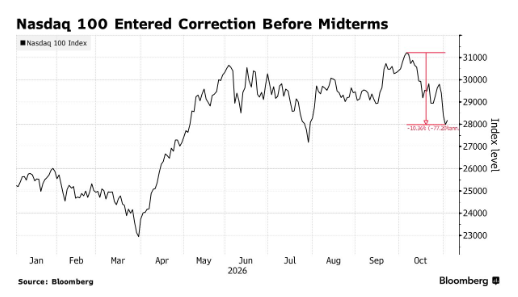
At the same time, he mentioned that although investors have previously reduced their exposure to stocks and left room to re-increase their positions, there aren't many trading days left this year, and the Thanksgiving and Christmas holidays usually bring thinner liquidity.
Admittedly, the election results could still have an impact on tech stocks — by increasing the possibility of actions at the state and federal levels to limit AI construction. Altman said this is the most direct channel for the midterm elections to influence AI transactions.
Take Texas, for example — data center developers are looking to build dozens of AI computing power parks in the state — Congressman James Tararico won the state's first Senate seat since 1994, and Gina Hinojosa was elected the first Democratic governor in more than 30 years. These victories raised the possibility of tightening construction regulations, and Inojosa repeatedly called for the suspension of data center development during the election campaign.
Altman said the importance of Texas is that it accounts for about a quarter of the total estimated data center construction.
Even so, the broader discussion around AI goes far beyond politics. Investors are still struggling with whether large-scale investments in AI infrastructure can generate sufficient revenue and how companies will finance these expenses.
“Currently, the two major drivers of the stock market are AI revenue cashout and AI financing pressure,” Altman said. These two problems are unlikely to be solved in the short term.
This makes the market vulnerable to further swings in sentiment, especially since AI is still a long-term investment narrative, and its ultimate return is difficult to measure.
“Everyone feels that the midterm elections are an event where short-term profits have cleared up. But is that really true for AI? I'm afraid not necessarily,” Altman said.