
Dine Brands’s (NYSE:DIN) Q3 2026 sales top estimates
Casual restaurant chain Dine Brands (NYSE:DIN) reported Q3 2026 results topping the market’s revenue expectations, with revenue up 15.1% year on year to $248.9 million. Its non-GAAP profit of $0.82 per share was 17.9% below analysts’ consensus estimates.
For more on Dine Brands, read our full research report, available free.
Dine Brands (DIN) Q3 2026 highlights:
- Revenue $248.9 million vs S&P analysts’ consensus estimates of $239.5 million (15.1% year-on-year growth, 3.9% beat)
- Adjusted EPS $0.82 vs S&P analysts’ consensus estimates of $1.00 (17.9% miss)
- Adjusted EBITDA $49 million vs analysts’ consensus estimates of $53.37 million (19.7% margin, 8.2% miss)
- Operating margin 13.3%, down from 15.9% in the same quarter last year
- Free cash flow margin 1.3%, down from 8.4% in the same quarter last year
- Locations 3,185 at quarter end, down from 3,374 in the same quarter last year
- Same-store sales were flat year on year, in line with the same quarter last year
- Market capitalization $447 million
"This quarter, Applebee's and IHOP both achieved positive growth due to our everyday value, menu innovation, culturally relevant marketing, and sharper operational execution,” said John Peyton, Chief Executive Officer of Dine Brands. “We're focused on supporting the future of our brands, including expanding our dual-brand program, improving our company-owned portfolio, and accelerating our remodel pipeline. We remain confident in the strategy we've laid out - building long-term value through consistent execution today and disciplined investment in our future growth."
Revenue growth
A company’s long-term revenue performance is one signal of its overall quality. Even a poor business can perform well for one or two quarters, but a high-quality one grows for years.
With $932.6 million in revenue over the past 12 months, Dine Brands is a mid-sized restaurant chain, which sometimes brings disadvantages compared to larger competitors benefiting from better brand awareness and economies of scale.
Dine Brands struggled to increase demand as its $932.6 million in revenue for the trailing 12 months was close to its revenue seven years ago. This was mainly because it didn’t open many new restaurants.
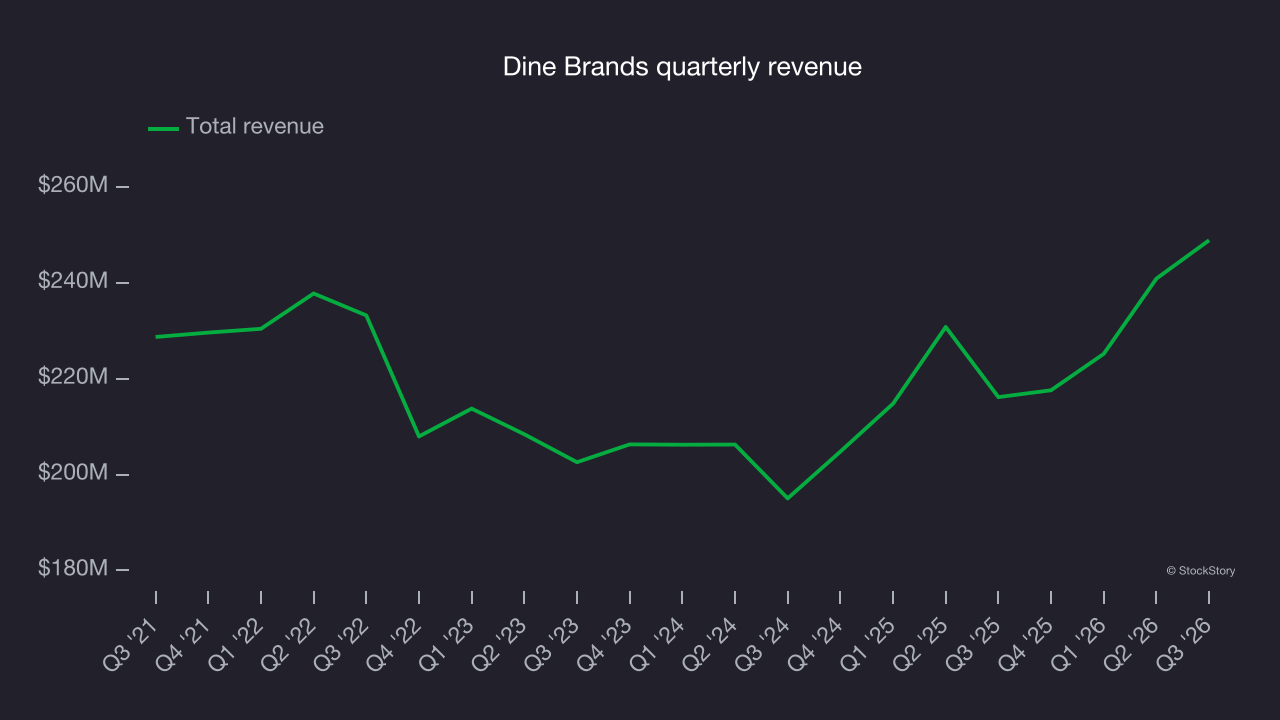
This quarter, Dine Brands reported year-on-year revenue growth of 15.1%, and its $248.9 million in revenue exceeded Wall Street’s consensus estimates by 3.9%.
Looking ahead, sell-side analysts expect revenue to grow 7.9% over the next 12 months, according to S&P, an acceleration versus the last seven years. This projection is above average for the sector and indicates its newer menu offerings will drive better revenue performance.
Restaurant performance
Number of restaurants
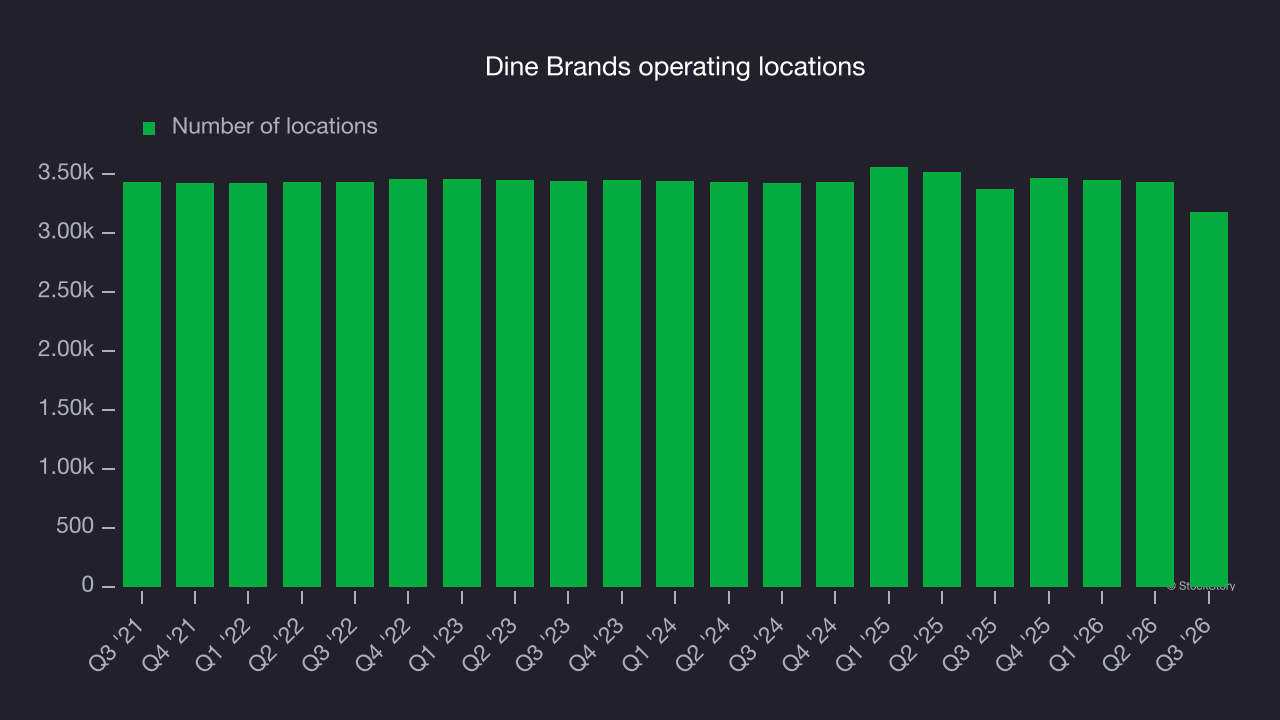
Dine Brands listed 3,185 locations in the latest quarter and has kept its restaurant count flat over the last two years while other restaurant businesses have opted for growth.
When a chain doesn’t open many new restaurants, it usually means there’s stable demand for its meals and it’s focused on improving operational efficiency to increase profitability.
Same-store sales
A company’s restaurant base only paints one part of the picture. When demand is high, it makes sense to open more. But when demand is low, it’s prudent to close some locations and use the money in other ways. Same-store sales is an industry measure of whether revenue is growing at those existing restaurants and is driven by customer visits (often called traffic) and the average spending per customer (ticket).
Dine Brands’s demand within its existing dining locations has barely increased over the last two years as its same-store sales were flat. This performance isn’t ideal, and any move by Dine Brands to open new restaurants to artificially boost revenue growth would warrant skepticism.
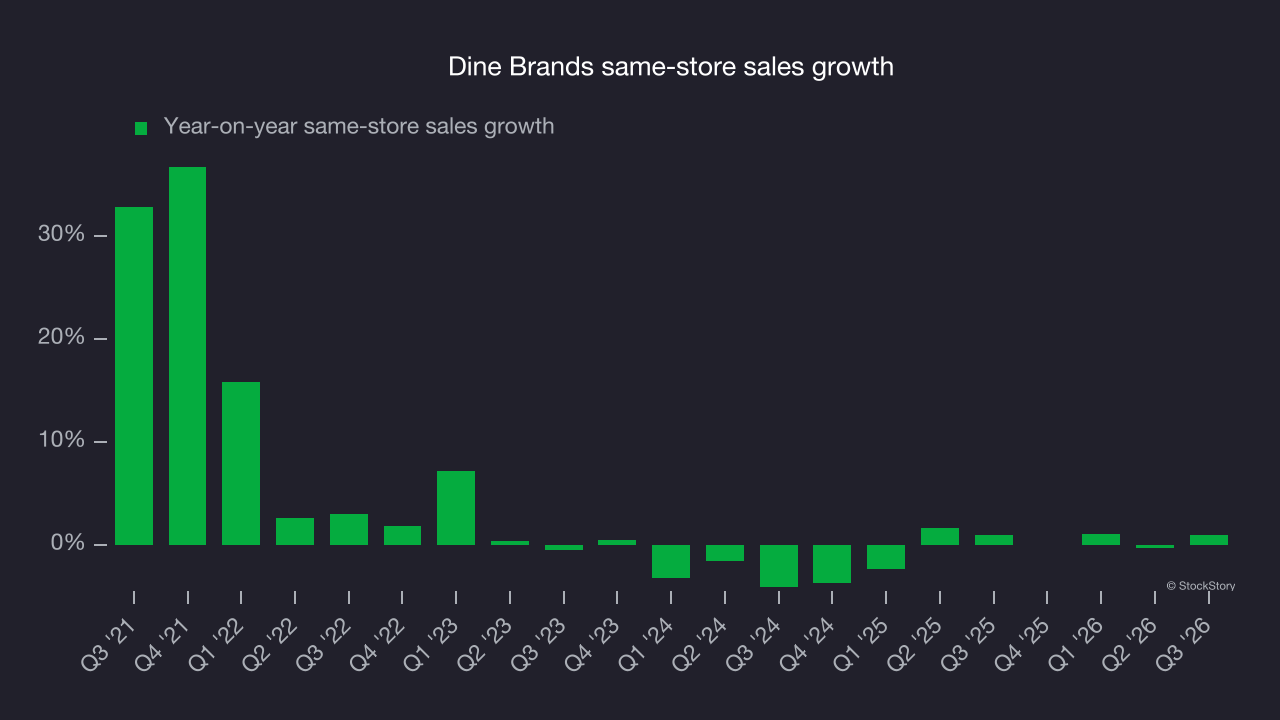
In the latest quarter, Dine Brands’s year-over-year same-store sales were flat. This performance was more or less in line with its historical levels.
Key takeaways from Dine Brands’s Q3 results
Dine Brands delivered a softer quarter despite revenue coming in well above analysts’ consensus estimates. Same-store sales met Wall Street’s expectations, but EBITDA and EPS missed estimates. Shares remained flat at $35.31 immediately after the results.
Is Dine Brands a suitable investment right now? The latest quarter matters when deciding whether to invest, but not as much as longer-term business quality and valuation. For more on Dine Brands, read the full research report here (it’s free).