
AI infrastructure financing front extended to Europe! Meta (META.US) launches Eurobonds, AI ambitions face major cash flow and credit tests
The Zhitong Finance App learned that Facebook and Instagram parent company Meta Platforms Inc. (META.US) announced plans to issue Eurobonds for the first time, highlighting that demand for AI computing power resources continues to explode as AI agents become popular around the world, the global trillion-dollar AI computing power infrastructure frenzy is still in full swing, and AI financing competition is crossing market and currency boundaries.
Meta recently launched its first Eurobond offering after completing $15 billion in debt financing, further extending the AI infrastructure financing front to Europe. Against the backdrop of the accelerated expansion of Muse AI smart applications developed by the company and technology giants continuing to invest in trillion-dollar computing power infrastructure, global financing competition is crossing market and currency boundaries. However, the speed of debt accumulation and the prospects for the return on investment to be realized also prompted investors to demand higher yield compensation.
Meta's current bond issuance once again reflects the core tension of the AI investment cycle — infrastructure expansion is still progressing, yet capital costs associated with AI infrastructure continue to rise. Even tech giants with AA credit qualifications are beginning to face bond yield pricing benchmarks closer to lower rated borrowers.
Meta launches its first Eurobond offering, and the AI financing race turns to Europe
Facebook's parent company Meta Platforms was first raised in euros and is expected to pay a generous yield. Meanwhile, the world's largest tech giants are racing to raise funds to support trillions of dollars in artificial intelligence computing power ambitions.
Facebook's parent company is accelerating its active shift to European investors after raising $15 billion in the US dollar bond market on Tuesday. Prior to the issuance of Eurobonds, large technology companies had just gone through one of the busiest bond issuance stages in history: since late last week, Meta, Microsoft, Oracle, and Alphabet have collectively raised nearly $57 billion.
Investors have recently become increasingly concerned about the speed of debt accumulation by hyperscale cloud computing companies, and are also raising broader questions about whether the trillion-dollar AI capital expenditure can be rewarded against the backdrop of significant negative overall free cash flows from big tech giants such as Google's parent company Alphabet and Amazon. These factors have been driving the comprehensive operating costs and capital costs of high-tech companies.
Alex Temple, global fixed income portfolio manager at Allspring Global Investments, said: “The current price is very cheap compared to credit ratings, so it's hard not to participate, but we are still cautious considering the continuing expansion financing needs next year.”
According to media reports citing information revealed by a person familiar with the matter, Meta's current Eurobonds are divided into six tiers, with terms ranging from more than four years to more than 38 years. The person who requested anonymity because he was not authorized to publicly discuss the transaction said that the initial pricing guide for shorter-term bonds was about 140 basis points higher than the median interest rate for term swaps, while the initial guideline for maximum term bonds was about 370 basis points higher.
According to Bloomberg Intelligence's latest estimates, these pricing levels mean that bond yields are closer to bonds with credit ratings several levels lower than Meta's AA rating. This isn't unique to Meta, as bond traders are pricing hyperscale cloud computing companies as a whole at the level of lower-rated borrowers.
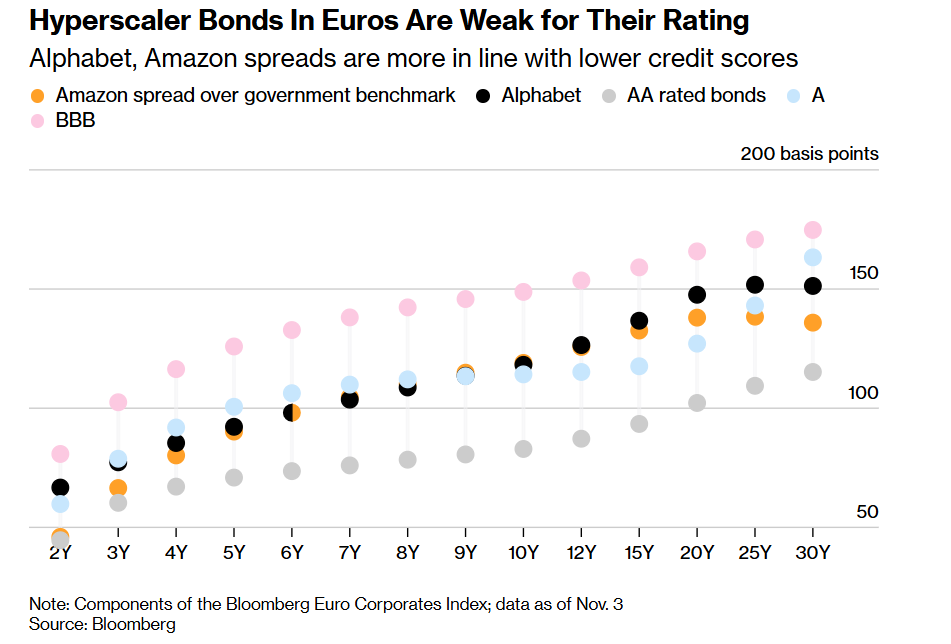
As shown in the chart above, the overall performance of the Eurobonds of the hyperscale cloud computing giants is weaker than the level corresponding to their “high-rated” investment-grade credit ratings — in particular, the interest spreads of Google's parent company Alphabet and Amazon are closer to those with lower credit ratings.
According to data compiled by Bloomberg, the spread on Eurobonds already issued by Alphabet and Amazon in the secondary market is significantly higher than the level usually corresponding to an AA rating. Over some longer periods, interest spreads even exceed the yield pricing range for lower-rated A-grade bonds, reflecting investors' unease about future financing needs.
Even so, the lower financing interest rates that Meta and its tech giants locked in earlier this year still provide additional financial support to bear the higher and more expensive AI financing costs now.
Al Cattermole, a senior fixed income portfolio manager from Mirabaud Asset Management, said, “If we include all of these companies' low coupon bonds and examine comprehensive financing costs, we will find that the company has the ability to pay the pricing prices associated with higher AI financing costs, so that new bonds can be successfully issued.”
This is the first time Meta has issued bonds outside of the local market. The maximum number of subscription orders submitted by investors for Tuesday's US dollar bond trading reached 58 billion US dollars. Citi and Morgan Stanley are responsible for the Eurobond deal, which is expected to be priced later on Wednesday.
Technology companies are returning to the market after suspending entry into the US high-rated bond market for three months, and investors are just becoming increasingly wary of the huge amount of money tech companies are investing in data centers, chips, and other infrastructure needed for AI. Microsoft issued 25 billion US dollars in bonds last week, breaking this empty issuance window period, after which Oracle issued 10 billion US dollars in bonds.
As this round of intensive debt issuance arrives, AI infrastructure construction is being scrutinized more strictly by investors and the political community. Outsiders are also questioning whether the Democratic Party, which has just won control of Congress in the US midterm elections, will treat large technology companies equally well. The growing dissatisfaction of voters with the large-scale AI data center construction process across the country is an important election issue in Ohio and other places; Republican Senator Jon Hurst lost the election in Ohio.
According to the latest estimates in the LPL Financial research report, interest spreads between AI-related companies and non-AI companies in the US investment-grade bond market have diverged in recent months.
In the past two years, almost every time a tech giant issued a new dollar bond, the average cost of debt financing increased. Higher energy prices are driving up government bond yields, putting another strain on the technology industry.
Adam Whiteley, head of global credit business at Insight Investment, said in an email comment that the bond supply of hyperscale cloud computing companies “poses more technical supply and demand pressure on specific industries, rather than a broader deterioration in the overall fundamentals of the credit market.”
AA ratings also have to pay higher spreads: AI financing pressure spreads rapidly to tech giants
Meta issued Eurobonds for the first time, highlighting that AI financing competition is crossing market and currency boundaries: the company just raised $15 billion through dollar bonds and then turned to Europe; Microsoft, Oracle, Alphabet, and Meta have issued a total of nearly $57 billion since late last week. The market is still willing to provide capital, but is demanding higher compensation — bonds from some AA tech giants have already been traded according to the spread of lower rated companies. The factors that determine the price of financing are extending from current profitability to future capital expenditure, cash flow gaps, and the scale of continuous debt issuance.
The stock market, on the other hand, was already pressured by revaluation ahead of schedule. The Nasdaq 100 index fell by about 6.7% in October, while SK Hynix and Samsung Electronics fell by about 20.2% and 16.2%, respectively. According to the latest closing and June closing highs, the Philadelphia Semiconductor Index and South Korea's KOSPI retreated by about 28% and 38% respectively, and the phased rebound has yet to bring an end to the technical bear market. The impact on individual stocks was also significant: Alphabet A shares fell by about 12.6% on October 29, the biggest one-day decline since listing; Intel fell by about 28.6% the next day, the worst performance since 1974.
The recent stock bond dynamics of AI Xinyun leader CoreWeave (CRWV.US), which is at the core of the “AI computing power sell-off storm” and the “AI bubble bursting argument”, have focused on revealing the most vulnerable link under high-leverage expansion: the cumulative decline in stock prices in October was about 37%; yields on some bonds rose to 15% to 16% in the middle of the month, and the five-year CDS once corresponded to an implied default probability of over 60%. This probability includes risk premium and recovery rate assumptions; it is not an actual default rate.
New cloud leaders such as CoreWeave and nScale are under pressure on comprehensive operating costs, including rising AI financing costs, mainly from AI computing power infrastructure construction and cash expenses to purchase GPUs, while power delivery, declining utilization rates, and customer payments are later realized; the more expensive the financing, the greater the cost of delayed revenue payment. CDS interest spreads or default protection costs for Meta, Amazon, and Alphabet are also driven by huge financing requirements and centralized hedging transactions, but it cannot be assumed that large platforms have the same credit market risks as the new cloud forces.
The stock market is looking for growth returns, and the bond market demands higher risk compensation
Facebook and Instagram parent company Meta entered the Eurobond market for the first time after completing $15 billion in debt financing, reflecting that the trillion-dollar AI infrastructure construction is driving the escalation of global capital competition. At the same time, stock market investors are anxiously awaiting growth data related to AI computing power infrastructure after production capacity is put into use, while bond investors demand that debt repayment risks during construction be fully compensated by yield.
Free cash flow data from some cloud computing giants turned negative, and the yield of new cloud corporate bonds such as CoreWeave and the risk of implied default in CDS rose sharply, prompting investors to re-measure the capital gap between computing power investment and cash return.
Funding pressure is also beginning to be reflected in the pricing of new bonds from high-rated tech giants: even with AA credit qualifications, Meta still needs to provide interest spread compensation closer to lower-rated borrowers. The market has not closed the door to AI financing, but is raising capital prices — whether the future strong growth expectations and potential led by AI agents can be transformed into a cash flow expansion path sufficient to cover construction investment, interest expenses, and continued financing needs is becoming a common constraint determining the speed of AI expansion and asset valuation.
During the Asian session on November 4, the 10-year US Treasury yield fell by about 5 basis points to 4.90%, which did not continue to rise unilaterally; however, the benchmark interest rate close to 5% combined with the widening credit spread will still raise the threshold for new financing. Existing fixed-rate bonds will not immediately increase the coupon burden; the pressure first spreads to new debt issuance, refinancing, and floating rate financing.
To a certain extent, this also explains the serious differences among Wall Street strategists over recent stock pricing between cloud computing giants and the new cloud forces. At a time when global technology stocks are plummeting, Daimo strategist Wilson believes that the retracement after the pressure on financing and liquidity has been absorbed may create a buying point. The latest shareholder letter from Pershing Square Inc. (Pershing Square), founded by billionaire and hedge fund legend Bill Ackman, shows that Wall Street hedge funds seem to pay too much attention to rising AI computing infrastructure construction costs and the associated AI financing costs, significantly underestimating the future long-term growth potential of large technology companies that invest heavily in artificial intelligence. Ackman emphasized that hedge funds have fully taken into account the current construction costs of hyperscale cloud vendors in their forecasts, so these companies are 'punished'; however, they are very limited in their expectations for future long-term growth in future revenue and profits that are likely to be brought about by these investments, or even a new round of revalued exponential growth.