
Did the Bank of England make a mistake? New research warns: UK interest rates have not reached a “restrictive” level at all, and the interest rate hike on Thursday will be the beginning of calibration
The Zhitong Finance App learned that a recent study shows that UK interest rates are not as strong as the Bank of England's previous judgment. This conclusion reinforces the reason for this week's interest rate hike.
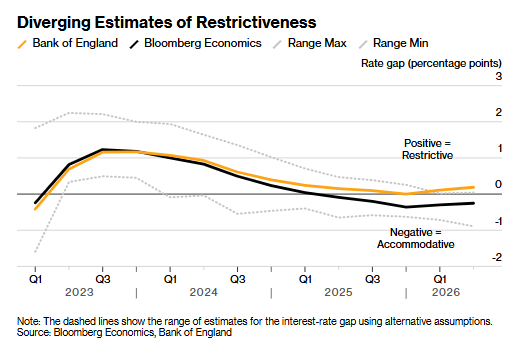
Bank of England officials have argued that at a time when the Iran conflict is driving up energy prices, monetary policy is already in a restricted range. However, an analysis found that current interest rates are likely to be close to a neutral level, which means that monetary policy is neither holding down inflation nor driving it up.
The study suggests that the Bank of England needs to act. Economists warn that inflation may rise above 4% at the beginning of next year — double the central bank's target level. The market generally expects that the Monetary Policy Committee will raise the benchmark interest rate by 25 basis points to 4% on Thursday. This will be the first rate hike in more than three years, but there is still uncertainty about the extent of the subsequent rate hike.
“Judging from economic trends, especially the performance of recent quarters, the Bank of England's policy stance has hardly suppressed aggregate demand and expenditure,” economists Simon Lloyd and Dan Hanson said. “Combined with the current inflationary environment, this requires policy recalibration. The means is to raise interest rates. We expect the first round of rate hikes to be implemented on Thursday and followed in February next year.”
After a series of data showed that the UK economy remained resilient in the face of energy shocks, market concerns that interest rates might not be high enough intensified. GDP unexpectedly achieved a third consecutive month of growth in August, making the Bank of England's forecast of 0.4% growth for the third quarter in September seem pessimistic. The labor market also appears to be stabilizing.
Several members of the Monetary Policy Committee who voted to keep interest rates at 3.75% in September argued that restrictive policies would help curb the risk of inflation. However, due to the resilience shown by the economy, its judgment that “idle production capacity continues to expand and policies are suppressing demand” has been questioned.
“Our judgment is that the UK economy is closer to the upper limit of non-inflationary growth, which also confirms that the central bank's current policy has a basically neutral impact on overall spending,” Lloyd and Hanson said.
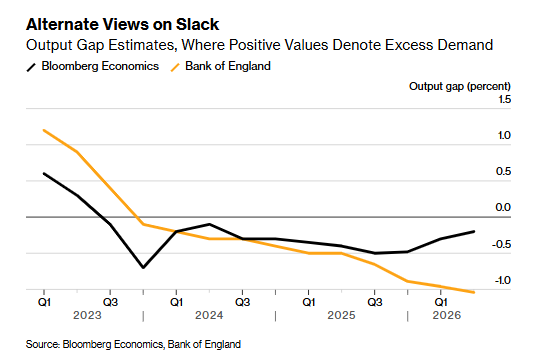
The key to this judgment is the output gap, that is, the difference between real GDP and the economy's potential production capacity. Higher demand will mean that idle production capacity is being exhausted; stronger supply means that the gap remains stable or widens, which is a more favorable situation for inflation.
“The Bank of England seems to have adopted the latter view,” Lloyd and Hanson said. “Although GDP continues to exceed expectations, the central bank continues to argue that idle production capacity in the economy continues to expand.”
According to the Bank of England's calculation and modelling of the output gap, interest rates appear to be having an austerity effect. “In contrast, our estimated level of excess demand has remained relatively stable. “Since the fourth quarter of 2023, the indicator has fluctuated within a range of only a few percentage points, and the end of the second quarter of 2026 was -0.2% of potential output,” Lloyd and Hanson said.