
Winmark (WINA) Stock Dropped, So What Is Driving Attention Now?
Winmark (WINA) has drawn fresh attention after a share price that closed at US$268.56 on 1 November 2026. The retailer’s franchise-focused model and leasing arm are now under closer investor review.
For context, Winmark’s share price has retreated sharply in recent months. The 30 day share price return is down 9.79% and the 90 day move is down 25.94%, contributing to a year to date share price decline of 33.13%, while the 5 year total shareholder return remains positive at 18.73%.
Scan beyond Winmark’s pullback and size up other beaten down quality plays using our curated list of 35 high quality undervalued stocks.
Winmark now trades only slightly below one intrinsic value estimate, yet sits at roughly a 51% discount to analyst targets. Is the market being too harsh on this franchise operator or spotting risks those models do not?
Price-to-Earnings of 23.1x: Is it justified for Winmark?
On earnings alone, Winmark trades on a P/E of 23.1x, which leaves the $268.56 share price looking rich compared to several reference points.
The P/E ratio compares what investors pay for each dollar of current earnings, which matters a lot for a mature franchisor with solid profitability. A richer multiple can signal that investors are comfortable paying up for the resale brands and equipment leasing arm, or that they are anchoring on past returns rather than the latest trends in profit growth.
For Winmark, that premium looks demanding. The P/E of 23.1x is higher than the US Specialty Retail peer average of 18.1x, so the stock is priced more aggressively than many direct comparables. It is also far above the estimated fair P/E of 9.9x; this level implies the market could move significantly lower if sentiment and assumptions revert toward that benchmark.
Explore the SWS fair ratio for Winmark.
Result: Price-to-Earnings of 23.1x (OVERVALUED)
Still, Winmark’s franchise reliant model leaves it exposed if store level economics weaken, and the separate equipment leasing arm adds another layer of cycle sensitivity.
Find out about the key risks to this Winmark narrative.
Another View: SWS DCF model points to mild undervaluation
The P/E story paints Winmark as expensive, yet the SWS DCF model tells a softer tale. On that measure, the $268.56 share price sits about 5.2% below an estimated fair value of $283.33, which frames the stock as modestly undervalued instead of stretched.
The two signals pull in different directions. One flags a rich earnings multiple; the other suggests the current quote is slightly under fair value. Which lens do you trust more for a franchisor with slow profit growth but strong revenue forecasts?
Look into how the SWS DCF model arrives at its fair value.
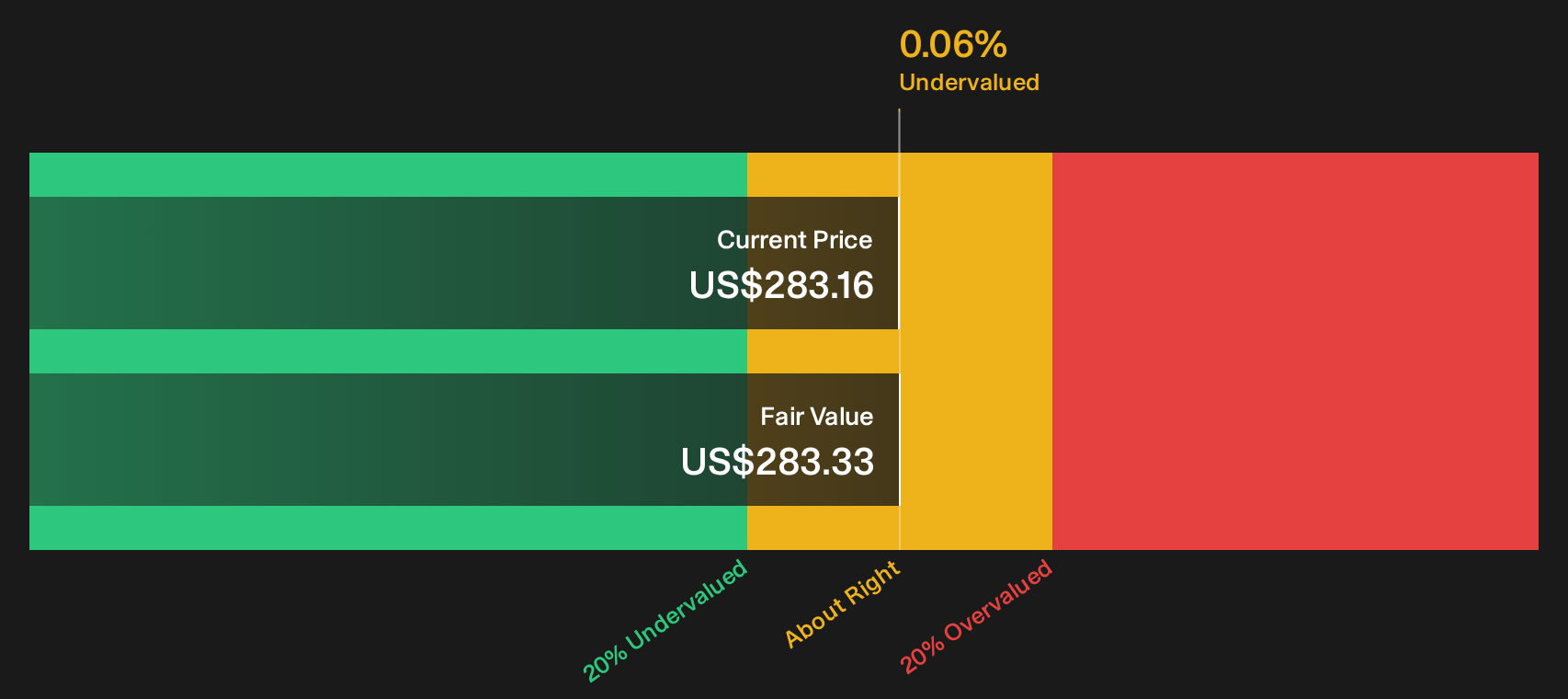
Simply Wall St performs a discounted cash flow (DCF) on every stock in the world every day (check out Winmark for example). We show the entire calculation in full. You can track the result in your watchlist or portfolio and be alerted when this changes, or use our stock screener to discover 35 high quality undervalued stocks. If you save a screener we even alert you when new companies match - so you never miss a potential opportunity.
Next Steps
Mixed signals on Winmark’s valuation and sentiment can make the picture feel messy. This is exactly why you should review the data yourself and decide how the trade off between potential upside and risk sits for you by weighing our 3 key rewards and 4 important warning signs
Looking for more investment ideas beyond Winmark?
If Winmark has you reassessing your watchlist, do not stop here. Fresh opportunities often emerge where pricing, quality and risk look out of sync.
- Target reliable income potential by scanning companies with resilient payouts and balance sheets through our 4 dividend fortresses.
- Spot resilient businesses where quality and downside risk look better balanced using the 30 resilient stocks with low risk scores.
- Hunt for underfollowed prospects with strong fundamentals by running the 19 high quality undiscovered gems.
Have feedback on this article? Concerned about the content? Get in touch with us directly. Alternatively, email editorial-team@simplywallst.com