
3 US LNG Stocks With Infrastructure Tied To Rising Export Demand
US liquefied natural gas is moving from a niche export story to a long-term pillar of global energy trade, and QatarEnergy’s push to lock in US volumes shows how serious that shift has become. That kind of buying interest can reshape which businesses gain, which stall and which get left behind. This article walks through three US LNG export and infrastructure stocks exposed to that news so you can judge where the risk and potential reward may sit.
The three LNG stocks covered below are just a starting sample, and the full screen surfaced 10 more companies with equally detailed stories that are not included in this article.
If you want to identify potential higher conviction ideas quickly, head straight to the US Liquefied Natural Gas (LNG) Export & Infrastructure Stocks screener to filter, analyze, and focus your LNG watchlist.
Chesapeake Utilities (CPK)
Overview: Chesapeake Utilities delivers regulated and unregulated energy, primarily natural gas distribution and transmission, with propane, electric and related services across several US regions.
Operations: The business generates about US$750 million from Regulated Energy, US$276 million from Unregulated Energy and the balance from other US operations.
Market Cap: US$3.4b
Chesapeake Utilities matters in an LNG-focused screen because its pipes, storage and related assets sit where higher US gas flows can show up first, giving investors indirect exposure to LNG-linked demand through long-lived utility-style infrastructure.
"Large regulated transmission and infrastructure projects, including the WRU LNG storage facility, Delmarva Regional Enhancement, Accomack County expansion and the US$1.2 billion Florida Energy Pathway pipeline that is backed by nearly 250,000 dekatherms per day of firm commitments, are expected to add material incremental gross margin in 2026 and 2027 and beyond and feed into higher earnings."
What really matters for Chesapeake Utilities now is how one quiet funding and execution pressure ultimately shapes those future margin expectations.
If that pressure is what you are weighing, read the full narrative for Chesapeake Utilities to see how funding risk, execution and LNG exposure intersect for Chesapeake Utilities.

UGI (UGI)
Overview: UGI is a diversified energy distributor that supplies propane, LPG, natural gas and electricity, supported by extensive storage and pipeline infrastructure linked to LNG flows.
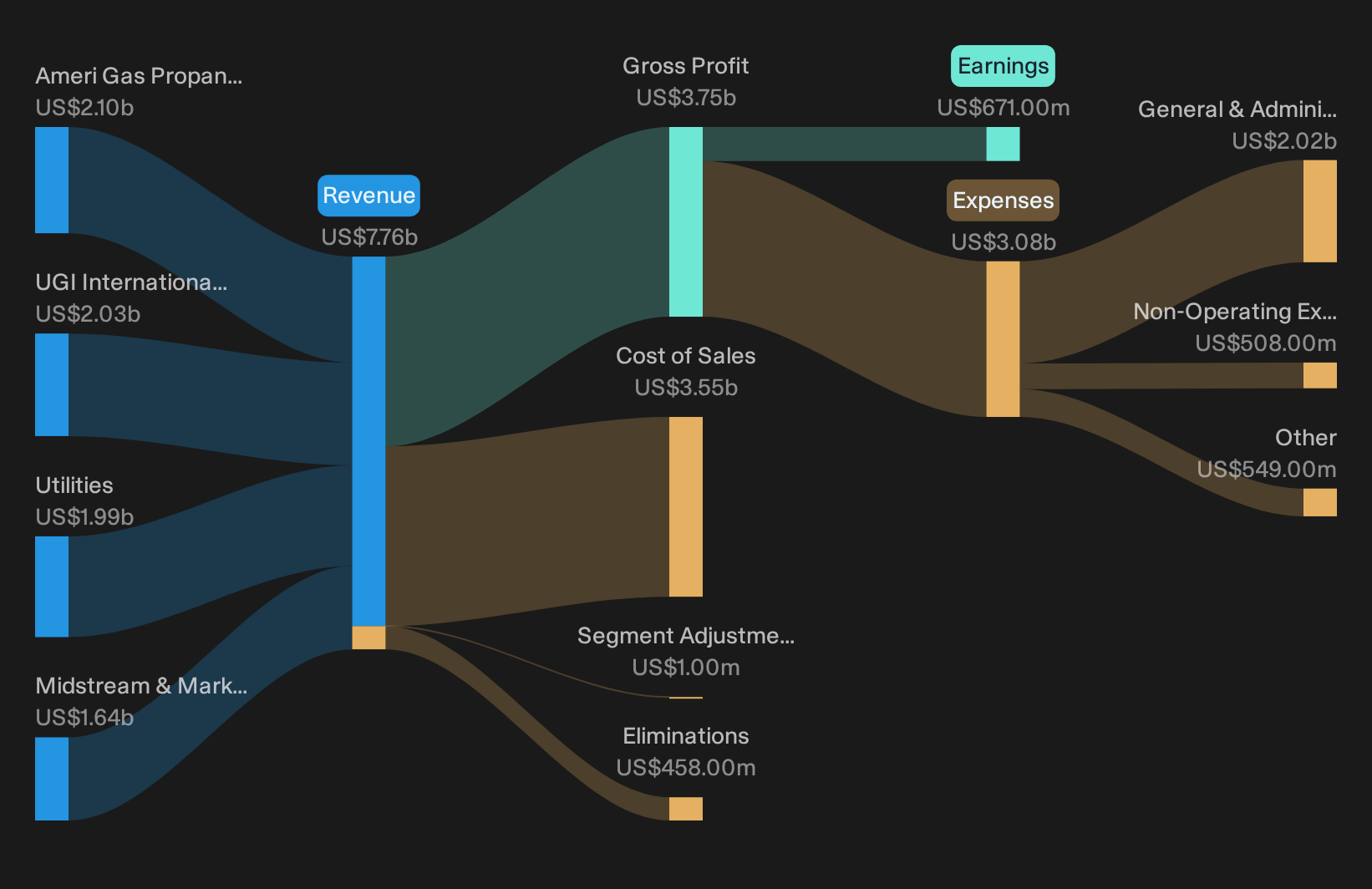
Operations: UGI generates about US$2.1b from AmeriGas Propane, US$2b from UGI International, US$2b from Utilities and US$1.6b from Midstream & Marketing.
Market Cap: US$8.3b
UGI matters in this LNG-focused screen because its regulated gas utilities, midstream pipes and liquefaction and storage assets sit close to the demand that LNG trade can create. This ties everyday retail and industrial energy use to global cargo flows.
"Implementation of the Pennsylvania gas rate settlement that phases in a US$65 million annual revenue increase between October 2026 and October 2027, raises the residential customer charge to US$20 by 2027, and introduces a Weather Normalization Surcharge pilot can support steadier UGI utility revenue and earnings visibility through at least early 2029."
A key factor that could reshape the UGI story from here is how the unresolved balance between funding costs and future LNG-linked demand is ultimately resolved.
If that balance is what you are trying to size up, the full narrative for UGI explains how LNG exposure, funding costs and regulatory shifts could be decoupling UGI’s story.
Targa Resources (TRGP)
Overview: Targa Resources runs a large North American midstream network that moves and processes natural gas and liquids linked to LNG export flows.
Operations: Targa Resources generates about US$6.6b from Gathering and Processing and roughly US$13.8b from Logistics and Transportation, after corporate eliminations.
Market Cap: US$63.2b
Targa Resources matters for this LNG-focused list because its Permian gas and NGL pipes, plants and export-facing assets help move US molecules toward Gulf Coast terminals that global buyers increasingly depend on.
"Strong growth in natural gas and NGL volumes across the Permian remains a live driver as Targa Resources reports record Permian inlet volumes of 7.2 billion cubic feet per day and continues to add new plants like Copperhead I and II, Yeti I and II, Roadrunner III and East Driver."
What investors really need to watch is how one funding and execution trade off ultimately filters through to margins and LNG-linked export demand.
That trade off is exactly where the story sharpens in the full narrative for Targa Resources, which unpacks how Targa Resources’ build out could accelerate or mask future LNG upside.

Seeking Alternatives Beyond LNG?
Fresh ideas move first. By the time every investor spots a breakout, early momentum has often flown. Scan these curated lists now, while it matters, and get in early.
- Spot income workhorses with yields that could steady your portfolio and still keep upside on the table by reviewing the 4 dividend fortresses.
- Chase expanding themes before they get crowded by scanning the 53 AI infrastructure stocks that zeroes in on builders behind the current AI and data boom.
- Track potential defensives while prices are still dropping or flat by checking the 30 resilient stocks with low risk scores that highlights resilient balance sheets and lower risk profiles.
Have feedback on this article? Concerned about the content? Get in touch with us directly. Alternatively, email editorial-team@simplywallst.com